Stockpyl
Stockpyl is a free, open-source Python package for inventory optimization and simulation.
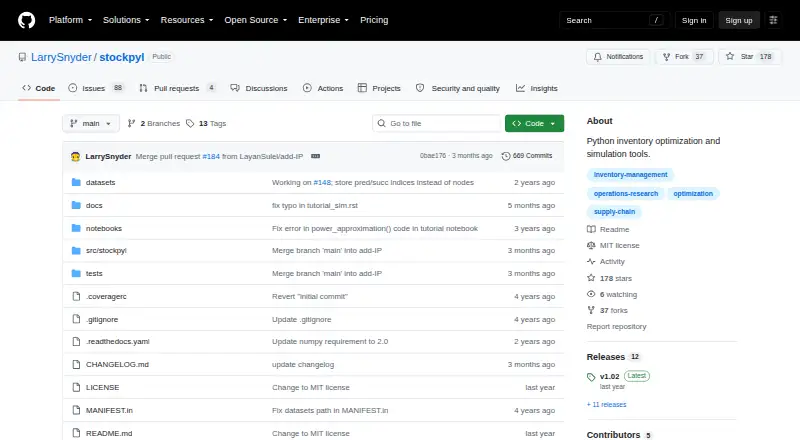
What Stockpyl is
Stockpyl is a free, open-source Python package for inventory optimization and simulation. It implements single-node approaches including economic order quantity, newsvendor, and Wagner-Whitin models, as well as optimization algorithms for multi-echelon stochastic-service and guaranteed-service systems. The package also supports simulation of multi-echelon inventory systems. Its documented methods include dynamic programming for Wagner-Whitin and finite-horizon stochastic inventory problems, along with algorithms for serial networks and acyclical guaranteed-service systems. Stockpyl is distributed through PyPI and requires Python v3.7 or later; installation uses `pip install stockpyl`. The project is released under the MIT License and credits Lawrence V. Snyder as its author. Its documentation includes tutorials and API modules covering optimization, simulation, and supply-chain data structures. The listed platforms are API and Linux. For questions or problems, the project directs users to GitHub Issues, with email as an alternative. PyPI classifies it under education, office/business, and scientific/engineering topics.
Good
- Free and released under the MIT License.
- Includes single-node and multi-echelon inventory models.
- Supports multi-echelon inventory simulation.
- Documentation covers tutorials and API modules.
- Available through PyPI.
Watch out
- Requires Python v3.7 or later.
- Listed platforms are API and Linux.
- Support is directed to GitHub Issues or email.
Who it suits
Stockpyl suits Python users working on inventory optimization or simulation, including learners and scientific or engineering users. It is relevant to people modeling single-node or multi-echelon inventory systems.
Verdict
Stockpyl provides a broad set of inventory models and simulation tools as an open-source Python package. Its Python requirement and technical workflow make it a fit for users comfortable working with Python.
Plans and prices
From Stockpyl's own pricing page, checked 4 Oct 2026.
| Plan | Price | What it gives you |
|---|---|---|
| Stockpyl | Free | Open-source Python package · MIT License |
The facts
Each one read from Stockpyl's own pages, with the date it was checked.
What it does
- Audience
- PyPI classifies the project under education, office/business, and scientific/engineering topics.checked 4 Oct 2026
- Distribution
- The installation guide says Stockpyl is available on PyPI and installs with `pip install stockpyl`.checked 4 Oct 2026
- Documentation
- The project links to documentation covering tutorials and API modules for optimization, simulation, and supply-chain data structures.checked 4 Oct 2026
- License
- The project describes itself as open-source and released under the MIT License.checked 4 Oct 2026
- Multi-echelon optimization
- It includes multi-echelon inventory optimization algorithms for stochastic-service and guaranteed-service models.checked 4 Oct 2026
- Network models
- It documents algorithms for serial systems and acyclical guaranteed-service systems.checked 4 Oct 2026
- Optimization methods
- Its documented methods include dynamic programming for Wagner-Whitin and finite-horizon stochastic inventory problems.checked 4 Oct 2026
- Purpose
- Stockpyl is a Python package for inventory optimization and simulation.checked 4 Oct 2026
- Python requirement
- The installation guide requires Python v3.7 or later.checked 4 Oct 2026
- Simulation
- It has features for simulating multi-echelon inventory systems.checked 4 Oct 2026
- Single-node models
- It implements economic order quantity, newsvendor, and Wagner-Whitin inventory models.checked 4 Oct 2026
- Support
- The project directs users to GitHub Issues for feedback and problems, with email as an alternative.checked 4 Oct 2026
The company
- Maker
- The package credits Lawrence V. Snyder as its author.checked 4 Oct 2026
The full review of Stockpyl
Stockpyl suits analysts and developers who want to build inventory models in Python, from single-node decisions to multi-echelon systems. Its strongest case is a focused, MIT-licensed toolkit with both optimization and simulation; its trade-off is a technical workflow rather than a ready-made business application.
Overview
Stockpyl brings several established inventory approaches into one Python package: economic order quantity, newsvendor, and Wagner-Whitin models, plus multi-echelon optimization and simulation. That range makes it useful for comparing model types without switching tools, particularly in education, business analysis, or scientific and engineering work.
Installation is through PyPI using pip install stockpyl, and requires Python v3.7 or later. The MIT License permits open-source use. Tutorials and API documentation cover optimization, simulation, and supply-chain data structures. For problems or feedback, the project points users to GitHub Issues, with email as another route; this suits users able to work through a software-project support channel.
Key features
Single-node and multi-echelon models
Alongside economic order quantity, newsvendor, and Wagner-Whitin methods, Stockpyl includes multi-echelon optimization for stochastic-service and guaranteed-service models. Safety stock optimization is supported as well. The breadth is valuable when the work calls for comparing inventory formulations, but users need to be comfortable expressing that work through a Python package.
Optimization and simulation
Documented methods include dynamic programming for Wagner-Whitin and finite-horizon stochastic inventory problems. The package also simulates multi-echelon inventory systems, giving analysts both optimization methods and a way to examine system behavior in simulation. Its network algorithms cover serial systems and acyclical guaranteed-service systems, making those structures a particular fit rather than implying support for every possible network design.
Pricing
Stockpyl is free: the Stockpyl plan costs free and is an open-source Python package under the MIT License. There is no paid tier to trade features against, so the main cost is working within the Python environment and the models the package provides. The project does not state seat or usage quotas.
Platforms
Stockpyl is listed for API and Linux use. It installs with pip and requires Python v3.7 or later, so it is best suited to Linux or API workflows where Python is already part of the environment, not readers looking for a conventional desktop inventory interface.
Who it's for
Choose Stockpyl if you are an analyst, developer, student, or researcher who wants inventory optimization and simulation methods inside Python, and values an open-source MIT-licensed package. Look elsewhere if your priority is a packaged business tool with a non-technical user workflow or commercial support.
Pros and cons
- Pros: Covers EOQ, newsvendor, Wagner-Whitin, and several multi-echelon methods, useful for comparing inventory models in one package.
- Pros: Combines optimization with multi-echelon simulation, supporting both model-solving and system-behavior analysis.
- Pros: Free and MIT-licensed, with tutorials and API documentation for the core modules.
- Cons: Requires Python v3.7 or later and a Python-oriented workflow, which rules it out for users seeking a turnkey business application.
- Cons: Support is routed through GitHub Issues or email rather than a stated dedicated commercial support service.
Alternatives
Inventory Optimization Software is the broader category to browse if you want to compare tools beyond a Python package.
ZebraDesigner is a paid option with a free plan and free trial, and is a better match when barcode label and tag design and printing for Zebra Link-OS printers are the priority.
Creo is a paid design product with floating licensing, so consider it when organizational users need a shared concurrent license rather than inventory modeling in Python.
Manhattan Active Inventory Replenishment is a paid alternative for readers looking for an inventory replenishment product rather than an open-source Python package.
Bluemingo Production Planning & Scheduling has custom pricing and is an option to consider when production planning and scheduling is the focus.
E2open Planning has custom pricing; consider it as another paid planning alternative.
GAINS has custom pricing and is another paid option for readers comparing inventory software.
Logility DemandAI+ has custom pricing and is another paid planning alternative.
4R Systems Intelligent Inventory Optimization has custom pricing and is another paid option to compare for inventory optimization.
Verdict
Stockpyl is a strong choice for Python-comfortable analysts and developers who need established inventory optimization methods plus multi-echelon simulation without a license fee. Its technical workflow is also the decisive reason to look elsewhere: users who need a conventional business application should compare commercial inventory tools instead.
Alternatives to Stockpyl
- 1

Flowlity
WebAPI6.9From €249 a month - 2
Anaplan
AndroidiOSWebAPI6.5 - 3

o9 Digital Brain
AndroidiOSWebAPI6.5 - 4
supplychainpy
Free planAPILinuxmacOSSelf-hosted6.4Free plan - 5
StockTrim
WebAPI6.3From $298 a month - 6
buffers.ai
Web6.1From $25 a month