
RelativityOne
RelativityOne is a vendor-cloud platform for legal work, including litigation, investigations, and other legal data challenges.
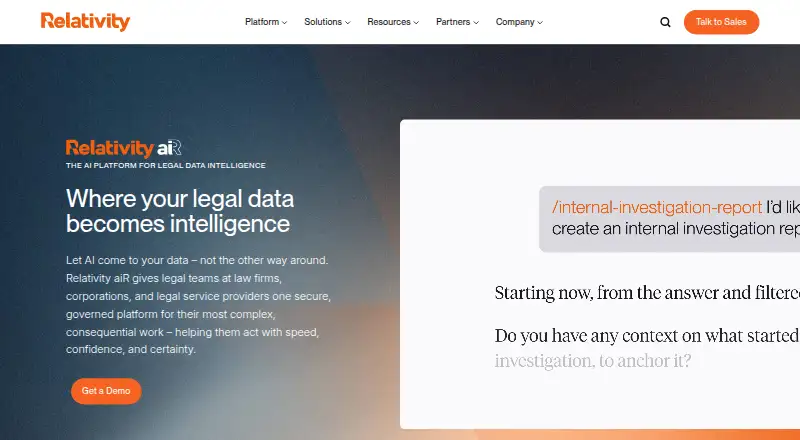
What RelativityOne is
RelativityOne is a vendor-cloud platform for legal work, including litigation, investigations, and other legal data challenges. It supports e-discovery from collection through production, as well as review of emails, spreadsheets, chats, prompt-and-response conversations, and PDFs. Its tools include a native file viewer, email threading, and automated redaction; production options include TIFF, text, metadata, load files, and native files with placeholders. Administrators can manage permissions for users, system administrators, workspaces, and individual objects such as views, tabs, and fields. Security Center is included. Relativity says several AI capabilities are included with committed data volume, without separate AI licenses or per-user fees; some other products are licensed separately. Flexible licensing is pay as you go or based on one- or three-year commitments, with pricing on request. The platform supports web, Windows, macOS, iOS, and API access, and customers can choose data location in 17 countries. It supports Windows and Mac OS, but not Linux-based devices or mobile browsers; mobile-device use requires its app.
Good
- Supports e-discovery from collection through production.
- Includes native file viewing and email threading.
- Automated redaction is supported.
- Includes Security Center.
- Data location can be chosen in 17 countries.
Watch out
- Pricing is on request.
- No free plan.
- Does not support Linux-based devices or mobile browsers.
- Some products are licensed separately.
Who it suits
RelativityOne is intended for law firms, corporations, and legal service providers handling litigation, investigations, or e-discovery. It suits users who need document review and production workflows.
Verdict
RelativityOne covers legal data review and e-discovery through production, with controls for permissions and data location. Check its supported-device limits and request pricing to assess fit.
Plans and prices
From RelativityOne's own pricing page, checked 15 Oct 2026.
| Plan | Price | What it gives you |
|---|---|---|
| Relativity aiR subscription | Priced on request | Data-volume commitment · AI capabilities included · Specialized add-ons licensed separately · 24/7 global support · Pay as you go, or one- or three-year commitment |
| RelativityOne | Priced on request | AI capabilities included with committed data volume · Data Breach Response, Translate, FOIA, and Legal Hold licensed separately · Flexible licensing: pay as you go, or commit for one or three years. |
The facts
Each one read from RelativityOne's own pages, with the date it was checked.
What it does
- Access control
- RelativityOne lets administrators manage permissions for users, system administrators, workspaces, and individual objects such as views, tabs, and fields.checked 30 Sep 2026
- AI
- The pricing page says Relativity claiR, Assist, aiR Review, Privilege, and Case Strategy are included with committed data volume, with no separate AI licenses or per-user fees.checked 30 Sep 2026
- AI capabilities
- Assist, aiR Review, Privilege and Case Strategy are included with committed data volume without separate AI licenses or per-user fees.checked 15 Oct 2026
- Analytics
- Built-in analytics include email-thread visualization, near-duplicate detection and other analysis tools.checked 15 Oct 2026
- API
- The REST API lets applications interact with Relativity resources over HTTP for mobile, web and cross-platform integrations.checked 15 Oct 2026
- Collection
- Collect and Purview Sync provide collection and Microsoft Purview eDiscovery connectivity.checked 15 Oct 2026
- Customer lockbox
- Customer Lockbox can restrict workspace access by Relativity employees and system administrators and generates alerts when access controls change.checked 15 Oct 2026
- Data location
- Relativity says RelativityOne is available in 17 countries and lets customers choose where their data lives.checked 30 Sep 2026
- Documentation
- Relativity publishes extensive product documentation organized by workflow, product and AI capability, plus separate developer documentation.checked 15 Oct 2026
- Document review
- The platform supports review of emails, spreadsheets, chats, prompt-and-response conversations, and PDFs.checked 30 Sep 2026
- E-discovery
- It supports the e-discovery process from collection through production.checked 30 Sep 2026
- Installer
- Staging Explorer is downloadable as either an EXE or MSI and requires local administrator rights or Group Policy deployment on Windows.checked 15 Oct 2026
- Integrations
- Relativity exposes an App Hub and partner ecosystem, and supports Microsoft Purview integration.checked 15 Oct 2026
- Intended users
- Relativity identifies law firms, corporations, and legal service providers as users of RelativityOne.checked 30 Sep 2026
- Legal hold
- Legal Hold provides repeatable processes for preserving information and issuing holds.checked 15 Oct 2026
- Licence
- Relativity software is proprietary, distributed under written licence agreements with restrictions on copying, modification, reverse engineering and derivative products.checked 15 Oct 2026
- Limit: complexity and learning curve
- Reviewers report that extensive configuration and many menus can overwhelm new users and often require specialist expertise or training.checked 15 Oct 2026
Where it runs
- Browser and OS limits
- RelativityOne supports Windows and Mac OS, but not Linux-based devices or mobile browsers; mobile-device use requires its mobile application.checked 30 Sep 2026
- Browser support
- Supported desktop browsers are current Chrome, Firefox and Safari releases plus Chromium Edge 79 or later; Internet Explorer is unsupported.checked 15 Oct 2026
- Custom applications
- Organizations can build custom applications with Relativity Dynamic Objects, the Application Deployment System and custom code.checked 15 Oct 2026
- Limit: mobile app gaps
- Apple reviewers complain that the iOS app cannot play MP4 files, lacks saved-search functionality and can be difficult to log into.checked 15 Oct 2026
The company
- Founded
- Relativity’s LinkedIn company information describes continuous growth since its founding in 2001.checked 15 Oct 2026
- Headquarters
- Chicago, Illinois, United Stateschecked 23 Sep 2026
- Headquarters and size
- LinkedIn lists Relativity as privately held, headquartered in Chicago, with 1,001–5,000 employees.checked 15 Oct 2026
The full review of RelativityOne
Overview
RelativityOne is a cloud platform for e-discovery and other legal data work, aimed at law firms, corporations and legal service providers. Its end-to-end review workflow, granular permissions and choice of data location make it a strong fit for complex matters; custom pricing and restrictions on mobile and Linux access make it less suited to teams seeking a broadly accessible, self-service tool.
Key features
RelativityOne supports e-discovery from collection through production, with a native file viewer, email threading and automated redaction. Review covers emails, spreadsheets, chats, prompt-and-response conversations and PDFs, and production can include TIFF, text, metadata, load files, or native files with placeholders. That breadth suits matters with varied evidence and formal production needs; teams should still assess whether the workflow and pricing fit their volume.
Administrators can manage permissions at the user, system administrator, workspace and individual-object level, including views, tabs and fields. That fine-grained control is valuable when access needs to vary across a large legal project. Security Center, a monitoring application, is included.
With committed data volume, the plan includes Relativity claiR, Assist, aiR Review, Privilege and Case Strategy without separate AI licenses or per-user fees. The platform also extends through open APIs, App Hub and a partner ecosystem; MCP connects external AI applications including Claude, Gemini, Copilot and GPT Enterprise. These options give teams room to build around the platform, though the included AI terms are tied to a data-volume commitment.
Supported data sources include Bloomberg, Box, Cellebrite, ChatGPT Enterprise, Claude, Google Workspace, iManage, Microsoft 365, Refinitiv Eikon, Slack and X1. Relativity describes human support as available 24/7/365, a useful provision for legal operations that cannot wait for business hours.
Pricing
RelativityOne
RelativityOne uses custom pricing with flexible licensing: pay as you go or commit for one or three years. AI capabilities are included with committed data volume. Data Breach Response, Translate, FOIA and Legal Hold are licensed separately. There is no free plan, so a team should request pricing and compare the commitment against its expected data volume and need for separately licensed modules before choosing it.
The model has a meaningful trade-off: committed volume brings included AI capabilities, but teams that need maximum flexibility may prefer pay-as-you-go licensing, while those needing one of the separately licensed products should account for that additional licensing in their evaluation.
Platforms
RelativityOne is delivered through the vendor cloud and supports web, Windows, macOS, iOS and an API. It supports Windows and Mac OS, but not Linux-based devices or mobile browsers; mobile-device use requires its mobile application. Supported browsers are the latest Chrome, Firefox and Safari releases and Chromium-based Edge version 79 or later. This is a practical constraint for Linux users and teams expecting browser access from phones or tablets.
Customers can choose where their data lives, with RelativityOne available in 17 countries. That choice can matter to organizations with data-location requirements, although the platform is not self-hosted.
Who it's for
Relativity identifies law firms, corporations and legal service providers as its users. It is best suited to organizations handling substantial or varied legal datasets that need a full collection-to-production workflow, detailed access controls and optional AI capabilities. Smaller teams, Linux-dependent users and buyers unwilling to enter a paid, custom-priced service should weigh those constraints carefully.
Pros and cons
- Pros: Collection-to-production support, broad document review and multiple production formats serve demanding e-discovery matters.
- Pros: Fine-grained permissions and included Security Center support controlled, monitored access.
- Pros: Five named AI capabilities are included with committed data volume without separate AI licenses or per-user fees.
- Pros: Data-location choice across 17 countries and human support around the clock address important operational needs.
- Cons: Pricing is custom, there is no free plan, and several products are licensed separately, so budgeting requires a direct quote.
- Cons: Linux devices and mobile browsers are unsupported; mobile use depends on the app.
- Cons: The AI inclusion is conditional on committed data volume, which may not suit buyers who prioritize a flexible commitment.
Alternatives
Consider Legal eDiscovery Software or eDiscovery Software to compare options across the category.
- Exterro eDiscovery is another paid, web-based option; its pricing details are available through a demo request.
- Everlaw is worth considering for teams seeking unlimited users and uploads, with flexible case or annual subscriptions based on data managed and usage; some batch AI actions require credits.
- CloudNine may suit buyers seeking volume-based pricing: its Pro, Plus and Premium subscription model costs $17.50 a month with a six-month minimum commitment, and a free trial is available.
- iCONECT is another paid option, available through web, API and self-hosted platforms.
- OpenText eDiscovery is another paid, web-based option.
- Lexbe eDiscovery Platform offers usage-based hosting priced by uploaded and hosted data volume, with pay-as-you-go, flat monthly, volume and subscription options and unlimited users.
- Reveal is another paid, web-based option.
- DISCO Ediscovery may appeal to teams seeking per-GB processed-data pricing, unlimited Cecilia AI and no separate ingest, processing or user fees; it requires a sales quote and has no free trial.
Verdict
RelativityOne is a strong choice for law firms, corporations and legal service providers that need comprehensive e-discovery, detailed access controls and choice over data location. Its central advantage is a broad workflow from collection through production, with AI capabilities included when teams commit data volume. Look elsewhere if Linux or mobile-browser access is essential, or if custom pricing and volume commitments do not fit the way your team buys software.
Alternatives to RelativityOne
- 1
GoldFynch
Free planWebAPIExtension7.5From $27 a month - 2
Microsoft Defender for Business
AndroidiOSAPImacOS7.5 - 3
Nextpoint
AndroidiOSWebAPI7.1 - 4
FreeEed
Free planLinuxmacOSSelf-hostedWindows6.7From $500 a year - 5
Venio eDiscovery
WebAPISelf-hostedWindows6.7 - 6
CloudNine
WebSelf-hostedWindows6.5From $17.50 a month