REDTAIL
REDTAIL links simulations and digital twins with remotely accessible laboratory equipment for remote laboratory learning.
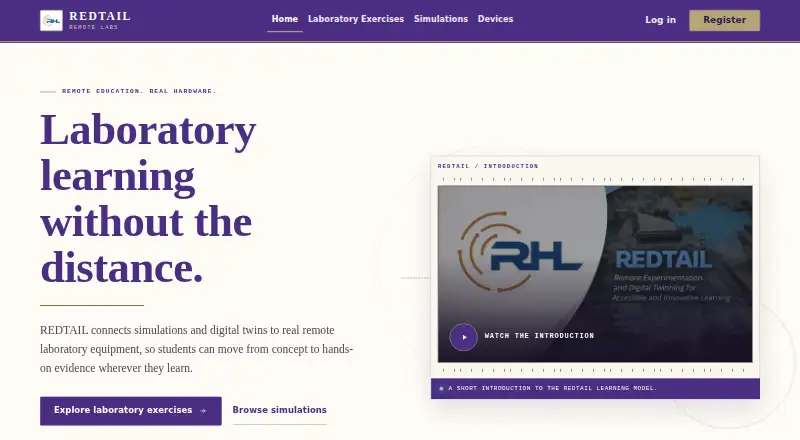
What REDTAIL is
REDTAIL links simulations and digital twins with remotely accessible laboratory equipment for remote laboratory learning. Instructors can combine simulated practice and remote equipment in one course assignment, giving students a way to compare simulated and physical results. The site offers instructors paths to browse and adapt exercises, while students complete activities assigned through their courses and receive links and access instructions from their instructor. Its exercise catalog lists 19 results with category, device, and difficulty filters. A separate catalog has 12 simulations, including activities involving a parking lot, keypad, breadboard, door, water tank, LED matrix, and wiper. The device catalog lists remote laboratories for the Altera DE1-SoC FPGA and STM32 Nucleo WB55RG board. Exercises use tools such as SystemVerilog, VHDL, Mbed OS, Arduino IDE, and Keil Studio Cloud. REDTAIL is web-based, self-hosted, free, and open source, with public source code linked from the site. Instructors can deploy scenarios without physical hardware. Instructor solutions require approval, and repository setup instructions specify Python 3.12, Node, and MySQL.
Good
- Combines simulated and remote equipment activities.
- Students can compare simulated and physical results.
- Catalog includes 19 exercises and 12 simulations.
- Source code is public and inspectable.
- Scenarios can be deployed without physical hardware.
Watch out
- Students receive access instructions from their instructor.
- Instructor solutions require approval.
- Repository setup specifies Python 3.12, Node, and MySQL.
Who it suits
REDTAIL suits instructors building remote lab activities and students completing assigned exercises. It may also suit institutions that want to deploy scenarios without physical hardware.
Verdict
REDTAIL supports course activities that connect simulation with remote equipment, with catalogs for exercises, simulations, and devices. Students depend on instructor-provided access, and instructor solutions are restricted by approval.
The facts
Each one read from REDTAIL's own pages, with the date it was checked.
What it does
- Access limits
- An exercise page states that instructor solutions require instructor approval and directs users to contact the REDTAIL team for access.checked 5 Oct 2026
- Access model
- Students receive the exercise, simulation or remote-laboratory link, and access instructions from their instructor.checked 11 Oct 2026
- Audience
- The site presents REDTAIL for instructors selecting and adapting course exercises and for students completing activities assigned through their course.checked 11 Oct 2026
- Deployment
- The Remote Hub Lab page says instructors at any institution can deploy REDTAIL scenarios without physical hardware.checked 11 Oct 2026
- Development requirements
- The public repository setup instructions specify Python 3.12, Node, and MySQL.checked 5 Oct 2026
- Exercises
- The laboratory exercise catalog lists 19 exercises, including activities for FPGA and STM32 devices.checked 11 Oct 2026
- Funding
- The website says it was supported by the National Science Foundation's Division of Undergraduate Education under Grant #2336745.checked 11 Oct 2026
- Funding and attribution
- The website says it was supported by the National Science Foundation's Division of Undergraduate Education under Grant #2336745 and notes some content may come from third parties or outside the REDTAIL project and grant.checked 5 Oct 2026
- Hardware
- The device catalog lists remote laboratories for the Altera DE1-SoC and STM32 Nucleo WB55RG.checked 11 Oct 2026
- Languages and tools
- Cataloged exercises include SystemVerilog, VHDL, mbedOS, Arduino IDE, and Keil Studio Cloud activities.checked 11 Oct 2026
- Learning workflow
- Students can rehearse in a simulation, use remote equipment, and compare simulated and physical results within an instructor-led assignment.checked 11 Oct 2026
- Open source
- The site describes REDTAIL as open source and links to its public source code on GitHub.checked 11 Oct 2026
- Partner
- REDTAIL is developed by the Remote Hub Lab at the University of Washington with LabsLand.checked 11 Oct 2026
- Purpose
- REDTAIL connects simulations and digital twins to remotely accessible laboratory equipment for hands-on learning.checked 11 Oct 2026
- Simulations
- The simulations catalog lists 12 scenarios, including parking lot, keypad, breadboard, door, water tank, LED matrix, and wiper examples.checked 11 Oct 2026
- Support
- Instructors and collaborators are invited to contact the REDTAIL team at [email protected] about courses, remote-lab setups, or collaborations.checked 11 Oct 2026
- Tools and frameworks
- Listed exercises use frameworks including SystemVerilog, VHDL, Mbed OS, Arduino IDE, and Keil Studio Cloud.checked 5 Oct 2026
Alternatives to REDTAIL
- 1

Beyond Labz
Free planAndroidiOSWebmacOS8.2$31.95 one-time - 2
PraxiLabs
Free planAndroidiOSWeb8.1From $29.99 a year - 3
Molecular Workbench
Free planOpen sourceWebLinuxmacOSWindows7.6Free plan - 4
ChemCollective Virtual Lab
Free planAndroidiOSWebmacOS7.5Free plan - 5

Labster
AndroidiOSWebmacOS7.0From $5,000 a year - 6
Pivot Interactives
iOSWebmacOSWindows7.0From $6.10 a year