
ReadTheory
ReadTheory is a web-based platform for personalized reading comprehension practice.
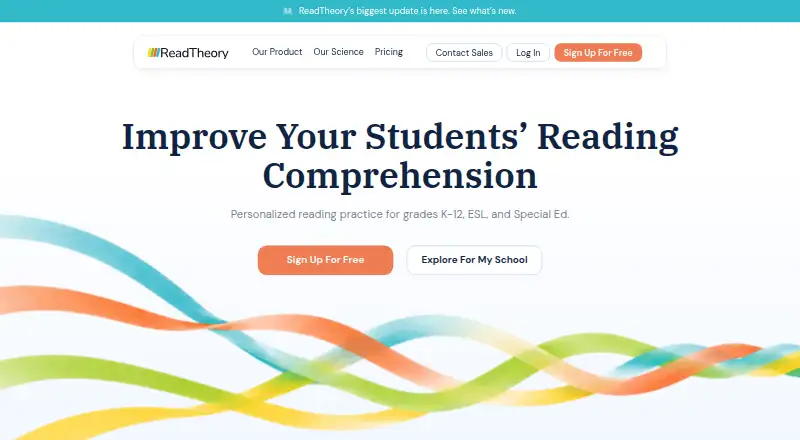
What ReadTheory is
ReadTheory is a web-based platform for personalized reading comprehension practice. A benchmark assessment identifies a student's reading level, and the platform adjusts practice as the student works. Its content includes thousands of standards-aligned fiction and nonfiction texts, printable materials, and custom content creation. Reports show Lexile level, grade level, ELA standards, and student progress history. The platform supports K–12, ESL, and special education learners, and the School & District plan is described for schools and districts. ReadTheory is designed for Chromebooks, iPads, Android tablets, and Windows or macOS computers; phones are not optimized for the student experience. The free Basic plan covers one staff member and 30 students, with limited weekly quizzes and progress history. School Champion costs $40 a month and covers one staff member and 40 students, with unlimited quizzes and progress history. Listed integrations include LMS, LTI, rostering, and single sign-on with Clever, Google Classroom, and ClassLink. ReadTheory says student personal information is not sent to third-party AI systems or used to train AI or machine-learning models.
Good
- Benchmark assessment adapts practice to reading level.
- Includes thousands of standards-aligned texts.
- Reports cover Lexile, grade, and ELA standards.
- Free Basic plan covers 30 students.
- Lists LMS, LTI, and rostering integrations.
Watch out
- Phones are not optimized for student use.
- Basic limits weekly quizzes and progress history.
- Offline access is not available.
- School & District pricing is custom.
Who it suits
ReadTheory suits educators seeking adaptive comprehension practice for K–12, ESL, or special education learners. Its school-focused integrations and reporting may also fit schools and districts managing student progress.
Verdict
ReadTheory pairs adaptive reading practice with reporting and school-oriented integrations. The free plan has quiz and history limits, while broader school needs may call for a paid plan.
Plans and prices
From ReadTheory's own pricing page, checked 15 Oct 2026.
| Plan | Price | What it gives you |
|---|---|---|
| Basic | Free | 1 staff member · 30 students · 4 quizzes per week · limited progress history |
| School Champion | $40 a month | 1 staff member · 40 students · unlimited quizzes · unlimited progress history · billed monthly or annually |
| School & District | Priced on request | custom staff · custom students · unlimited quizzes · unlimited progress history · priced per student |
The facts
Each one read from ReadTheory's own pages, with the date it was checked.
What it does
- Accessibility
- ReadTheory states that it supports screen readers, zoom and text scaling.checked 15 Oct 2026
- Activities
- Teachers can assign goals, passages, competitions and repeatable benchmark tests, then monitor completion and performance.checked 15 Oct 2026
- Adaptive assessment
- An adaptive benchmark assessment estimates each student's reading level in about 14 minutes and continues adjusting difficulty.checked 15 Oct 2026
- Adaptive practice
- A benchmark assessment identifies a student's reading level, and the platform adjusts practice as the student works.checked 30 Sep 2026
- API and SDKs
- The official pages reviewed document integrations and SSO but do not publish a public ReadTheory API or SDK.checked 15 Oct 2026
- Audience
- The School & District plan is described for schools and districts, with the platform supporting K–12, ESL, and special education learners.checked 30 Sep 2026
- Clever integration
- Clever's app gallery says ReadTheory supports Clever Instant Login and can be installed by schools.checked 15 Oct 2026
- Content
- The platform offers thousands of standards-aligned fiction and nonfiction texts, printable materials, and custom content creation.checked 30 Sep 2026
- Content library
- The service offers thousands of standards-aligned fiction and nonfiction texts plus custom content generation.checked 15 Oct 2026
- Data location
- ReadTheory says it stores information on servers in the United States.checked 30 Sep 2026
- Documentation
- The help center covers account setup, classroom creation, activities, billing, troubleshooting, reporting and FAQs.checked 15 Oct 2026
- Founder
- Crunchbase names Tanner Hock as founder and editor.checked 15 Oct 2026
- Integrations
- Official materials list LMS and LTI integrations, rostering assistance, and SSO with Google, Microsoft, Clever and ClassLink.checked 15 Oct 2026
- Legal entity
- The privacy policy identifies the operator as ReadTheory LP.checked 15 Oct 2026
- Limit: advertising experience
- Trustpilot reviewers repeatedly describe ads as distracting, including ads covering or interrupting the answer-submission area.checked 15 Oct 2026
- Limit: AI-generated content
- Trustpilot reviewers criticize some passages and quizzes as poorly edited or overly simplistic AI-generated material.checked 15 Oct 2026
- Limit: grading and difficulty
- Reviewers report frustration with hard-to-adjust reading levels, harsh score drops and low scores caused by one missed question.checked 15 Oct 2026
- Limit: question quality
- Multiple Trustpilot reviewers complain that questions and answer choices are vague, biased, overly easy or subjective.checked 15 Oct 2026
The company
- Company founding
- ReadTheory says it launched in 2015.checked 15 Oct 2026
- Company headquarters
- Crunchbase lists headquarters in Chapel Hill, North Carolina, United States.checked 15 Oct 2026
- Company history
- ReadTheory says its founder began developing the adaptive program in 2011, and the website launched publicly after a rebuild in 2016.checked 30 Sep 2026
- Company size
- Crunchbase lists ReadTheory as a private company with 1-10 employees.checked 15 Oct 2026
- Founded
- 2010checked 28 Sep 2026
- Ownership
- Crunchbase says ReadTheory was acquired by Pomador Media.checked 15 Oct 2026
The full review of ReadTheory
Overview
ReadTheory is a browser-based platform for adaptive reading-comprehension practice, built mainly for educators supporting K–12, ESL, special education, or adult learners. Its strongest case is pairing adjustable practice with progress reporting; tight free-plan limits and a student experience not optimized for phones are meaningful trade-offs.
Key features
Adaptive practice and reading material
A benchmark assessment sets a learner’s starting reading level, and ReadTheory adjusts practice as the learner works. That makes it more useful for varied reading levels than a fixed sequence of exercises, though the platform is focused on comprehension practice rather than general-purpose reading.
The library includes thousands of standards-aligned fiction and nonfiction texts. Printable materials and custom content creation give educators options beyond the built-in passages, while mixed content formats serve both screen-based and printed work.
Reporting and classroom connections
Reports cover Lexile and grade levels, ELA standards, and student progress history. Those measures can help educators follow progress across learners; unlimited history is reserved for paid plans, so the free tier is less suitable for ongoing recordkeeping.
School-oriented integrations include LMS, LTI, and rostering connections, plus single sign-on with Clever, Google Classroom, and ClassLink. These are useful for schools fitting the platform into existing classroom systems.
Privacy, devices, and support
ReadTheory says it encrypts information in transit and at rest, limits access by least privilege, separates sensitive data across networks, and undergoes annual independent security audits. It also says student personal information is not sent to third-party AI systems or used to train AI or machine-learning models. Information is stored on servers in the United States.
The browser-based service is designed for Chromebooks, iPads, Android tablets, and Windows or macOS computers. Although supported platforms include iOS and Android, phones are not optimized for students, so a larger screen is the better fit. Offline access is not available. Chat and email support are offered, with ReadTheory aiming to answer chat questions within 24 hours.
Pricing
ReadTheory uses a freemium model, with a free plan and a free trial. The Basic plan costs nothing and allows 1 staff member and 30 students, with limited quizzes per week and limited progress history. It is a sensible way to try the platform or support a small group, but quiz and history caps make it a weaker choice for sustained classroom use.
School Champion costs $40 a month, billed monthly. It includes 1 staff member and 40 students, with unlimited quizzes and unlimited progress history. Compared with Basic, it adds capacity for 10 students and removes those two usage limits, making it the clearer fit for a teacher who needs regular practice and continued tracking.
School & District has custom pricing and is priced per student. It offers custom staff and student counts, unlimited quizzes, and unlimited progress history, fitting larger or more complex school needs where School Champion’s fixed seat limits are too restrictive. The paid entry point is 40 /mo.
Platforms
ReadTheory is available on web, Windows, macOS, iOS, and Android. It is browser-based, with no offline access; students are better served on a Chromebook, tablet, or computer than a phone.
Who it's for
ReadTheory is best suited to educators who want adaptive comprehension practice and reporting for K–12, ESL, special education, or adult learners. Its school integrations and roster-oriented features also suit organized classroom use. It is a less natural choice for independent phone-first reading or anyone who needs offline study.
Pros and cons
- Pros: Practice adjusts to a benchmarked reading level, so learners are not all assigned the same fixed sequence.
- Pros: Thousands of aligned texts, printable materials, and custom content give educators multiple ways to assign practice.
- Pros: Reporting spans Lexile level, grade level, ELA standards, and student history, with unlimited history on paid plans.
- Pros: School and district integrations, rostering, and single sign-on support institutional use.
- Cons: Basic limits weekly quizzes and progress history, constraining regular use and longer-term tracking.
- Cons: School Champion is capped at 40 students and one staff member, so larger groups need custom-priced School & District.
- Cons: No offline access and an unoptimized phone experience make it a poor fit for mobile-only students.
Alternatives
Reading Apps is the broader category to browse if ReadTheory’s classroom-focused comprehension practice is not the right fit.
- Duolingo is a freemium option with a free plan and a one-week free trial; consider it if you want a different kind of learning app rather than ReadTheory’s reading-comprehension focus.
- Skybrary offers a free tier with 100 books, 50 adventure videos, up to five child profiles, progress tracking, ad-free use, and offline access. It is worth considering for families seeking a children’s reading library and offline access.
- CommonLit has a free digital text library and CommonLit 360 curriculum for teachers and students, as well as a $4,200 per school / per year Spark plan. Choose it if that curriculum and text-library model better suits a school.
- Epic offers free school access to about 20,000 books and videos on weekdays from 7am–4pm, and a family annual plan for $7.25 a year. It is a better match for readers prioritizing a broad book-and-video library.
- Headway provides one pre-selected book summary per day free, with no card details required. It serves a different purpose for readers seeking book summaries rather than student comprehension practice.
- Instapaper is an option for saving articles, videos, and pages, with folders and syncing across web, iOS, and Android on its free plan. Pick it for collecting reading material rather than structured instruction.
- Teach Your Monster to Read makes all games playable free through its website on computers and laptops. Consider it for game-based early reading instead of adaptive comprehension practice.
- Google Play Books Auto-narrated Audiobooks is another option.
Verdict
ReadTheory is a strong choice for educators who need adaptive comprehension work, useful progress measures, and school integrations in one browser-based platform. The main reason to choose it is the combination of level-adjusted practice and reporting; look elsewhere if students rely on phones or offline access, or if a free plan with generous, unlimited classroom use is essential.
Alternatives to ReadTheory
- 1

NewsBlur
Free planOpen sourceAndroidiOSWebAPI8.5From $36 a year - 2

BookFusion
Free planAndroidiOSWebAPI8.0From $2.99 a month - 3

FreshRSS
Free planOpen sourceAndroidiOSWebAPI7.9Free plan - 4

Inoreader
Free planAndroidiOSWebAPI7.9From €7.50 a month - 5

Reading Eggs
AndroidiOSWebmacOS7.9From $99.99 a year - 6

Duolingo
Free planAndroidiOSWebmacOS7.7Free plan