
Rami Code Review
Rami Code Review automatically examines GitHub pull requests for possible security vulnerabilities, bugs, and code quality problems, then posts findings as r…
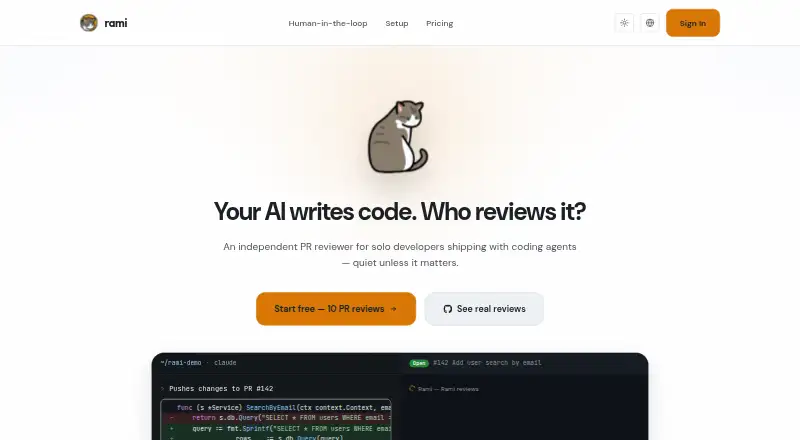
What Rami Code Review is
Rami Code Review automatically examines GitHub pull requests for possible security vulnerabilities, bugs, and code quality problems, then posts findings as review comments. It can run another review after new pushes until findings are no longer open. Claude Code, Cursor, and Codex can retrieve findings through MCP, apply fixes, and request a new review, while Rami itself does not alter code; users decide what gets merged. Each pull request counts as one review per month regardless of its files or findings, and re-reviews of that request use no extra quota. Users can challenge findings with evidence, and accepted rebuttals return some review credits. Repository configuration can set review language and tone, auto-approval, CI blocking, fix prompts, comment hygiene, and instruction-file use. Merge gates are available on Pro+ and Team+ plans. Rami accesses only repositories where its GitHub App is installed. Pull request diffs and contextual repository data are sent to third-party LLM providers for analysis. The free plan is free; Pro costs $7 a month.
Good
- Reviews GitHub pull requests automatically
- Repeat reviews use no additional monthly quota
- Users can rebut findings with evidence
- Repository settings can tailor review behavior
- Free plan is available
Watch out
- Rami does not change code
- Analysis data is sent to third-party LLM providers
- Merge gates require Pro+ or Team+
Who it suits
Rami is designed for solo developers and small teams whose code is increasingly written by AI agents. It suits GitHub users who want automated findings while retaining control over code changes and merge decisions.
Verdict
Rami automates pull request review and supports an agent-assisted fix-and-review workflow without taking over code changes. Consider the plan quotas and third-party processing of repository data when deciding whether it fits your workflow.
Plans and prices
From Rami Code Review's own pricing page, checked 11 Oct 2026.
| Plan | Price | What it gives you |
|---|---|---|
| Free | Free | 2/day · 20/month · 10 signup reviews · 3 evidence-based rebuttals/month · forever |
| Pro | $7 a month | 100 reviews/month · unlimited evidence-based rebuttals · accepted rebuttals return credits · $7/month |
| Starter credits | $7, paid once | 10 credits = 1 review · purchased credits never expire · 500 credits $7 |
| Standard credits | $12, paid once | 10 credits = 1 review · purchased credits never expire · 1,000 credits $12 |
| Pro+ | $15 a month | 225 reviews/month · self-tuning · Check Run merge gates · $15/month |
| Team | $17 a month | 150 reviews per seat, shared across your org · unlimited evidence-based rebuttals · $17/seat/month |
| Value credits | $25, paid once | 10 credits = 1 review · purchased credits never expire · 2,500 credits $25 |
| Team+ | $31 a month | 275 reviews per seat, shared across your org · self-tuning · Check Run merge gates · $31/seat/month |
The facts
Each one read from Rami Code Review's own pages, with the date it was checked.
What it does
- Agent workflow
- Claude Code, Cursor, and Codex can fetch findings over MCP, apply fixes, and request re-reviews.checked 11 Oct 2026
- Data access
- Rami accesses only repositories where its GitHub App is installed, with pull request read/write, contents read-only, metadata read-only, and organization members read-only permissions.checked 11 Oct 2026
- Data retention
- Cached analysis and completed result snapshots are retained for up to 7 days, while review finding lifecycle history is retained for up to 90 days.checked 11 Oct 2026
- Human control
- Rami reports findings and explains them but does not change code; the user decides what gets merged.checked 11 Oct 2026
- Intended users
- Rami describes itself as designed for solo developers and small teams whose code is increasingly written by AI agents.checked 11 Oct 2026
- Merge gates
- Check Run merge gates are available on Pro+ and Team+ plans.checked 11 Oct 2026
- Rebuttals
- Users can rebut findings with evidence; accepted rebuttals return some review credits, and repeated accepted rebuttals can teach Rami repository conventions on eligible plans.checked 11 Oct 2026
- Repository configuration
- A repository config file can control review language, tone, auto-approval, CI blocking, fix prompts, comment hygiene, and repository instruction-file use.checked 11 Oct 2026
- Review quotas
- A pull request counts as one review per month regardless of files or findings, and re-reviews of that PR use no additional review quota.checked 11 Oct 2026
- Review scope
- Rami identifies potential security vulnerabilities, bugs, and code quality issues in GitHub pull request changes.checked 11 Oct 2026
- Security measures
- Rami says it uses encryption in transit and at rest, access controls, and audit logging.checked 11 Oct 2026
- Support
- The privacy policy lists [email protected] for privacy questions and data rights requests.checked 11 Oct 2026
- Third-party processing
- Pull request diffs and contextual repository data are sent to third-party LLM providers for analysis, including OpenAI, Anthropic, Google, OpenRouter, xAI, and AWS Bedrock.checked 11 Oct 2026
- What it does
- Rami automatically reviews GitHub pull requests, posts findings as review comments, and re-reviews after pushes until no findings remain open.checked 11 Oct 2026
Alternatives to Rami Code Review
- 1

RhodeCode Enterprise
Free planOpen sourceWebAPILinuxSelf-hosted8.3From $75 a year - 2

Cubic
Free planWebAPILinuxmacOS7.9From $30 a month - 3

Sourcery
Free planWebAPIExtensionLinux7.9From $12 a month - 4

Ellipsis
Free planWebAPILinuxmacOS7.8Free plan - 5

Gerrit Code Review
Free planOpen sourceWebAPILinuxmacOS7.7Free plan - 6

Greptile
Free planWebAPIExtensionLinux7.7From $30 a month