QuickEmailVerification
QuickEmailVerification checks whether email addresses are valid and deliverable, helping businesses reduce bounces.
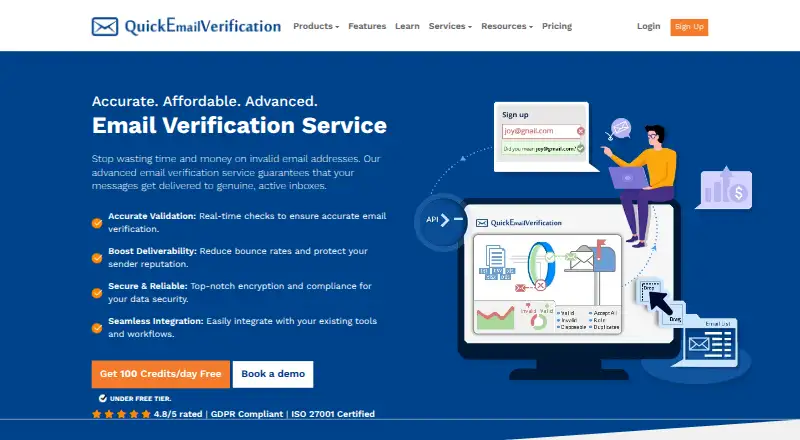
What QuickEmailVerification is
QuickEmailVerification checks whether email addresses are valid and deliverable, helping businesses reduce bounces. The web service supports bulk list verification through drag-and-drop lists, ESP imports, computer uploads and API uploads. Its REST API returns JSON for real-time checks at signup, with result fields for safe-to-send status, disposable and role addresses, accept-all behavior, free email providers and typo suggestions. A batch API accepts CSV files, reports job progress, offers categorized result downloads and can notify users through a completion webhook. Integrations include ActiveCampaign, AWeber, Brevo, HubSpot, Mailchimp, Salesforce, SendGrid and Make. Developer examples or libraries are listed for PHP, Node.js, Python, Ruby, Go, Java, C#, VB.Net and cURL. API access can be restricted to allowed IP addresses or CIDR ranges. The company says results it cannot determine do not consume credits. The Free Tier is free, with 100 credits per day and no card required; Pay As You Go is $4, paid once for 500 credits that do not expire. Daily credits reset, and active daily credits are used before persistent credits.
Good
- Bulk verification accepts ESP imports and API uploads
- REST API supports real-time signup checks
- Unknown results do not use credits
- Pay As You Go credits never expire
Watch out
- Free Tier is limited to 100 daily credits
- High Volume pricing requires a quote
Who it suits
QuickEmailVerification suits marketers, developers, agencies and businesses that need to check sign-up addresses or clean lists. Its API and batch options also fit teams integrating verification into existing workflows.
Verdict
QuickEmailVerification offers both list-based checks and API verification, with result details and batch tools for different workflows. Compare the daily free allowance with the one-time credit option when deciding how to use it.
Plans and prices
From QuickEmailVerification's own pricing page, checked 2 Oct 2026.
| Plan | Price | What it gives you |
|---|---|---|
| Free Tier | Free | 100 credits / day · No credit card required · Resets daily |
| Pay As You Go | $4, paid once | 500 credits · Credits never expire · One time |
| High Volume | Priced on request | Volume discounts for 5M+ verifications · Contact for a quote · Custom pricing at scale |
The facts
Each one read from QuickEmailVerification's own pages, with the date it was checked.
What it does
- API key security
- API access can be restricted to allowed IP addresses or CIDR ranges in API Settings.checked 2 Oct 2026
- Batch API
- The batch API accepts CSV uploads, reports job progress, provides categorized result downloads, and can notify completion by webhook.checked 2 Oct 2026
- Bulk verification
- Bulk Email Verifier supports drag-and-drop lists, ESP imports, computer uploads, and API uploads.checked 2 Oct 2026
- Credit limits
- Daily credits reset each day, while pay-as-you-go persistent credits do not expire; active daily credits are used first.checked 2 Oct 2026
- Developer SDKs
- The API page provides SDK examples or libraries for PHP, Node.js, Python, Ruby, Go, Java, C#, and VB.Net, plus cURL.checked 2 Oct 2026
- Integrations
- The maker lists integrations including ActiveCampaign, AWeber, Brevo, HubSpot, Mailchimp, Salesforce, SendGrid, Make, and others.checked 2 Oct 2026
- Real-time API
- The REST API returns JSON and supports real-time email verification at signup.checked 2 Oct 2026
- Security and compliance
- The maker states that it is ISO 27001 certified and GDPR, CCPA, and HIPAA compliant.checked 2 Oct 2026
- Support
- The pricing page says a dedicated customer support team is available to help users.checked 2 Oct 2026
- Unknown results
- The maker says it does not deduct credits or charge for results it cannot determine.checked 2 Oct 2026
- Verification signals
- API results include fields for safe_to_send, disposable, role, accept_all, free email providers, and typo suggestions.checked 2 Oct 2026
- What it does
- QuickEmailVerification checks whether email addresses are valid and deliverable to help reduce bounces and improve email deliverability.checked 2 Oct 2026
- Who it is for
- The maker names small businesses and startups for its free tier and highlights marketers, developers, agencies, and enterprises as audiences or use cases.checked 2 Oct 2026
The company
- Company history
- The About page says the company was established in 2014 and has helped more than 300,000 clients.checked 2 Oct 2026
- Founded
- 2014checked 23 Sep 2026
The full review of QuickEmailVerification
QuickEmailVerification checks email addresses for validity and deliverability through bulk-list tools and APIs. It is best suited to marketers and developers who need both list cleanup and signup-time checks. Its flexible workflows are useful, but the free tier’s 100-credit daily cap may be restrictive for larger lists.
Overview
The service is built to reduce bounced messages by identifying addresses that may not be deliverable. It covers existing lists, real-time checks during signup, and CSV-based batch jobs, so teams can choose a workflow that fits how addresses enter their systems. Results include signals such as safe_to_send, disposable, role, accept_all, free email providers, and typo suggestions, giving teams more context than a simple valid-or-invalid result.
Unknown results do not consume credits, which helps preserve an allowance when the service cannot classify an address. QuickEmailVerification was established in 2014 and says it has served more than 300,000 clients.
Key features
List and batch workflows
The Bulk Email Verifier accepts drag-and-drop lists, imports from email service providers, computer uploads, and API uploads. That breadth is practical for marketers cleaning an existing list from different sources. For larger jobs, the batch API accepts CSV files, reports progress, provides categorized downloads, and can notify completion by webhook. These tools make asynchronous list processing a better fit than checking every address individually.
Signup checks and integrations
The REST API returns JSON for real-time verification at signup, helping developers check addresses as users submit them. SDK examples or libraries cover PHP, Node.js, Python, Ruby, Go, Java, C#, and VB.Net, alongside cURL. Integrations include ActiveCampaign, AWeber, Brevo, HubSpot, Mailchimp, Salesforce, SendGrid, and Make, giving marketing teams routes into several common email and automation workflows.
Controls and compliance
API access can be restricted to allowed IP addresses or CIDR ranges, a useful control for teams limiting where credentials can be used. The company states that it is ISO 27001 certified and compliant with GDPR, CCPA, and HIPAA. Those claims may matter to organizations evaluating vendors for sensitive workflows, though they do not replace an organization’s own compliance review.
Pricing
| Plan | Price | What it includes |
|---|---|---|
| Free Tier | free | 100 credits / day; resets daily; no credit card required |
| Pay As You Go | $4, paid once | 500 credits; one-time purchase; credits never expire |
| High Volume | Custom pricing | Volume discounts for 5M+ verifications; contact for a quote |
The free tier suits small businesses and startups with modest, recurring daily needs, but unused daily credits reset rather than accumulate. Pay As You Go is more suitable for occasional list cleanup: its 500 credits persist and do not expire, though that one-time package is small for teams processing large lists. Daily credits are used first when both types are active. High Volume targets organizations handling at least 5M verifications and requires a quote. The pricing page also says a dedicated customer support team is available.
The service offers a free trial, but no trial duration or separate terms are given. Unknown results are not charged or deducted from credits, which reduces the cost of inconclusive checks.
Platforms
QuickEmailVerification is available on web and through an API. The API supports both real-time checks and batch processing, so it can serve applications as well as list-management workflows.
Who it's for
Marketers who need to clean lists across imports and uploads, developers adding address checks to signup flows, and agencies or enterprises managing multiple verification workflows are the clearest fits. Small businesses and startups can use the free daily allowance to handle light volumes. Teams that need substantially more than 100 free checks per day should expect to buy credits or seek custom pricing.
Pros and cons
- Pros: Bulk, real-time, and CSV batch options accommodate different verification workflows.
- Pros: Unknown results do not consume credits, and persistent pay-as-you-go credits never expire.
- Pros: API result fields, SDK coverage, integrations, and IP restrictions support both implementation and account controls.
- Cons: The free tier is capped at 100 credits per day, limiting its usefulness for sizable list cleanups.
- Cons: The one-time 500-credit package may be insufficient for high-volume work, which moves buyers to custom pricing.
Alternatives
For a broader comparison, browse Email Verification Services.
ZeroBounce is worth considering if iOS access matters or a larger minimum purchase suits your workflow: its free plan includes 100 monthly email verifications for a business account, while its pay-as-you-go option is $39, paid once for a minimum purchase that validates 2,000 addresses.
VerifyAnyEmail may fit developers seeking a larger monthly free allowance: it offers 1,000 credits per month, with limits of 10 requests per minute, batches of up to 10, and one concurrent batch, but no webhooks or priority support on that plan.
Email Verifier API is an alternative with a one-time free 100-credit allocation and a listed 1,000-credit purchase for $9.95, paid once.
DeBounce may suit buyers who want selectable 5K–5M credit options, one credit per validation, and credits that never expire; its pay-as-you-go plan lists free.
Reoon Email Verifier offers a lifetime free tier with 20 emails per day, 100 instant credits, single and bulk checks, and live API validation.
Bouncer is another pay-as-you-go option, listing 8.00 USD for 1,000 credits, with a 1,000-credit minimum and credits that never expire.
Clearout Email Verification may be relevant to buyers comparing subscription billing: its listed annual subscription is $163,000 a year for 3,000 credits, with unused credits rolling over and never expiring.
MillionVerifier offers one-time credit packages, including 10,000 verification credits for $39, paid once, with credits that never expire.
Verdict
QuickEmailVerification is a strong fit for teams that need one service for bulk cleanup, signup validation, and batch jobs, especially when API signals and persistent credits matter. Its main drawback is scale: the free tier is small, the 500-credit purchase is limited, and larger-volume pricing requires a quote. Choose it for workflow flexibility; look elsewhere if you need a more generous free quota or a clearly sized high-volume package.
Alternatives to QuickEmailVerification
- 1

ZeroBounce
Free planAndroidiOSWebAPI8.1Free plan - 2

MailboxValidator
Free planWebAPI6.8Free plan - 3

Emailable
Free planWebAPI6.7From $32.30 a month - 4

EmailValidator
Free planWebAPI6.7Free plan - 5

Mailbeam
Free planWebAPI6.7From €19 a month - 6

Reoon Email Verifier
Free planWebAPI6.7From $9 a month