Querybook
The facts below are what the maker publishes about Querybook, checked and dated. Our editors have not written about it yet.
The facts
Each one read from Querybook's own pages, with the date it was checked.
What it does
- Access controls
- Environment access can be configured as public, hidden, or shareable, with private environments managed through user access controls.checked 3 Oct 2026
- AI features
- The optional AI Assistant plugin can generate and edit SQL from text prompts, fix failed SQL, suggest SQL completions, and search tables and queries in natural language when its vector store is enabled.checked 2 Oct 2026
- API
- Users can create API access tokens and send them in the api-access-token request header for authentication.checked 2 Oct 2026
- Audience
- The site describes Querybook as a tool for engineers and data scientists.checked 3 Oct 2026
- Authentication
- Documented authentication options include username and password, OAuth including Google Cloud OAuth, and LDAP.checked 3 Oct 2026
- Charts and scheduling
- Users can create charts in DataDocs and schedule automatic DataDoc updates at set intervals.checked 3 Oct 2026
- Collaborative notebooks
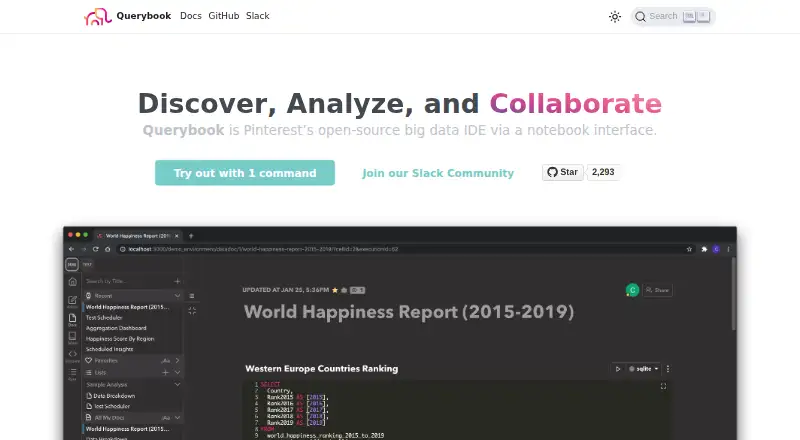
- DataDocs combine rich text, queries, and charts, and support real-time collaboration.checked 3 Oct 2026
- Deployment
- Querybook runs in Docker; the site describes a Docker Compose demo and production deployment options including Kubernetes.checked 3 Oct 2026
- Exports and notifications
- Documented options include Google Sheets and Python exports, plus email and Slack notifications.checked 2 Oct 2026
- Infrastructure requirements
- The architecture documentation lists a database, Redis, Elasticsearch, and remote storage as infrastructure components, with MySQL recommended for the database.checked 3 Oct 2026
- Integrations
- Documented query engines include Presto, Hive, Druid, Snowflake, BigQuery, MySQL, SQLite, PostgreSQL, SQL Server, and Oracle.checked 2 Oct 2026
- Notifications
- Query completion and DataDoc invitations can generate email or Slack notifications.checked 3 Oct 2026
- Product
- Querybook is an open-source big data IDE for discovering, creating, and sharing data analyses, queries, and tables.checked 3 Oct 2026
- Query analytics
- Querybook analyzes executed queries to provide lineage, example queries, frequent-user information, and search and autocomplete ranking.checked 3 Oct 2026
- Query editor
- The query editor provides table-aware autocompletion, syntax highlighting, and table information on hover or click.checked 3 Oct 2026
- Query engines
- Documented query engines include Presto, Hive, Druid, Snowflake, BigQuery, MySQL, SQLite, PostgreSQL, SQL Server, and Oracle.checked 3 Oct 2026
- Result storage and export
- Query results can be stored in a database, S3, Google Cloud Storage, or local files, and exported to Google Sheets or Python.checked 3 Oct 2026
- Scale guidance
- The setup guide describes single-machine setup for trying Querybook with fewer than five users and multi-machine setup for scaling to thousands.checked 2 Oct 2026
- Security advisory
- The security advisories page reports a reflected XSS issue affecting versions before 3.14.2 when OAuth or Okta OAuth authentication was configured, with 3.14.2 listed as patched.checked 2 Oct 2026
- Support
- The site provides a Slack community and lists [email protected] as a contact email.checked 3 Oct 2026
Alternatives to Querybook
- 1

Outerbase Studio
Free planOpen sourceAndroidiOSWebAPI8.5From $9 a month - 2
DBeaver
Free planOpen sourceWebAPIExtensionLinux8.2From $113 a year - 3

Beekeeper Studio
Free planOpen sourceAPIExtensionLinuxmacOS8.0From $18 a month - 4
Mode
Free planWebAPILinuxmacOS7.5Free plan - 5

CloudBeaver
Free planWebLinuxmacOSSelf-hosted7.1From $1,025 a year - 6

Hex
Free planWebAPI7.0From $36 a month