Pythia
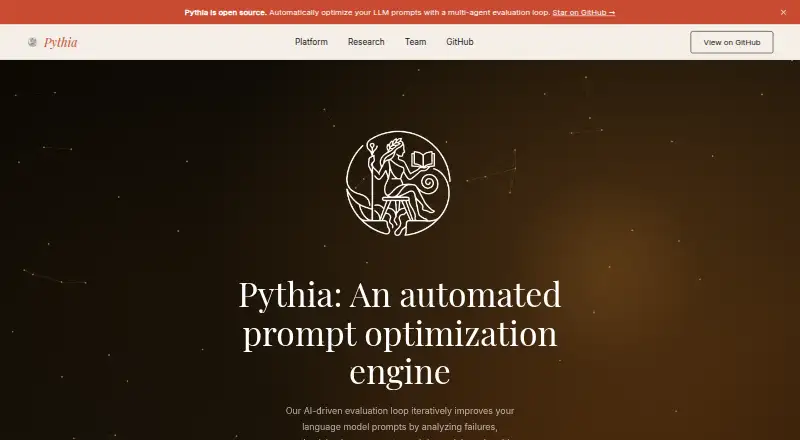
The facts below are what the maker publishes about Pythia, checked and dated. Our editors have not written about it yet.
The facts
Each one read from Pythia's own pages, with the date it was checked.
What it does
- Backends
- The repository README says Pythia includes Gemini and Ollama backends and can use another backend whose LLM is called with an .invoke() method.checked 5 Oct 2026
- Clinical focus
- The project describes its optimization as clinical and sensitive to sensitivity and specificity.checked 11 Oct 2026
- Configurable thresholds
- The README says sensitivity and specificity thresholds are configurable and default to 0.75, while the priority metric defaults to specificity.checked 5 Oct 2026
- Data requirements
- The documented workflow requires development and validation datasets, an output directory, an SOP, and an initial prompt.checked 11 Oct 2026
- Dataset format
- The README recommends CSV datasets, with each CSV representing a person and rows representing visits or notes, using “visit” and “Ground Truth” columns.checked 5 Oct 2026
- Error analysis
- A specialist LLM analyzes failures in aggregate, identifies root causes, and proposes improvement hypotheses.checked 11 Oct 2026
- Evaluation
- Pythia evaluates prompts against a held-out dataset using configurable metrics and tracks results across iterations.checked 11 Oct 2026
- Framework
- The site says Pythia uses LangGraph stateful agentic workflows.checked 5 Oct 2026
- History and export
- Pythia logs prompt versions, scores, and controller decisions, and the site says users can compare runs, export results, and roll back to earlier checkpoints.checked 5 Oct 2026
- Hosting and privacy
- The project describes Pythia as locally hosted and privacy-preserving, with optimization running on open-source models within the institution.checked 11 Oct 2026
- Intended users
- The project presents Pythia for clinical prompt optimization and also gives a general example involving home-buying inquiries.checked 11 Oct 2026
- Iteration control
- A controller can continue, backtrack to a stronger prior prompt, or halt when the prompt has converged.checked 11 Oct 2026
- Local hosting
- The maker describes Pythia as locally hosted and privacy-preserving, with optimization running on open-source models within the institution.checked 5 Oct 2026
- Model backends
- The repository says Pythia includes Gemini and Ollama backends and can use another LLM backend that provides an invoke() method.checked 11 Oct 2026
- Model scale
- The site says optimization can run on models ranging from one billion to one trillion parameters.checked 5 Oct 2026
- Prompt improvements
- An improver agent generates and ranks multiple candidate prompt rewrites before evaluation.checked 11 Oct 2026
- Purpose
- Pythia is an automated prompt optimization engine that iteratively evaluates prompts, analyzes failures, and synthesizes improvements.checked 11 Oct 2026
- Run history
- Pythia logs prompt versions, scores, and controller decisions, and supports comparing runs, exporting results, and rolling back to checkpoints.checked 11 Oct 2026
- Support
- The project links to its GitHub repository issues for questions and issue reporting.checked 11 Oct 2026
- Usage limit
- The repository warns that Pythia is API-call heavy and says fewer iterations or a smaller dataset can reduce token costs and computation.checked 11 Oct 2026
- Workflow
- Its workflow evaluates prompts on a held-out dataset, analyzes failure patterns, proposes prompt rewrites, and controls whether to continue, backtrack, or stop.checked 5 Oct 2026
Alternatives to Pythia
- 1
Vellum
Free planOpen sourceAndroidiOSWebAPI8.7From $30 a month - 2

Agenta
Free planOpen sourceWebAPISelf-hosted8.0From $29 a month - 3
Latitude
Free planOpen sourceWebAPILinuxSelf-hosted7.7From $99 a month - 4
VantagePrompt
Free planWeb7.3From $3 a month - 5

PromptLayer
Free planWebAPISelf-hosted7.0From $49 a month - 6
PromptWizard
Free planAPILinuxmacOSSelf-hosted6.8Free plan