
Pure Data
Pure Data (Pd) is free software for building graphical programs that process audio and other media in real time.
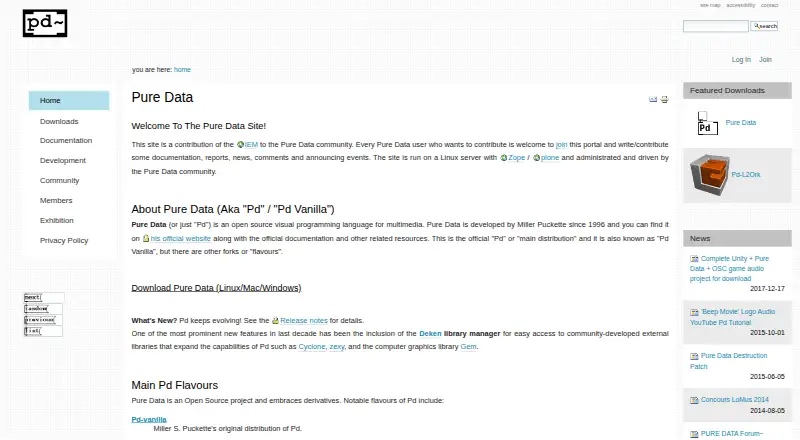
What Pure Data is
Pure Data (Pd) is free software for building graphical programs that process audio and other media in real time. It runs on Windows, macOS, and Linux, with users combining processing elements in patch-based programs. Its graphical environment is used for audio and graphical processing, and the stated audiences include artists working in visual arts, theatre, dance, audio, installations, performance, and media art. Pd can also control hardware and electronics or provide interfaces for other programs. External libraries can expand its functionality through the built-in Deken package manager. Deken is aimed mainly at Pd vanilla, though some other Pd flavors, including Plug Data, can use it. Listings identify packages for macOS, Linux, Windows, or source compilation, and some libraries are limited to particular architectures. To install an external, users can find a library or object and install its downloaded DEK package through Pd’s Find externals tool. The listed plan is free; no paid tiers or usage limits are stated.
Good
- Free software for Windows, macOS, and Linux.
- Combines media processing through graphical patches.
- Deken can install external libraries.
- Can control hardware and electronics.
Watch out
- Some library packages are limited to specific architectures.
- Deken is mainly targeted at Pd vanilla.
Who it suits
Pd may suit artists and other users who want a patch-based environment for real-time audio or graphical media work. It also supports hardware control and interfaces for other programs.
Verdict
Pure Data offers a free, patch-based environment for real-time audio and graphical processing, with external libraries available through Deken. Check package platform and architecture listings when choosing extensions.
Plans and prices
From Pure Data's own pricing page, checked 15 Oct 2026.
| Plan | Price | What it gives you |
|---|---|---|
| Pure Data | Free | Free to download and use · no paid tiers stated |
| Pure Data (Pd) | Free | Free software; no paid plans or usage limits stated on the pages opened |
The facts
Each one read from Pure Data's own pages, with the date it was checked.
What it does
- API and embedding
- libpd exposes Pd's audio engine for embedding in applications and supports C, C++, Java, Objective-C, Python and other wrappers.checked 15 Oct 2026
- Audio and graphics
- A Pure Data workshop page describes Pd as a real-time graphical programming environment for audio and graphical processing.checked 30 Sep 2026
- Audio processing
- The environment supports real-time synthesis, digital signal processing, audio input and output, and sound-file processing.checked 15 Oct 2026
- Current stable release
- Miller Puckette's software page lists Pd 0.57-0 as the current stable release.checked 15 Oct 2026
- Deken compatibility
- Deken is mainly targeted at Pd vanilla and can also be used with some other Pd flavors, including Plug Data.checked 30 Sep 2026
- Documentation
- The official manual includes tutorial patches, audio examples and an online version of Miller Puckette's electronic-music book.checked 15 Oct 2026
- Documentation depth
- The installed application provides object help patches with examples and comments, according to an independent programmer review.checked 15 Oct 2026
- Extensibility
- Pd supports third-party externals and reusable abstractions that can be shared between projects.checked 15 Oct 2026
- Extensible
- Pd's built-in Deken package manager installs external libraries that enhance Pd's functionality.checked 30 Sep 2026
- External installation
- Users can search for a library or object and install a downloaded DEK package through Pd's Find externals tool.checked 30 Sep 2026
- Graphics extensions
- External libraries such as GEM extend Pd with video and 3D graphics capabilities.checked 15 Oct 2026
- Hardware and other programs
- The page says Pd can control hardware and electronics and develop interfaces for other programs.checked 30 Sep 2026
- Intended audience
- The page describes Pd as used by artists for visual arts, theatre, dance, audio, installation, performance, and media art.checked 30 Sep 2026
- License
- The core distribution uses the Standard Improved BSD License and includes an as-is warranty disclaimer.checked 15 Oct 2026
- Limit: debugging
- An independent overview says debugging visual patches can be harder than debugging text-based programs.checked 15 Oct 2026
- Limit: documentation presentation
- A programmer review reports formatting problems in the wiki documentation even though in-program help was useful.checked 15 Oct 2026
- Limit: interface scaling
- A programmer review reported difficulty zooming the canvas and considered the default object and comment text too small.checked 15 Oct 2026
- Limit: large patches
- A programmer review reported lag when moving roughly 15 or more objects simultaneously.checked 15 Oct 2026
- Limit: learning advanced projects
- An independent overview says complex Pd work has a steeper learning curve than basic patching.checked 15 Oct 2026
- Limit: multimedia setup
- A programmer review reported webcam and video-codec setup problems and limited documentation for the pix_video object.checked 15 Oct 2026
Where it runs
- External library platforms
- Deken package listings can identify packages for macOS, Linux, Windows, or source compilation.checked 30 Sep 2026
- macOS requirements
- The manual states that Pd supports macOS 10.7 and newer, with a universal binary for modern Intel and Apple silicon systems.checked 15 Oct 2026
Money
- Free software
- The page describes Pd as free software.checked 30 Sep 2026
The company
- Maker
- Miller Puckette is identified as Pd's developer and continues developing it as an open-source multimedia arts environment.checked 15 Oct 2026
The full review of Pure Data
Pure Data is a free, modular graphical environment for building real-time audio, graphics, and integrated-media systems. It suits artists, performers, and makers who need interactive patches that can connect software with hardware. The main reason to choose it is its adaptable free-software workflow; the main caution is checking external-library compatibility before committing to an extension.
Overview
Pure Data (Pd) combines media-processing components in graphical patches, so a project can link sound, visuals, performance control, and physical equipment in one workspace. Its documented audience includes visual artists, theatre and dance practitioners, installation and performance creators, and media artists. Pd can control hardware and electronics and can serve as an interface for other programs, making it more suitable for bespoke interactive systems than for a single-purpose audio utility.
The modular model is valuable when a project changes over time or spans several media types: you assemble the signal and control flow you need instead of being confined to a fixed instrument. That same requirement to construct a system makes Pd a poorer fit for users who want a ready-made production application with a narrowly defined workflow.
Key features
Patch-based real-time processing
Pd's graphical programming environment connects processing elements in patches for real-time audio and graphical work. Sample import is supported, so source material can be brought into a patch-based design. This visual structure makes relationships between components explicit and supports interactive setups, but it also places responsibility on the user to design and maintain the processing graph.
External libraries through Deken
The built-in Deken package manager extends Pd with external libraries. Users can search for a library or object and install a downloaded DEK package through Pd's Find externals tool, avoiding a wholly separate installation workflow. Deken is primarily aimed at Pd vanilla and can also work with some other Pd flavors, including Plug Data.
Package choice needs care. Listings can identify builds for macOS, Linux, Windows, or source compilation, and some packages are restricted to particular architectures. That ecosystem broadens what Pd can do, while architecture and flavor checks remain part of the setup process.
Pricing
| Plan | Price | What it includes |
|---|---|---|
| Pure Data (Pd) | free | Free software with no paid plans or usage limits stated |
There is no paid tier or free-trial term to weigh, so Pd is suited to anyone who wants a cost-free environment for experimentation, education, or production work. The trade-off is not a reduced free edition but the time required to assemble patches and vet external packages for the target system.
Platforms
Pd runs on Windows, macOS, and Linux, including GNU/Linux. Deken listings can distinguish packages for those desktop platforms or offer source compilation, but individual libraries may be limited to specific architectures. Check the package's platform and architecture before relying on an extension in a cross-platform project.
Who it's for
Pd is a strong choice for artists and makers developing interactive sound-and-image work, installations, performances, theatre or dance systems, and media-art pieces. It also fits users who need to control electronics or expose an interface to another program. Its standalone, modular workflow rewards people willing to build a system around a project. Choose a more focused instrument or effect when the priority is immediate, preconfigured audio production rather than graphical programming.
Pros and cons
Pros
- Free software at no cost: the complete stated plan is free, with no paid tier or usage cap stated.
- Broad real-time scope: one patching environment handles audio and graphics and can connect to hardware and other programs.
- Extensible package workflow: Deken and Find externals provide an in-application route to additional libraries and objects.
- Three major desktop systems: Windows, macOS, and Linux support make it practical for varied development setups.
Cons
- Construction is part of the job: the patch-based approach is less direct than a ready-made audio tool for users who do not want to design processing graphs.
- Extension compatibility varies: libraries may target Pd vanilla or another flavor and may be limited by platform or architecture.
Alternatives
Csound is another free and open-source audio programming language, with builds spanning Android, iOS, web, and desktop platforms; choose it when language-based audio work or broader platform reach matters more than Pd's graphical patches.
Bespoke Synth offers a free open-source modular environment with more than 190 modules on Windows, Mac, and Linux; pick it when that module collection and synth-focused workflow are a better starting point.
SuperCollider is free and open source for Windows, macOS, Linux, and web use; it is the alternative to consider when its programming-oriented approach and wider platform list suit the project.
MSoundFactory is a freemium instrument for macOS and Windows with a free player, a 55.00 USD perpetual LE plan, and a trial; choose it for a sound-library instrument rather than a general patching environment.
Vital provides a free Basic synth with 75 presets and 25 wavetables, plus a 5.00 USD monthly subscription; choose it when a dedicated synthesizer is the goal.
SynthMaster 3 is a paid macOS and Windows instrument with a 99.00 USD perpetual plan and free trial; it fits buyers seeking a packaged synth instead of programmable media patches.
FabFilter Pro-L 2 is a paid limiter for iOS, macOS, and Windows with a free trial; choose it for focused mastering control.
Quanta 2 is a paid granular instrument with a 99.00 USD perpetual license and no subscription; it suits users seeking that specialized instrument rather than Pd's general-purpose environment.
Verdict
Choose Pure Data if you are building interactive audio, visual, performance, or hardware-linked systems and want a free, modular desktop environment you can extend. Look elsewhere if you need a finished instrument, effect, or tightly guided workflow, or if managing package and architecture compatibility would slow the project.
Alternatives to Pure Data
- 1

Vital
Free planOpen sourceLinuxmacOSSelf-hostedWindows8.0From $5 a month - 2
Csound
Free planOpen sourceAndroidiOSWebAPI7.7Free plan - 3
SynthMaster 3
Free planiOSmacOSWindows7.7$99 one-time - 4
Bespoke Synth
Free planLinuxmacOSWindows6.9$20 one-time - 5
MSoundFactory
Free planmacOSWindows6.6$55 one-time - 6
Quanta 2
iOSLinuxmacOSWindows6.6$99 one-time