PromptDocker
PromptDocker is a shared workspace for teams that write, test, version, reuse, and manage prompts.
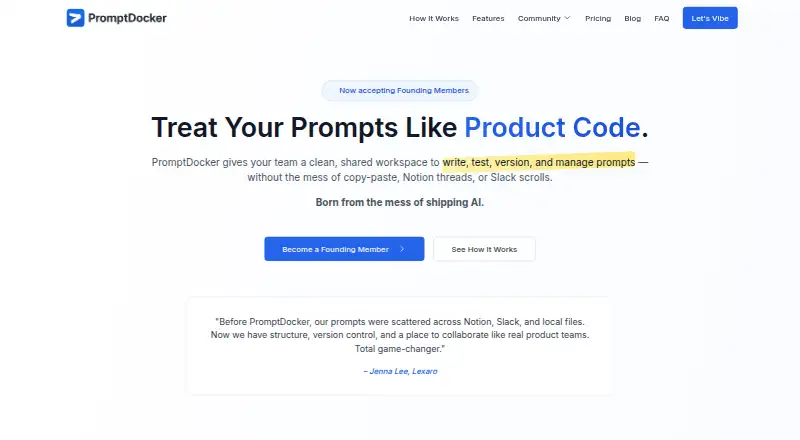
What PromptDocker is
PromptDocker is a shared workspace for teams that write, test, version, reuse, and manage prompts. Its library supports tagging, searching, and organizing prompts by workflow, use case, or model. Reusable templates can hold variables, usage notes, and context. A testing sandbox accepts real inputs across models and places results side by side, while A/B testing helps compare prompt versions before production. Prompt changes are tracked and can be reverted without Git. Collaboration tools let teams invite members, comment on prompts, and assign ownership. API access can send prompts into agents, workflows, or proprietary platforms, and the product names Zapier, n8n, and Supabase as compatible tools. The Free plan allows up to five prompts and one team member. Pro costs $29 a month, with unlimited prompts and up to 50 team members. Enterprise adds SSO, advanced security, permissions, audit logs, custom integrations, dedicated support, SLA guarantees, and training. PromptDocker is available through the web and an API, while its homepage describes access as invite-only during founding-member onboarding. A 14-day trial is listed, and the service positions itself as no-code.
Good
- Tag, search, and organize prompts by workflow or model
- Compare real outputs across models in a testing sandbox
- A/B test prompt versions before production
- Revert prompt changes without Git
- Invite teammates, comment, and assign ownership
- API access supports agents and proprietary platforms
Watch out
- Free plan allows only five prompts
- Free plan is limited to one team member
- Homepage describes access as invite-only
- Enterprise pricing is not provided
Who it suits
PromptDocker fits startup AI teams, solo builders, consultants, prompt engineers, and low-code users working with tools such as Zapier, n8n, or Make. It suits teams that need shared prompt organization, testing, version history, and API deployment.
Verdict
Choose PromptDocker for a collaborative prompt workspace with testing, version control, and API deployment. Pro is aimed at larger teams needing unlimited prompts and team collaboration. Look elsewhere if immediate open access is essential or if five prompts and one member are insufficient on the free plan.
Plans and prices
From PromptDocker's own pricing page, checked 1 Oct 2001.
| Plan | Price | What it gives you |
|---|---|---|
| Free | Free | Up to 5 prompts · 1 team member · Basic version control · Simple testing tools · Export to text files · Community support · Limited integrations · Basic analytics |
| Pro | $29 a month | Unlimited prompts · Up to 50 team members · Advanced version control · Team collaboration · A/B testing suite · API integrations · Custom variables · Advanced analytics · Priority support |
| Enterprise | Priced on request | Unlimited prompts · Unlimited team members · SSO + advanced security · Custom integrations · Dedicated support · SLA guarantees · Advanced permissions · Audit logs · Custom training |
| Founding Member | — | Lifetime access · No recurring fees · Limited number of early users · Early feature access · 1:1 onboarding and real-time support · one-time fee |
The facts
Each one read from PromptDocker's own pages, with the date it was checked.
What it does
- Access status
- The homepage says PromptDocker is invite-only while it onboards early founding members.checked 1 Oct 2001
- API
- PromptDocker says its API access can push prompts into agents, workflows, or proprietary platforms.checked 30 Sep 2001
- API deployment
- API access lets users push prompts into agents, workflows, or proprietary platforms.checked 1 Oct 2001
- Availability
- The homepage says PromptDocker is invite-only while it onboards founding members.checked 30 Sep 2001
- Collaboration
- Teams can invite members, comment on prompts, assign ownership, and build together.checked 1 Oct 2001
- Core product
- PromptDocker is a shared workspace for writing, testing, tracking, reusing, versioning, and managing prompts.checked 1 Oct 2001
- Enterprise security
- The Enterprise plan includes SSO, advanced security, advanced permissions, and audit logs.checked 1 Oct 2001
- Founding membership
- The founding-members page describes lifetime access for a one-time fee, with no recurring fees or renewals, but gives no amount.checked 30 Sep 2001
- Integrations
- PromptDocker lists integrations with Zapier, n8n, and Supabase, with more integrations planned.checked 1 Oct 2001
- Intended users
- The founding-members page lists startup teams, solo builders, consultants, prompt engineers, and low-code users among its intended users.checked 30 Sep 2001
- No-code positioning
- The homepage describes PromptDocker as requiring no developer tools and no code.checked 1 Oct 2001
- Product
- PromptDocker is a shared workspace for teams to write, test, version, and manage prompts.checked 30 Sep 2001
- Prompt library
- Its prompt library supports tagging, searching, and organizing prompts by workflow, use case, or model.checked 1 Oct 2001
- Security and privacy
- The homepage includes a FAQ question asking whether data is private but does not provide an answer in the page text.checked 30 Sep 2001
- Support
- Support is community for Free, priority for Pro, and dedicated for Enterprise.checked 1 Oct 2001
- Target users
- PromptDocker says it is built for startup AI teams, solo builders, consultants, prompt engineers, and low-code users of Zapier, n8n, or Make.checked 1 Oct 2001
- Templates
- Reusable templates can include variables, usage notes, and context.checked 1 Oct 2001
- Testing
- The prompt testing sandbox tests real inputs across models and previews results side by side.checked 1 Oct 2001
- Variant comparison
- Users can A/B test prompt versions before shipping to production.checked 30 Sep 2001
- Variant testing
- PromptDocker supports A/B testing multiple prompt versions before production.checked 1 Oct 2001
- Version control
- Version control tracks changes, supports reverting versions, and requires no Git.checked 1 Oct 2001
- Version history
- The product tracks prompt changes and lets users revert versions without Git.checked 30 Sep 2001
The company
- Maker
- The maker page says PromptDocker began as a weekend project by a founder frustrated with managing prompts across workflows; it does not name the founder or state a location or founding year.checked 30 Sep 2001
The full review of PromptDocker
PromptDocker is a collaborative prompt workspace for writing, evaluating, organizing, and deploying prompts. It suits startup AI teams, consultants, prompt engineers, solo builders, and low-code workflow creators who need shared control without Git. The main qualification is access: the service is currently invite-only while it brings on founding members.
Overview
PromptDocker combines a prompt catalog, reusable templates, testing, revision tracking, and team ownership in one workspace. Its no-code positioning is useful for people building AI processes without developer tooling, while API access gives more technical users a way to send prompts into agents, workflows, or proprietary platforms. That combination is more compelling when several people maintain prompts or when changes need review before release than when one person keeps a small personal collection.
The service supports multiple model providers and runs on the web, with API access for connected applications. Founding members receive lifetime access for a one-time fee, with no recurring charges or renewals, plus one-to-one onboarding and real-time team support; the amount of that fee is custom. Membership is limited to an early group, so this is not an immediately open sign-up.
Key features
The library can be tagged, searched, and arranged around a workflow, use case, or model. Templates retain variables, usage notes, and context, giving teams a repeatable starting point instead of scattered text snippets. Prompt changes are recorded in version history and can be rolled back without Git, a practical safeguard for nontechnical collaborators.
A sandbox accepts real inputs across models and places outputs side by side. A/B testing makes it possible to compare prompt variants before production, which is valuable for teams that want a deliberate release decision rather than informal trial and error. Collaboration tools cover invitations, comments, and ownership assignments.
PromptDocker names Zapier, n8n, and Supabase among its integrations. API deployment can push prompts into agents, workflows, or private platforms. Those connections broaden its usefulness for low-code builders, although users who only need a prompt notebook may find the broader workflow focus unnecessary.
Pricing
The Free plan costs nothing and allows up to five prompts and one team member. It includes basic version control, simple testing, text-file export, community support, limited integrations, and basic analytics. That is enough to assess the core workflow, but the prompt and seat caps make it unsuitable for an active team or a sizable library.
Pro costs $29 a month per user. It removes the prompt ceiling, supports up to 50 team members, and adds advanced version control, team collaboration, an A/B testing suite, API integrations, custom variables, advanced analytics, and priority support. It is the sensible tier for growing teams, though the per-user billing means costs rise with participation.
Enterprise uses custom pricing and adds unlimited prompts and members, SSO, advanced security, custom integrations, dedicated support, SLA guarantees, advanced permissions, audit logs, and custom training. It targets organizations with formal access and operational requirements. A 14-day trial is offered; renewal terms beyond the stated plan structure are not given.
Platforms
PromptDocker is available through the web and API. The API route suits embedded agents and workflow systems, while the web workspace is the primary place for library management, testing, review, and collaboration.
Who it's for
Choose it for a startup AI team standardizing prompts, a consultant managing client workflows, or a prompt engineer who needs comparisons and reversible releases. Solo builders and low-code users can benefit from the no-code approach and named Zapier, n8n, and Supabase connections, but the free one-member limit and invite-only status reduce its appeal for casual experimentation.
Pros and cons
Pros
- Side-by-side model testing and A/B comparisons support more disciplined prompt releases.
- Version history with rollback provides Git-free change control.
- Templates, tagging, search, and ownership keep shared prompt work organized.
- API access and integrations connect prompts to agents and low-code workflows.
- Enterprise controls include SSO, permissions, audit logs, and SLA guarantees.
Cons
- Invite-only access prevents immediate, open onboarding.
- The free tier permits only five prompts and one member.
- Pro's 29.00 USD per-user monthly price can become substantial for larger groups.
Alternatives
Vellum is a better fit if you want broad device coverage, including mobile, desktop, extension, web, and self-hosted options, with a free entry point and pay-as-you-go credits.
PromptHelm suits users who need a gateway quota and explicit limits such as 10,000 calls per month, 10 prompts, and seven-day logs.
Agenta is worth choosing for a free hobby tier with two team members, 5,000 agent runs per month, and 20 evaluations.
PromptFluent is aimed at a large personal prompt collection, offering more than 1,500 prompts on its free plan and browser access.
Modular Prompt Library fits personal users wanting unlimited prompts and modules with their own API keys.
Prompt Assay is an alternative prompt-management service with a 49.00 USD monthly Solo plan.
PromptForge is preferable when a low-cost production endpoint matters: its hobby tier includes one production prompt and 1,000 API requests monthly.
PromptHub favors public sharing, with unlimited public prompts and team members on its free tier, but no private prompts.
Verdict
PromptDocker is a strong choice for teams that need a shared, no-Git prompt workflow combining testing, variants, revision control, and API delivery. Pick it when collaborative release discipline matters; look elsewhere if you need unrestricted sign-up now or the free plan's five prompts and single seat cannot cover your work.
Getting started
- Open the PromptDocker website
- Seek an invitation while the service onboards founding members
- Start with the Free plan, the 14-day trial, or Pro
- Create and organize prompts in the shared workspace
- Connect listed tools such as Zapier, n8n, or Supabase through available integrations
- Use the API to push prompts into agents or workflows
Limits worth knowing
The Free plan allows up to five prompts and one team member, with basic version control, simple testing, limited integrations, and basic analytics. Pro costs $29 a month and allows up to 50 team members.
Questions
Is PromptDocker free?
Yes. The Free plan costs nothing and includes up to five prompts and one team member. A 14-day trial is also listed.
What does Pro cost?
Pro costs $29 a month and includes unlimited prompts and up to 50 team members.
Which platforms are available?
PromptDocker is available on the web and through an API.
Can PromptDocker connect to other tools?
The features page names Zapier, n8n, and Supabase, and the API can push prompts into agents, workflows, or proprietary platforms.
Does it support prompt versioning and testing?
Yes. It tracks changes, supports reverting without Git, provides sandbox comparisons across models, and enables A/B testing.
Alternatives to PromptDocker
- 1
Vellum
Free planOpen sourceAndroidiOSWebAPI8.7From $30 a month - 2

Langfuse
Free planOpen sourceWebAPILinuxSelf-hosted8.1From $29 a month - 3
PromptHelm
Free planAndroidiOSWebAPI8.0From $39 a month - 4

Agenta
Free planOpen sourceWebAPISelf-hosted7.9From $29 a month - 5
PromptFluent
Free planWebExtensionLinuxmacOS7.7From $14 a month - 6

Braintrust
Free planWebAPISelf-hosted7.6From $249 a month