Privacy.com
Privacy.com creates virtual payment cards that mask actual payment information for online transactions.
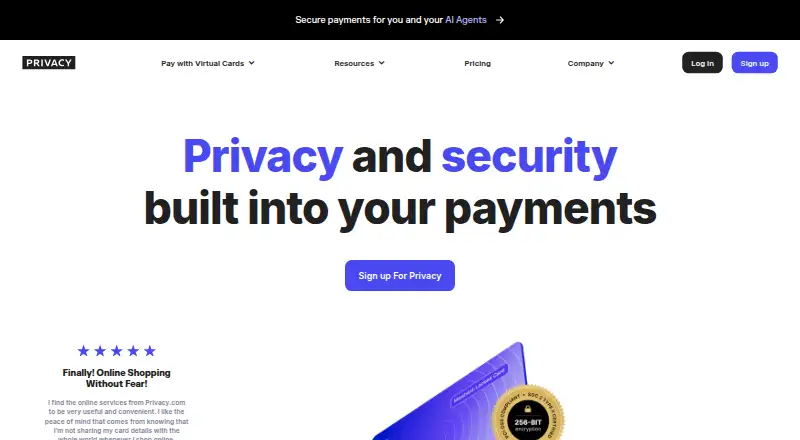
What Privacy.com is
Privacy.com creates virtual payment cards that mask actual payment information for online transactions. A card locks to the first merchant where it is used, and a single-use card closes automatically after one transaction. Users can set transaction, monthly, yearly or total spending limits; transactions exceeding a limit are declined. Cards can also be paused or closed at any time. The free Personal plan is free and allows 12 new cards per month. Paid plans start with Plus at $5 a month, which includes 24 new cards per month and API access. Pro is $10 a month and includes 36 new cards per month, up to three open Everywhere Cards and 1% cashback on eligible transactions up to $4,500 per month. Premium costs $25 a month and allows 60 new cards per month. Browser extensions are available for Chrome, Safari, Edge and Firefox, alongside iOS, Android and web access. Privacy says it does not sell customer data and states that it is PCI-DSS and ISO 27001 compliant and SOC 1 and SOC 2 Type 2 certified. Users must be US citizens or legal residents aged 18 or older with a checking account at a US bank or credit union, and must pass identity verification before transacting.
Good
- Cards lock to their first merchant.
- Single-use cards close after one transaction.
- Spending limits can be set for different periods.
- Cards can be paused or closed at any time.
Watch out
- Available only to eligible US residents with a US checking account.
- Identity verification is required before transacting.
- Personal plan has a 3% foreign transaction fee, minimum $0.50.
Who it suits
Privacy.com suits eligible US adults who want merchant-locked virtual cards, single-use cards or card-level spending limits. Plus and higher plans may suit users needing API access.
Verdict
Privacy.com offers virtual cards with merchant locks, one-time use and spending controls, with a free plan and paid tiers. Check eligibility and the Personal plan’s foreign transaction fee before signing up.
Plans and prices
From Privacy.com's own pricing page, checked 8 Oct 2026.
| Plan | Price | What it gives you |
|---|---|---|
| Personal | Free | 12 new cards/month · Merchant-locked and single-use cards · Spend limits · Pause and close cards · 3% foreign transaction fee (min. $0.50) |
| Plus | $5 a month | 24 new cards/month · Category-locked cards · Card sharing · Card notes · API access · Billed monthly |
| Pro | $10 a month | 36 new cards/month · Everywhere Cards (max 3 open) · 1% cashback on eligible transactions up to $4,500/month · No foreign transaction fees · Billed monthly |
| Premium | $25 a month | 60 new cards/month · Everything in Pro · Billed monthly |
| Plus | $60 a year | 24 new cards/month · Category-locked cards · Card sharing · Card notes · API access · $60 billed annually |
| Pro | $120 a year | 36 new cards/month · Everywhere Cards (max 3 open) · 1% cashback on eligible transactions up to $4,500/month · No foreign transaction fees · $120 billed annually |
| Premium | $300 a year | 60 new cards/month · Everything in Pro · $300 billed annually |
The facts
Each one read from Privacy.com's own pages, with the date it was checked.
What it does
- API
- The developer API supports creating and configuring virtual cards, retrieving real-time payment data, setting card permissions, and setting spending limits.checked 8 Oct 2026
- Card issuer
- Privacy cards are issued by Patriot Bank, N.A., Member FDIC, under Mastercard and Visa licenses.checked 8 Oct 2026
- Card management
- Users can pause or close Privacy Cards at any time.checked 8 Oct 2026
- Data protection
- Privacy says sensitive data is encrypted, web traffic uses TLS with HSTS, and inter-data-center communication uses IPsec with AES-256.checked 8 Oct 2026
- Eligibility
- Privacy is available to US citizens or legal residents aged 18 or older who have a checking account at a US bank or credit union.checked 8 Oct 2026
- Integrations
- The site links browser extensions for Chrome, Safari, Edge, and Firefox, plus iOS and Android apps; paid Plus and higher plans include API access.checked 8 Oct 2026
- Merchant lock
- Privacy Cards lock to the first merchant they are used with and cannot be used elsewhere if stolen or compromised.checked 8 Oct 2026
- Privacy policy
- Privacy says it does not sell customer data and earns transaction fees from merchants.checked 8 Oct 2026
- Product
- Privacy creates virtual payment cards that mask a user's actual payment information for online transactions.checked 8 Oct 2026
- Security
- Privacy states it is PCI-DSS compliant, ISO 27001 compliant, and SOC 1 and SOC 2 Type 2 certified.checked 8 Oct 2026
- Single-use cards
- Privacy Cards can be set for one-time use and automatically close after a single transaction.checked 8 Oct 2026
- Spending controls
- Cards can have transaction, monthly, yearly, or total spend limits, and transactions over the limit are declined.checked 8 Oct 2026
- Support
- Privacy provides a support center with articles on account setup, cards, funding sources, limits, disputes, fraud protections, and business use.checked 8 Oct 2026
- Verification
- Customers must pass identity verification before they can transact, and the company says some personal information is required for that process.checked 8 Oct 2026
The company
- Company history
- Privacy says it began working on the product in 2014 and identifies Lithic as its broader company.checked 8 Oct 2026
- Founded
- 2014checked 28 Sep 2026
The full review of Privacy.com
Overview
Privacy.com issues virtual payment cards that keep your actual payment information out of online transactions. It suits US adults who want to limit a card to one merchant, one purchase, or a set spending amount. Its free tier delivers the main controls; the key trade-offs are strict US eligibility and a foreign transaction fee on Personal.
Key features
A merchant-locked card works only with the first merchant where it is used, so compromised details cannot simply be reused elsewhere. Single-use cards close automatically after one transaction, making them a practical option for isolated purchases. You can set transaction, monthly, yearly, or total spending limits, with charges over the cap declined, and pause or close cards whenever needed. These controls reduce exposure and help contain spending, but they do not make transactions anonymous: customers must pass identity verification and provide some personal information.
Plus and higher plans include API access for creating and configuring cards, retrieving real-time payment data, and setting permissions and spending limits. That is a meaningful step beyond consumer card management for developers building card workflows; it is not included with Personal.
Privacy says it is PCI-DSS and ISO 27001 compliant and SOC 1 and SOC 2 Type 2 certified. It also says sensitive data is encrypted, web traffic uses TLS with HSTS, and inter-data-center communication uses IPsec with AES-256. The company says it does not sell customer data and earns transaction fees from merchants. Cards are issued by Patriot Bank, N.A., Member FDIC, under Mastercard and Visa licenses.
Pricing
Personal: free. It includes 12 new cards/month, merchant-locked and single-use cards, spend limits, and the ability to pause and close cards. This is enough for someone who wants the core protections without a subscription, but the 12-card monthly allowance and 3% foreign transaction fee (min. $0.50) matter for frequent card creation or overseas purchases.
Plus: $5 a month, billed monthly. Its 24 new cards/month double Personal's allowance and add category-locked cards, card sharing, card notes, and API access. Choose it if those controls or integrations justify a recurring fee; otherwise Personal retains the central card protections.
Pro: $10 a month, billed monthly. It raises the allowance to 36 new cards/month, adds Everywhere Cards (max 3 open), offers 1% cashback on eligible transactions up to $4,500/month, and removes foreign transaction fees. It is the more relevant upgrade for people making foreign transactions or who will use the cashback, while the three-open-card cap on Everywhere Cards is a specific constraint.
Premium: $25 a month, billed monthly. It provides 60 new cards/month and everything in Pro. The higher allowance is its stated distinction, so it makes sense only for users whose card volume outgrows Pro's 36-card limit. All paid plans recur monthly; recurring billing is enabled.
Platforms
Privacy is available on Android, iOS, the web, and through a browser extension; the site links extensions for Chrome, Safari, Edge, and Firefox. API access is included with Plus and higher plans. Support is provided through a help center covering setup, cards, funding sources, limits, disputes, fraud protections, and business use.
Who it's for
Privacy is limited to US citizens or legal residents aged 18 or older who have a checking account at a US bank or credit union. It is a good fit for eligible consumers who want to compartmentalize online purchases or impose firm card-level spending limits. It is not a fit for people seeking anonymous payments, and the eligibility rules rule out users outside that US audience.
Pros and cons
- Pros: Merchant locks, single-use cards, and multiple spending caps give users concrete ways to restrict where and how cards can be used.
- Pros: The free Personal plan includes those core controls, while paid plans add API access, higher card allowances, and, on Pro, no foreign transaction fees.
- Cons: Identity verification requires personal information, so Privacy cannot serve as an anonymous payment method.
- Cons: Personal charges a 3% foreign transaction fee (min. $0.50); avoiding it requires Pro at $10 a month.
- Cons: Eligibility requires US residence or citizenship, age 18 or older, and a US checking account.
Alternatives
For a broader comparison of payment tools, browse the Payment Processing Software category. Choose BitPay for a paid service with a free plan and support across desktop, mobile, web, and API platforms. Helcim is worth considering for payment processing with no account monthly fees and transaction rates that vary by volume. Choose Kill Bill if you want a self-hosted, open-source payment platform with control of infrastructure and data. Mollie offers pay-as-you-go processing with no contract or commitment. PayPal Invoicing is the alternative for creating and sending invoices without setup or subscription fees, with transaction fees when customers pay. Airwallex Payments offers online card and local payment acceptance on a free Explore tier, with processing fees. Checkout Page has a free plan capped at $3,000 in sales per 30 days and one team member. Checkout.com offers free payment processing for registered charities in countries where it operates.
Verdict
Privacy.com is a strong choice for eligible US adults who want virtual cards with merchant restrictions, single-use options, and spending caps, especially if the free Personal allowance is sufficient. Look elsewhere if you need service outside the US, anonymous payments, or want to avoid Personal's foreign transaction fee without taking on Pro's monthly cost.
Getting started
- Open https://www.privacy.com/
- Create an account and complete identity verification.
- Connect a checking account at a US bank or credit union.
- Choose the free Personal plan or a paid plan.
- Use the web app, iOS or Android app, or a browser extension.
- Configure a virtual card’s merchant lock, usage type, or spending limit.
Limits worth knowing
Personal provides 12 new cards per month and applies a 3% foreign transaction fee with a $0.50 minimum. Plus, Pro, and Premium raise monthly card allowances to 24, 36, and 60 respectively; Pro limits Everywhere Cards to three open cards.
Questions
Is Privacy.com free?
Yes. The Personal plan costs nothing and allows 12 new cards monthly.
Which platforms support Privacy.com?
Privacy.com offers web, iOS, Android, API, and browser extensions for Chrome, Safari, Edge, and Firefox.
Who can use Privacy.com?
It is available to US citizens or legal residents aged 18 or older who have a checking account at a US bank or credit union.
Does Privacy.com provide an API?
Yes. API access is included with Plus and higher plans. The API can create and configure cards, retrieve real-time payment data, set permissions, and set spending limits.
What does Pro cost?
Pro costs $10 a month, billed monthly. It includes 36 new cards monthly, up to three open Everywhere Cards, and 1% cashback on eligible transactions up to $4,500 per month.
Alternatives to Privacy.com
- 1

BitPay
Free planOpen sourceAndroidiOSWebAPI8.6From $1.53 a month - 2
Kill Bill
Free planOpen sourceWebAPILinuxmacOS8.3From $9,999 a month - 3
Helcim
Free planAndroidiOSWebAPI8.2From $0.40 a month - 4

Mollie
Free planAndroidiOSWebAPI8.2Free plan - 5
Paystack
Free planAndroidiOSWebAPI8.2From 1 NGN a month - 6

Airwallex Payments
Free planAndroidiOSWebAPI8.1From $12 a month