PostalUp
PostalUp provides ZIP code databases and an address validation API for working with U.S.
What PostalUp is
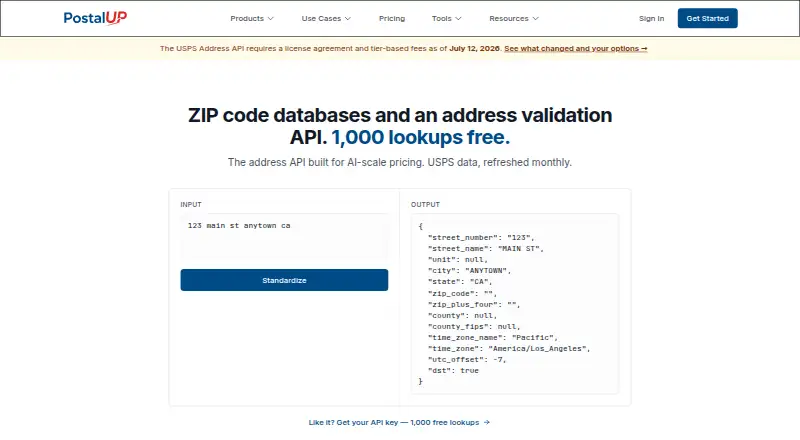
PostalUp provides ZIP code databases and an address validation API for working with U.S. address data. The API supports address standardization, verification, geocoding, and bulk processing. PostalUp says its API uses USPS data refreshed monthly; submitted address information is processed in real time and is not permanently stored except as needed to provide the service or as allowed by its Privacy Policy. Developer resources include documentation, code examples, a playground, webhooks, a Postman collection, and an OpenAPI specification. Examples or options cover JavaScript, Python, PHP, Ruby, cURL, Go, and Java. Depending on the product, downloadable datasets are available in CSV, JSON, Parquet, GeoJSON, and Shapefile formats, with sources including USPS, Census, OMB, HUD, and TIGER. Listed use cases include e-commerce, real estate, logistics, marketing, insurance, and healthcare. Annual database plans are also available, and internal commercial use is included with downloads, while redistribution to customers requires a license.
Good
- Free plan includes 1,000 requests.
- Supports standardization, verification, geocoding, and bulk processing.
- Developer materials include an API playground and OpenAPI specification.
- Downloads include CSV, JSON, Parquet, GeoJSON, and Shapefile options.
Watch out
- Free plan is limited to 1,000 requests.
- Paid API requests pause after the 20% courtesy buffer and quota.
- Redistributing downloads to customers requires a license.
- International coverage is listed as local.
Who it suits
PostalUp may suit teams that need to validate or process U.S. addresses through an API, or download postal datasets for internal commercial use. Its listed use cases include e-commerce, logistics, real estate, marketing, insurance, and healthcare.
Verdict
PostalUp combines address validation tools with downloadable postal datasets and developer resources. Check the request limits and redistribution terms against your intended use before choosing a plan.
Plans and prices
From PostalUp's own pricing page, checked 7 Oct 2026.
| Plan | Price | What it gives you |
|---|---|---|
| Free to Try | Free | 1,000 requests · 10 requests/min · address standardization · basic validation · email support · 1,000 requests, never expires |
| ZIP Code Database Basic | $19 a year | 4 core fields · 40,000+ ZIP codes · annual updates · CSV, TSV, JSON, SQL · Your Price:$19/year |
| Starter | $29 a month | 10,000 requests/month · 50 requests/min · ZIP+4 validation · batch processing · $29/month |
| ZIP Code Database Standard | $39 a year | 35 fields · coordinates and mapping · monthly updates · dashboard download access · Your Price:$39/year |
| ZIP Code Database Deluxe | $79 a year | 63 fields · population and income data · metro area data · priority email support · Your Price:$79/year |
| Professional | $99 a month | 100,000 requests/month · 200 requests/min · batch and real-time processing · priority support · $99/month |
| ZIP Code Database Business | $129 a year | 110 fields · business and employment data · priority email support · Your Price:$129/year |
| ZIP+4 Database Standard | $299 a year | 38 fields · 190M+ addresses covered · 48.7M+ delivery ranges · building coordinates · dashboard access · Your Price:$299/year |
| Scale | $299 a month | 500,000 requests/month · 200 requests/min · batches up to 5,000 addresses · priority support · $299/month |
| Enterprise | Priced on request | Unlimited requests · no rate limits · dedicated support · custom SLA · volume discounts · Custom pricing based on your needs |
The facts
Each one read from PostalUp's own pages, with the date it was checked.
What it does
- Address processing
- The terms state that address data submitted for validation is processed in real time and is not permanently stored except as necessary to provide the service or as permitted by the Privacy Policy.checked 7 Oct 2026
- API data
- The homepage says its address API uses USPS data refreshed monthly.checked 7 Oct 2026
- Data sources
- The downloads page says its datasets are sourced from USPS, Census, OMB, HUD, and TIGER.checked 7 Oct 2026
- Developer tools
- The developer page offers API documentation, code examples, an API playground, webhooks, and a Postman collection.checked 7 Oct 2026
- Downloads
- PostalUp lists postal data downloads in CSV, JSON, Parquet, GeoJSON, and Shapefile formats, depending on the product.checked 7 Oct 2026
- Integrations
- The developer page provides a Postman collection and an OpenAPI specification for working with the API.checked 7 Oct 2026
- Languages
- The developer page shows examples or options for JavaScript, Python, PHP, Ruby, cURL, Go, and Java.checked 7 Oct 2026
- License
- The downloads page says internal commercial use is included, while redistribution to customers requires a redistribution license.checked 7 Oct 2026
- Product
- PostalUp provides ZIP code databases and an address validation API for address standardization, verification, geocoding, and bulk address processing.checked 7 Oct 2026
- Support
- The developer page says technical support from its engineering team responds within 24 hours.checked 7 Oct 2026
- Usage limit
- The pricing page says paid API plans continue serving requests through a 20% courtesy buffer past the monthly quota, after which requests pause until an upgrade or the monthly reset.checked 7 Oct 2026
- Use cases
- The site lists e-commerce, real estate, logistics, marketing, insurance, and healthcare among its use cases.checked 7 Oct 2026
The company
- Company
- The terms identify PostalUp, Inc. and give an Austin, Texas address of 13359 N Highway 183 Suite 406-528, Austin, TX 78750.checked 7 Oct 2026
The full review of PostalUp
Overview
PostalUp pairs a U.S.-focused address validation API with downloadable ZIP code and ZIP+4 datasets. It is a strong fit for developers and businesses that need U.S. address processing or postal data, though teams validating international addresses should look elsewhere.
The appeal is breadth: address standardization, validation, geocoding and bulk processing sit alongside downloadable datasets and developer tools. The trade-offs are local coverage, request ceilings on paid API plans, and a redistribution license requirement for postal data shared with customers.
Key features
The API supports address standardization, verification, geocoding and bulk processing, using USPS data refreshed monthly. Submitted addresses are processed in real time and are not permanently stored except as needed to provide the service or as permitted by the Privacy Policy. That handling suits routine validation workflows, while the monthly refresh cadence is worth weighing for applications that depend on current postal data.
Developers get documentation, code examples, an API playground, webhooks, a Postman collection and an OpenAPI specification. Examples or options cover JavaScript, Python, PHP, Ruby, cURL, Go and Java. This is a useful integration toolkit across common development environments; engineering support responds within 24 hours, with priority support reserved for some paid plans.
Postal datasets are offered in CSV, JSON, Parquet, GeoJSON and Shapefile formats, depending on the product. Sources include USPS, Census, OMB, HUD and TIGER. Internal commercial use is included, but redistribution to customers requires a separate license, so teams that plan to bundle data into customer-facing products need to account for that permission boundary.
Pricing
The free API plan, Free to Try, costs nothing and never expires, but is capped at 1,000 requests, 10 requests per minute, address standardization, basic validation and email support. It is enough for a small evaluation or low-volume use, not sustained production traffic. There is no free trial of a paid plan.
Starter costs $29 a month for 10,000 requests per month, 50 requests per minute, ZIP+4 validation and batch processing. It is the lowest paid API tier and suits modest workloads, but the quota and rate limit constrain higher-volume services. Professional costs $99 a month for 100,000 requests per month, 200 requests per minute, batch and real-time processing and priority support, a more suitable step up for regular production use. Scale costs $299 a month for 500,000 requests per month, 200 requests per minute, batches of up to 5,000 addresses and priority support. It adds headroom and larger batches, but does not raise the stated rate limit above Professional.
Paid API plans continue serving requests through a 20% courtesy buffer beyond the monthly quota; after that, requests pause until an upgrade or monthly reset. That is a limited cushion, not an overage service, so applications that cannot tolerate interruptions should size their plan carefully. Enterprise has custom pricing based on your needs and includes unlimited requests, no rate limits, dedicated support, a custom SLA and volume discounts.
The downloadable databases have separate annual pricing. ZIP Code Database Basic costs $19 a year for four core fields, 40,000+ ZIP codes, annual updates and CSV, TSV, JSON and SQL formats. It is the low-cost option for basic ZIP reference data, but gives up the broader fields and monthly updates of higher tiers. ZIP Code Database Standard costs $39 a year for 35 fields, coordinates and mapping, monthly updates and dashboard download access. Deluxe costs $79 a year for 63 fields, population and income data, metro area data and priority email support. Business costs $129 a year for 110 fields, business and employment data and priority email support.
ZIP+4 Database Standard costs $299 a year and includes 38 fields, coverage of 190M+ addresses, 48.7M+ delivery ranges, building coordinates and dashboard access. It is the specialized choice for buyers needing ZIP+4-level data rather than a general ZIP code dataset. Across download plans, internal commercial use is included; redistribution to customers requires a redistribution license.
Platforms
PostalUp is offered as an API and on the web. It is not positioned as an international address service; its stated coverage is local.
Who it's for
PostalUp is best suited to developers integrating U.S. address validation, and businesses that want postal datasets for internal commercial use. Its use cases include e-commerce, real estate, logistics, marketing, insurance and healthcare. Teams that need customer-facing redistribution rights or international coverage should assess those constraints before committing.
Pros and cons
- Pros: Combines address validation and data downloads, reducing the need to source those capabilities separately.
- Pros: Broad developer resources, including an API playground, webhooks and OpenAPI specification, support integration work.
- Pros: Annual ZIP database plans start at $19 a year, giving occasional data users an inexpensive entry point.
- Cons: Local coverage makes it unsuitable for international validation needs.
- Cons: API requests pause after the 20% quota buffer, which creates an interruption risk for plans that exceed their allowance.
- Cons: Customer redistribution of downloaded data needs a separate license, limiting straightforward resale or bundling.
Alternatives
Address Verification Software is a broader category directory for comparing services. Consider Addresser if you want an option with Android and iOS apps as well as API and web access; it also offers a free plan and free trial. Melissa Global Address Verification is an alternative with API, web, Linux, Windows and self-hosted platforms, plus a free tier of 250 records per month.
Addressify offers a free 30-day trial with 1,000 daily API calls and is available across mobile, desktop and web platforms. Addrex Address Validation API may suit teams wanting a larger free monthly lookup allowance: its Free Beta includes 10,000 lookups per month, spreadsheet upload, map coordinates, usage dashboard and CSV export, with no automatic overage billing. AddressZen is another option, with a free-for-one-year offer of 1,400 verified addresses and an address bundle priced as a one-time purchase.
Lob Address Verification has a free Developer plan with up to 6,000 mailings and one user, while additional address verification is charged per address. Addressr offers self-hosted open-source software with no hosted request limit, but requires your team to provide infrastructure, hosting, monitoring and data updates. PostNL Address Validation API is an alternative for Benelux address checks, with its free offer requiring a PostNL parcel contract.
Verdict
Choose PostalUp if you need U.S. address validation alongside downloadable ZIP or ZIP+4 data and can work within its quotas and licensing terms. Its combination of API tools and multiple dataset tiers is its clearest advantage. Look elsewhere if you need international coverage, uninterrupted requests beyond a defined quota, or customer redistribution without a separate data license.
Alternatives to PostalUp
- 1

Addresser
Free planAndroidiOSWebAPI7.9$10 one-time - 2

AddressZen
Free planAndroidiOSWebAPI7.9$49 one-time - 3
Addressify
AndroidiOSWebAPI7.6From $2,000 a year - 4
Melissa Global Address Verification
Free planWebAPILinuxSelf-hosted7.1From $40 a month - 5

Smarty Address Verification
AndroidiOSWebAPI7.0From $552 a year - 6
Ideal Postcodes Address Finder
AndroidiOSWebAPI6.8