PointOne
PointOne is a platform that uses AI to automate law-firm time entry and analyze how work is distributed across a firm.
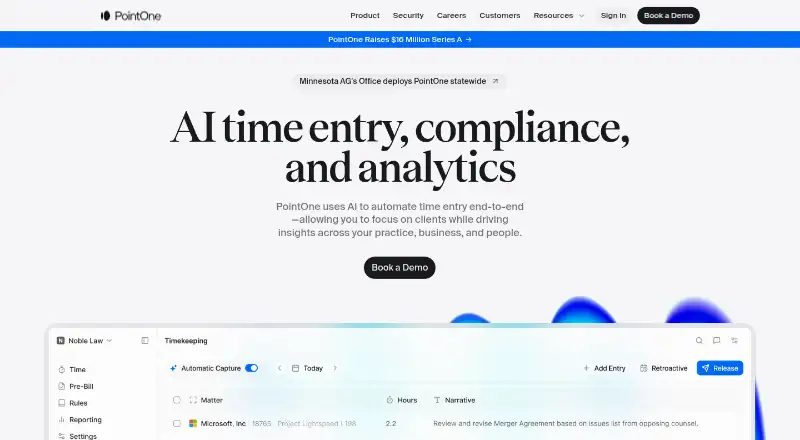
What PointOne is
PointOne is a platform that uses AI to automate law-firm time entry and analyze how work is distributed across a firm. Its timekeeping product captures activity and creates entries describing work performed; users can also enter time later for any date range. AI timers can draft narratives, and generated entries can follow firm and client billing rules. PointOne says it captures context from documents, email, calls, the web, and other work apps. AI-assisted pre-bill review flags issues and suggests fixes. PointOne Rules stores Outside Counsel Guidelines and extracts structured billing rules, while the company describes it as enforcing billing compliance automatically. PointOne Intelligence analyzes time data to surface patterns, bottlenecks, and inefficiencies. Listed integrations include Clio, Elite, Microsoft 365, SharePoint, QuickBooks, RingCentral, Webex by Cisco, and other legal, accounting, and communications systems. The company says it holds SOC 2 Type 2 and ISO 27001 certifications and complies with GDPR and HIPAA requirements. It says firm data is not used to train AI models and models retain no data. Pricing is available on request.
Good
- Creates time entries from captured activity.
- Supports retroactive entries over any date range.
- AI timers can draft entry narratives.
- Includes pre-bill review and billing-rule tools.
- Offers integrations including Clio and Microsoft 365.
Watch out
- Pricing is available on request.
- The platform is focused on law firms.
Who it suits
PointOne is intended for law firms seeking automated time capture, billing-rule support, and analysis of time data. Its listed platforms include iOS, macOS, web, and Windows.
Verdict
PointOne brings time capture, billing review, guideline management, and time analysis together for law firms. Firms considering it should request pricing and assess its deployment and data-handling options.
The facts
Each one read from PointOne's own pages, with the date it was checked.
What it does
- Activity context
- PointOne says it captures context from documents, email, calls, the web, and other apps used at work.checked 4 Oct 2026
- AI data handling
- PointOne says it does not train AI models on firm data and AI models retain no data.checked 5 Oct 2026
- AI insights
- PointOne Intelligence analyzes time data to help firms understand how people spend their time and identify patterns, bottlenecks, and inefficiencies.checked 4 Oct 2026
- AI timers
- PointOne can generate narratives for time entries created with timers.checked 5 Oct 2026
- Analytics
- PointOne Intelligence provides time analysis to help firms identify patterns, bottlenecks, and inefficiencies.checked 5 Oct 2026
- Automatic timekeeping
- PointOne Time captures a user's day and generates time entries describing the work performed.checked 5 Oct 2026
- Compliance product
- PointOne Rules stores and manages Outside Counsel Guidelines in one place and is described as enforcing billing compliance automatically.checked 4 Oct 2026
- Deployment
- The company describes configurable deployments, full data segregation, customizable retention and geolocation, single-tenant enterprise options, and compatibility with on-premises systems.checked 4 Oct 2026
- Deployment options
- Security options include full data segregation, customizable data retention and geolocation, single-tenant enterprise deployments, and compatibility with on-prem systems.checked 5 Oct 2026
- Integrations
- Listed integrations include Clio, Microsoft 365, SharePoint, QuickBooks, Filevine, Aderant, RingCentral, and Webex by Cisco.checked 5 Oct 2026
- Intended users
- PointOne describes its products as automating work for lawyers and helping law firms improve efficiency and make data-driven decisions.checked 5 Oct 2026
- Outside counsel guidelines
- PointOne Rules stores and manages Outside Counsel Guidelines and extracts structured billing rules from them.checked 5 Oct 2026
- Pre-bill review
- PointOne's platform describes an AI billing copilot that marks up pre-bills, flags problems, and suggests fixes.checked 5 Oct 2026
- Purpose
- PointOne uses AI to automate time entry for law firms and provide insights across their practices, businesses, and people.checked 5 Oct 2026
- Retroactive capture
- Users can create entries for past work over any date range, including at the end of a day, week, or month.checked 5 Oct 2026
- Security
- The company states that it has SOC 2 Type 2 certification, ISO 27001 certification, and GDPR and HIPAA compliance.checked 4 Oct 2026
- Security certifications and compliance
- PointOne states that it is SOC 2 Type 2 certified, ISO 27001 certified, GDPR compliant, and meets HIPAA requirements.checked 5 Oct 2026
- Support
- PointOne says everyone on its team spends time directly supporting customers on a daily basis.checked 5 Oct 2026
- Time capture
- Its timekeeping product can capture activity automatically and generate time entries describing work performed.checked 4 Oct 2026
- Who it serves
- PointOne describes its products as helping law firms improve efficiency and make more data-driven decisions.checked 4 Oct 2026
Money
- Billing rules
- AI-generated time entries can be configured to comply with firm and client billing rules.checked 5 Oct 2026
The company
- Headquarters
- The company says it is based in New York City.checked 5 Oct 2026
The full review of PointOne
PointOne is an AI-assisted timekeeping and billing platform for law firms. It best suits firms seeking to connect time capture with guideline compliance and analysis; its breadth is useful, but custom pricing makes it harder to compare before a sales conversation.
Overview
PointOne brings time entry, billing-rule management, pre-bill review, and firm-wide time analysis into one product family. That combination may appeal to firms looking beyond basic timers toward more consistent billing and insight into how work is distributed. Firms that chiefly need an inexpensive, transparent time tracker may find its custom-priced, law-firm-focused approach a poor fit.
Key features
Capture and time entry
PointOne Time captures activity and generates entries describing work performed, using context from documents, email, calls, the web, and other work apps. Users can also create entries retrospectively for any date range, including at the end of a day, week, or month, and AI timers can generate narratives. This flexibility helps accommodate different timekeeping habits, though firms should assess whether automatic activity capture suits their policies and workflows.
Billing rules and pre-bill review
PointOne Rules stores Outside Counsel Guidelines and extracts structured billing rules; the platform says it can enforce compliance automatically. AI-generated entries can also be made to comply with firm and client billing rules. AI-assisted pre-bill review flags problems and suggests fixes, giving billing teams a further opportunity to catch issues before invoices go out. These tools make the product more relevant to firms managing client-specific requirements than a tracker focused only on recording hours.
Time analysis
PointOne Intelligence analyzes time data to help firms identify patterns, bottlenecks, and inefficiencies across practice, business, and people. That can support more data-driven operational decisions, but firms seeking only individual time capture may not need this broader layer.
Integrations and safeguards
The integrations page names Clio, Elite, Surepoint, LeanLaw, Microsoft 365, SharePoint, TimeSolv, QuickBooks, MyCase, Juris, Filevine, Aderant, RingCentral, and Webex by Cisco. PointOne states that it holds SOC 2 Type 2 and ISO 27001 certifications and is GDPR compliant and meets HIPAA requirements. It says firm data is not used to train AI models and models retain no data, and offers private Azure cloud model use. Deployment options include full data segregation, customizable retention and geolocation, single-tenant enterprise deployments, and compatibility with on-premises systems. Those options may matter to firms with particular security or infrastructure needs; buyers should determine which configuration fits their requirements.
Pricing
PointOne is paid software with custom pricing on request. With no public plan tiers or prices to compare, firms should request a quote and evaluate it against their expected deployment and workflow needs. This is a less convenient starting point for smaller firms or buyers who need to screen costs before speaking with a vendor.
Platforms
PointOne is available on iOS, macOS, web, and Windows. Mobile access is listed for iOS, so firms whose lawyers rely on Android mobile access may prefer to consider alternatives with Android support.
Who it's for
PointOne is aimed at law firms seeking to automate lawyers’ timekeeping and improve operational efficiency and data-driven decisions. It is especially relevant where billing guidelines, pre-bill review, time analysis, or configurable data handling matter alongside time capture. Firms wanting a simple, publicly priced tracker, or requiring Android mobile access, should compare other options.
Pros and cons
- Pros: Activity capture, retrospective entry, and narrative-generating timers offer several ways to record work.
- Pros: Guideline management, automated billing-rule compliance, and pre-bill review address multiple points in the billing workflow.
- Pros: Time analysis can surface patterns and bottlenecks beyond individual time entry.
- Pros: Multiple deployment and data-handling options may suit firms with specific security or infrastructure requirements.
- Cons: Custom pricing makes upfront cost comparisons difficult.
- Cons: The listed mobile platform is iOS, which may not fit firms needing Android access.
Alternatives
Browse legal time tracking software to compare more options. Choose Bill4Time if a freemium option and a published monthly Time & Billing plan at $49 a month suit your needs; that plan includes time tracking, task and client management, a client portal, and expense management. Chrometa is worth considering for published monthly pricing: Standard is $19 a month with unlimited time entries, while Plus is $29 a month with unlimited projects. iTimekeep may suit buyers who want a free trial and Android access, with pricing available by requesting a demo or trial. Laurel offers one price for everything and supports Android, iOS, web, Windows, and API; contact it for a demo. RTG Bills starts at $15.95 a month for one user, with price varying by user count, and offers a free trial; pick it if per-user pricing and a broad platform range matter. WiseTime may suit teams seeking an enterprise plan with unlimited team members and data retention up to two years; pricing options come through a demo request. LeanLaw is an alternative with a free trial and a Core plan at $55 per user / month, including time and expense tracking, e-payments, reporting, trust accounting, and professional services. Consider Billables AI as another option for macOS, web, and Windows.
Verdict
PointOne is a strong candidate for law firms that want time capture tied to guideline enforcement, pre-bill review, and time analysis, especially when flexible deployment and data handling are priorities. Its main drawback is the lack of public pricing, so firms that need a clear cost comparison or Android mobile access should look elsewhere.
Getting started
- Visit the PointOne website
- Request pricing from the company
- Choose a deployment configuration that fits the firm’s data segregation, retention, and geolocation requirements
- Connect relevant tools from the listed integrations
- Use iOS mobile access if needed
Questions
How much does PointOne cost?
Pricing is available on request.
Which platforms are listed?
PointOne lists iOS, macOS, web, and Windows.
What integrations are available?
The listed integrations include Clio, Elite, Surepoint, LeanLaw, Microsoft 365, SharePoint, TimeSolv, QuickBooks, MyCase, Juris, Filevine, Aderant, RingCentral, and Webex by Cisco.
How does PointOne handle firm data for AI?
PointOne says firm data is not used to train AI models and that the models retain no data. It also offers private Azure cloud model use.
What security credentials does the company state?
PointOne states that it has SOC 2 Type 2 and ISO 27001 certifications, is GDPR compliant, and meets HIPAA requirements.
What deployment options does PointOne describe?
Options include full data segregation, customizable retention and geolocation, single-tenant enterprise deployments, and compatibility with on-premises systems.