
PM4Py
PM4Py is a Python library for developers who want to run process mining algorithms from their own code.
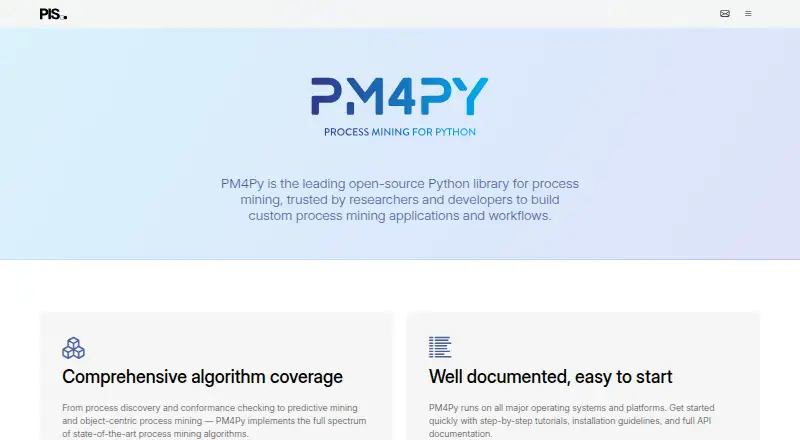
What PM4Py is
PM4Py is a Python library for developers who want to run process mining algorithms from their own code. From event data, it can discover directly-follows graphs, Petri nets, BPMN models, and process trees, and compare observed behavior with process models using replay and alignment-based measures. Its object-centric mining supports logs where events relate to multiple object types, such as orders, items, and deliveries. PM4Py imports and exports event logs, including XES and OCEL 1.0 and 2.0 formats. It also provides machine-learning feature extraction for use with pandas and scikit-learn. The library is free under AGPL v3; covered work using it must be published under AGPL when distributed or made available over a network. A commercial license permits closed-source use, with pricing available by quote. Commercial evaluation without open-sourcing code is available through a requested evaluation license. PM4Py is available for Linux, macOS, Windows, and API use; the maker recommends pip installation and provides Windows and Linux instructions. Graphviz must be installed and configured for visualization features.
Good
- Discovers several process model types
- Supports replay and alignment-based comparison
- Imports and exports XES and OCEL logs
- Feature extraction works with pandas and scikit-learn
Watch out
- Graphviz is required for visualization
- AGPL requires covered distributed or network-accessible work to use AGPL
- Community version lists no support
Who it suits
PM4Py is aimed at developers, data scientists, and researchers building process-mining workflows in Python. Teams needing closed-source commercial use should consider its commercial license and quote-based pricing.
Verdict
PM4Py offers process discovery, conformance checking, and object-centric mining in a Python library. Check the AGPL obligations and Graphviz requirement before choosing the free community version.
Plans and prices
From PM4Py's own pricing page, checked 7 Oct 2026.
| Plan | Price | What it gives you |
|---|---|---|
| Community Version | Free | AGPL v3 · teaching, research, and open-source projects · covered work must be published under AGPL · Free of charge |
| Commercial Version | Priced on request | Closed-source commercial use · regular releases · early feature access · dedicated professional support · Request a Quote ([email protected]) |
The facts
Each one read from PM4Py's own pages, with the date it was checked.
What it does
- Audience
- The maker describes PM4Py as built for developers, data scientists, and researchers.checked 7 Oct 2026
- Conformance
- It supports comparing observed behavior with process models, including replay and alignment-based measures.checked 7 Oct 2026
- Discovery
- It can discover directly-follows graphs, Petri nets, BPMN models, and process trees from event data.checked 7 Oct 2026
- Evaluation
- The maker says commercial evaluation without open-sourcing code is available by requesting a specific evaluation license.checked 7 Oct 2026
- Event data
- The feature list states that PM4Py imports and exports event logs, supports XES, and supports OCEL 1.0 and OCEL 2.0.checked 7 Oct 2026
- Installation
- The maker provides Windows and Linux installation instructions and recommends installing with pip.checked 7 Oct 2026
- License limit
- The maker says AGPL-covered software using PM4Py must be published under AGPL when distributed or made available over a network; a commercial license permits closed-source use.checked 7 Oct 2026
- Maintenance
- The maker says Process Intelligence Solutions GmbH has been responsible for PM4Py’s development, maintenance, distribution, and licensing since 2024.checked 7 Oct 2026
- Object-centric mining
- It can analyze event logs where events relate to multiple object types, such as orders, items, and deliveries.checked 7 Oct 2026
- Product
- PM4Py is a Python library that lets developers call process mining algorithms from their own code.checked 7 Oct 2026
- Python ecosystem
- The maker shows machine-learning feature extraction for use with pandas and scikit-learn.checked 7 Oct 2026
- Support
- The commercial version includes dedicated professional support; the community version lists no support.checked 7 Oct 2026
- Visualization requirement
- Graphviz must be installed and configured to use PM4Py’s visualization features.checked 7 Oct 2026
The full review of PM4Py
Overview
PM4Py is a Python library for building process-mining workflows directly into code, rather than working through a standalone interface. It is best suited to developers, data scientists, and researchers who need to analyze event data in Python. Its broad mining capabilities are compelling, but the AGPL terms and Graphviz setup make it a poor fit for some commercial and less technical teams.
Key features
Discovery and conformance
PM4Py can derive directly-follows graphs, Petri nets, BPMN models, and process trees from event data. That range gives technical users several ways to represent a process, while replay and alignment-based measures help compare observed behavior with a model. Conformance checking and root-cause analysis are supported, but data refresh is manual, so recurring analysis needs a workflow that handles updates.
Event data and object-centric mining
The library imports and exports event logs and supports XES, as well as OCEL 1.0 and OCEL 2.0. Object-centric analysis can account for events linked to multiple kinds of objects, such as orders, items, and deliveries. This makes PM4Py a stronger fit for event data that does not map neatly to a single case-based view.
Python workflow and visualization
PM4Py can extract machine-learning features for use with pandas and scikit-learn, making it relevant to teams that want process analysis alongside data-science work. Installation is through pip, with Windows and Linux instructions provided. Visualization requires Graphviz to be installed and configured, an extra setup step that may matter to teams seeking a ready-made interface.
Pricing
The Community Version costs nothing. It is intended for teaching, research, and open-source projects, and covered work must be published under AGPL v3. The free version lists no support, so it suits teams able to manage their own implementation and maintenance.
The Commercial Version has custom pricing: request a quote at [email protected]. It permits closed-source commercial use and includes regular releases, early feature access, and dedicated professional support. Commercial evaluation without open-sourcing code is available through a specific evaluation license. The choice is not simply free versus paid: organizations distributing AGPL-covered software or making it available over a network must publish the covered work under AGPL unless they obtain a commercial license.
Platforms
PM4Py is available as an API on Linux, macOS, and Windows. It is self-hosted, so teams control where their code and event data run; there is no automatic refresh to remove the need for data-pipeline work.
Who it's for
PM4Py is a strong choice for developers, data scientists, and researchers who want process mining as part of a Python codebase, need object-centric analysis, or plan to connect process features with pandas and scikit-learn. It is less suited to teams that want a graphical, managed service, hands-off data refresh, or closed-source commercial use without licensing work.
Pros and cons
Pros
- Multiple discovery outputs: directly-follows graphs, Petri nets, BPMN models, and process trees support different ways to inspect discovered processes.
- Object-centric event analysis: support for multiple object types and OCEL 1.0 and 2.0 fits logs that span entities such as orders, items, and deliveries.
- Python ecosystem fit: feature extraction for pandas and scikit-learn helps bring process data into machine-learning workflows.
- Free community option: teaching, research, and open-source projects can use the Community Version at no charge.
Cons
- AGPL obligations: covered work distributed or made available over a network must be published under AGPL unless using a commercial license, which can rule out the free version for proprietary products.
- Extra visualization setup: Graphviz must be installed and configured before using visualization features.
- Manual refresh and self-hosting: teams must run their own environment and update data themselves.
- No community-version support: users need to handle implementation issues without dedicated professional support.
Alternatives
For a broader category comparison, see Process Mining Software.
- Mindzie Process Mining is worth considering if a desktop product is preferable: its free desktop edition includes full functionality for up to 1,000 cases and has no time-limited trial.
- Celonis Process Mining Platform is a paid alternative with a free plan; its listed platforms include API, web, and Windows.
- ProcessMind may suit teams looking for a web-based option with a free plan and trial; its Free plan covers one member, unlimited models, and 20 AI credits per month, with no additional seats or free viewer seats.
- ARIS is another paid option, available through API, self-hosted, web, and Windows platforms.
- Cortado is a free alternative for Linux, macOS, and Windows.
- Pega CRM is a paid web option with a free trial.
- RuM is a free alternative for Linux, macOS, and Windows.
- UiPath Maestro Case Management offers a free trial and is self-hosted.
Verdict
Choose PM4Py if your team can work in Python and wants flexible process discovery, conformance checking, and object-centric mining within its own workflows. Its strongest reason to choose it is the breadth of analysis and event-data support in a free community library. Look elsewhere if you need a managed interface or cannot accept AGPL obligations; commercial closed-source use requires a separate license.
Getting started
- Open the PM4Py website.
- Choose the free Community Version or request a Commercial Version quote.
- Install with pip, following the maker's Windows or Linux instructions as applicable.
- Install and configure Graphviz if you need visualization features.
- Request the specific evaluation license for commercial evaluation without open-sourcing code.
Limits worth knowing
The free Community Version is covered by AGPL v3; covered work using PM4Py must be published under AGPL when distributed or made available over a network. Graphviz is required for visualization features.
Questions
Is PM4Py free?
The Community Version is free of charge at no cost. A Commercial Version is also offered at a price available by quote.
Can I use PM4Py in a closed-source commercial project?
The Commercial Version permits closed-source commercial use. The free Community Version is under AGPL v3, with publication requirements for covered work when distributed or made available over a network.
Which platforms does PM4Py support?
The listed platforms are Windows, Linux, and macOS, as well as API use.
What event log formats does PM4Py support?
It imports and exports event logs and supports XES, OCEL 1.0, and OCEL 2.0.
What does the Commercial Version include?
It lists regular releases, early feature access, and dedicated professional support. Pricing is available by quote.
Is Graphviz required?
Graphviz must be installed and configured to use PM4Py's visualization features.
Alternatives to PM4Py
- 1

ProcessMind
Free planWebAPI6.9From €29 a month - 2
Mindzie Process Mining
Free planWebAPImacOSSelf-hosted6.6Free plan - 3

QPR ProcessAnalyzer
WebSelf-hosted6.4 - 4

Celonis Process Mining Platform
Free planWebAPIWindows6.3Free plan - 5

Pega RPA
WebSelf-hostedWindows6.3 - 6

Process.Science
WebSelf-hostedWindows6.2