plain
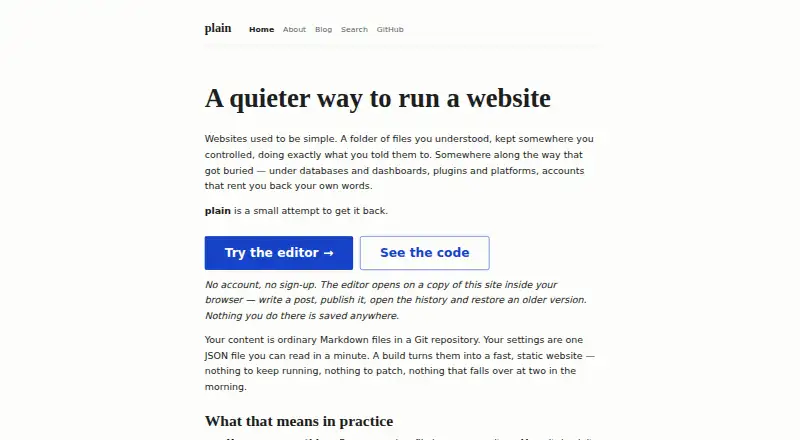
plain turns Markdown and JSON files in a Git repository into a static website, with a browser admin for people who would rather not work directly with Git.
What plain is
plain turns Markdown and JSON files in a Git repository into a static website, with a browser admin for people who would rather not work directly with Git. The admin edits Markdown with live preview, media uploads, drafts, version history, and optional AI writing suggestions. Saving changes creates a commit, and earlier versions can be restored. Published pages are HTML and CSS, so visitors do not need JavaScript to read them. The static output can be hosted wherever static files are served, without running a server or database. Content remains in Markdown files, with settings stored in JSON. The admin uses a GitHub access token scoped to the site repository; the project says the token stays in the browser except when sent to api.github.com. Optional writing help requires a user-provided Anthropic API key, which stays in the browser and is sent to Anthropic. Each build publishes read-only JSON files that scripts and apps can access without keys or rate limits. The project also includes fifteen starter themes, importers for Jekyll, VuePress, and Joomla, and optional plugins. plain is open source and free, and is listed for web, API, and self-hosted use.
Good
- Live preview, drafts, and version history
- Published pages need no JavaScript to read
- Static output needs no server or database
- Read-only JSON files need no keys or rate limits
- Includes fifteen starter themes
Watch out
- Editing and publishing use GitHub commits
- Optional AI suggestions require an Anthropic API key
- No visual editor
Who it suits
plain suits site owners who want to manage Markdown content in a browser while keeping content in Git. It also fits projects that want static output and a read-only JSON API.
Verdict
plain is a fit for Git-based content workflows that publish static pages and JSON files. Its browser admin offers a way to edit without working directly in Git, while hosting remains self-managed.
The facts
Each one read from plain's own pages, with the date it was checked.
What it does
- AI features
- Optional AI writing assistance uses a user-provided Anthropic API key, which stays in the browser and is sent to Anthropic.checked 9 Oct 2026
- API
- Each build publishes read-only JSON API files that need no keys and have no rate limits.checked 9 Oct 2026
- Audience
- The About page describes the browser admin as an option for people who would rather not work directly with Git.checked 9 Oct 2026
- Content API
- Each build publishes read-only JSON files that scripts, apps, or AI agents can consume without keys or rate limits.checked 9 Oct 2026
- Content storage
- Content is stored as Markdown files in a Git repository, with settings in a JSON file.checked 9 Oct 2026
- GitHub sign-in
- The repository instructions describe signing in to the admin with a GitHub access token scoped to the site repository.checked 9 Oct 2026
- Hosting
- The static site can be hosted anywhere static files live, with no server or database to run.checked 9 Oct 2026
- Integrations
- The repository describes optional plugins for search, contact forms, reading time, forms sent to a configured backend, and GoatCounter page-view counts.checked 9 Oct 2026
- Intended users
- The About page describes the browser admin as intended for people who would rather not use Git directly.checked 9 Oct 2026
- Migration
- The repository includes importers for Jekyll, VuePress, and Joomla, which create content, media, and redirect files for review.checked 9 Oct 2026
- Open source
- plain is open source and licensed under MIT.checked 9 Oct 2026
- Optional AI
- The admin can use an Anthropic API key for optional writing suggestions, and the key stays in the browser and is sent only to Anthropic.checked 9 Oct 2026
- Plugins
- The project includes search and reading-time plugins, plus a contact-form plugin described as a disabled reference.checked 9 Oct 2026
- Product
- plain turns Markdown and JSON files in a Git repository into a static website.checked 9 Oct 2026
- Published sites
- The published site is plain HTML and CSS and requires no JavaScript to read.checked 9 Oct 2026
- Publishing
- Each save in the browser admin writes a commit to the repository, and older versions can be restored.checked 9 Oct 2026
- Runtime
- The About page describes one runtime dependency and a core small enough to read in an afternoon.checked 9 Oct 2026
- Static output
- The published site is plain HTML and CSS, and reading it does not require JavaScript.checked 9 Oct 2026
- Themes
- The repository says fifteen starters ship with the product, covering uses such as blogs, portfolios, restaurants and documentation.checked 9 Oct 2026
- Token handling
- The repository instructions state that the GitHub token stays in the browser except when sent to api.github.com.checked 9 Oct 2026
Where it runs
- Browser editor
- The browser admin edits Markdown with a live preview, media uploads, drafts, version history, and optional AI help.checked 9 Oct 2026
The company
- Maker details
- The About page does not state the maker's name, headquarters, or founding date.checked 9 Oct 2026
Alternatives to plain
- 1

CrafterCMS
Free planOpen sourceWebAPILinuxmacOS8.3Free plan - 2

deco CMS
Free planOpen sourceWebAPImacOSSelf-hosted7.9Free plan - 3

Kiln
Free planOpen sourceWebAPISelf-hosted7.9From $4.99 a month - 4

Keystatic
Free planOpen sourceWebAPISelf-hosted7.6From $10 a month - 5
Quiqr
Free planOpen sourceWebLinuxmacOSSelf-hosted7.5Free plan - 6
Siteleaf
Free planWebAPI7.4From $7 a month