
PlaidCloud Operational Transfer Pricing
PlaidCloud Operational Transfer Pricing is software for managing intercompany transaction prices, invoices, and journal entries across entities, systems, and…
What PlaidCloud Operational Transfer Pricing is
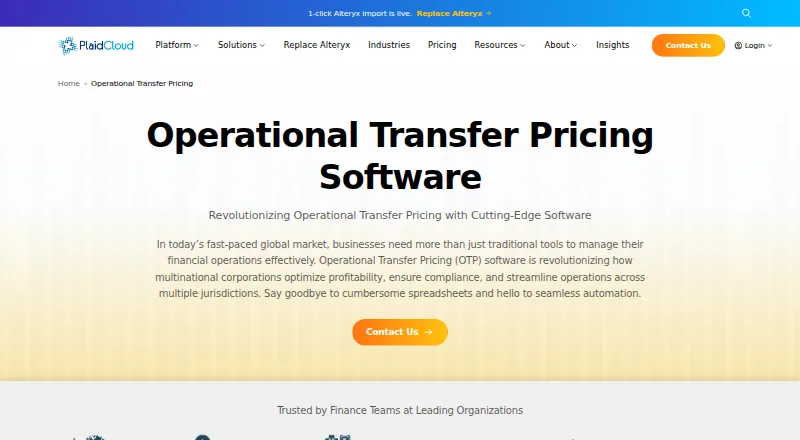
PlaidCloud Operational Transfer Pricing is software for managing intercompany transaction prices, invoices, and journal entries across entities, systems, and jurisdictions. It is designed for mid-market multinational finance teams and connects with existing ERP infrastructure, including SAP, Oracle, and Microsoft Dynamics. The platform supports monthly price resets, profitability monitoring by segment, exception handling, and country-by-country reporting. It can calculate prices, coordinate journal entries, and generate country-compliant invoices. Listed tools include flexible allocation models, automated workflows and compliance checks, multi-currency reporting, dashboards, audit documentation, and scenario analysis. PlaidCloud says records retain traceable links from source ERP data through calculations, adjustments, invoices, and posted journal entries. The product has web, API, and self-hosted options, an open Iceberg lakehouse, and more than 140 connectors. A permanent free plan is available; paid Starter is listed at $800/mo billed annually, and a 7-day trial is offered for paid Starter and Team plans. PlaidCloud says data is encrypted in transit and at rest and workflows run in isolated environments.
Good
- Supports monthly price resets and segment profitability monitoring.
- Connects with SAP, Oracle, and Microsoft Dynamics.
- Includes country-compliant invoices and coordinated journal entries.
- Offers more than 140 connectors.
- Provides web, API, and self-hosted options.
Watch out
- Starter is $800/mo billed annually.
- Paid Starter and Team trials last seven days.
- Free plan includes one builder and one workspace.
- Free plan allows 100 workflow runs monthly.
Who it suits
This product is suited to mid-market multinational finance teams managing intercompany pricing and reporting across jurisdictions. It may also suit teams that want ERP-connected calculations, invoices, and journal entries with traceable records.
Verdict
PlaidCloud brings intercompany pricing calculations, finance workflows, and reporting into an ERP-connected platform. Its free plan has limited workspace and workflow capacity, and the listed Starter price is billed annually.
Plans and prices
From PlaidCloud Operational Transfer Pricing's own pricing page, checked 14 Oct 2026.
| Plan | Price | What it gives you |
|---|---|---|
| Free | Free | 1 builder · unlimited viewers · 15 GB storage · 1 workspace · 100 workflow runs/month · community support · Forever |
| Starter | $800 a month | 4 builders · unlimited viewers · 50 GB storage · 10,000 workflow runs/month · $75/TB storage overage · Billed annually; $900/month month to month |
| Team | $5,000 a month | 25 builders · unlimited viewers · 500 GB storage · unlimited workflow runs · $75/TB storage overage · Billed annually; $6,000/month month to month |
| Business | Priced on request | 100 builders · unlimited viewers · 5 TB reserved storage · up to 5 workspaces · Custom pricing |
| Enterprise | Priced on request | Unlimited builders · 5 TB plus multi-region storage · unlimited workspaces · dedicated or customer-provided cluster option · Custom pricing |
The facts
Each one read from PlaidCloud Operational Transfer Pricing's own pages, with the date it was checked.
What it does
- API and SDK access
- PlaidCloud documents OAuth-secured JSON-RPC access and provides PlaidCloud client libraries for Panel apps.checked 14 Oct 2026
- Audit lineage
- The product page says price calculations, adjustments, invoices, and journal entries are stored with traceable lineage from source ERP data to posted output.checked 29 Sep 2026
- Audit traceability
- The product says it retains transaction-level audit traceability and flags exceptions for review.checked 14 Oct 2026
- Calculations and outputs
- PlaidCloud says it connects to existing ERP infrastructure to calculate prices, post coordinated journal entries, and generate country-compliant invoices.checked 29 Sep 2026
- Country reporting
- Country-by-country reporting is included in the stated transfer-pricing capabilities.checked 14 Oct 2026
- Data protection
- PlaidCloud says data in transit uses HTTPS with modern SSL/TLS, file-based content is encrypted at rest in Google Cloud Storage, and workflows run in isolated environments.checked 29 Sep 2026
- Documentation scope
- The public reference covers workflow steps, expressions, connectors, CLI commands, and a glossary, while separate guides explain integrations and app creation.checked 14 Oct 2026
- ERP and data integrations
- PlaidCloud lists connections for ERP systems including SAP, Oracle, NetSuite, Workday, and Infor, alongside databases and cloud data services.checked 14 Oct 2026
- Features
- Listed OTP features include flexible allocation models, automated workflows, multi-currency reporting, real-time dashboards, audit-ready documentation, scenario analysis, and automated compliance checks.checked 29 Sep 2026
- Generic REST integration
- A generic REST connection supports Basic, API-key, bearer-token, and OAuth 2.0 authentication and can use OpenAPI or Swagger definitions.checked 14 Oct 2026
- Hosting and deployment
- PlaidCloud describes its service as cloud-based and says Enterprise customers can use a dedicated or customer-provided AWS, Azure, or GCP cluster.checked 14 Oct 2026
- Integrations
- The OTP page says the software connects with existing ERP infrastructure and identifies SAP, Oracle, and Microsoft Dynamics as examples of leading ERP systems.checked 29 Sep 2026
- Intended users
- The product page says it is purpose-built for mid-market multinational finance teams.checked 29 Sep 2026
- Invoices and journal entries
- PlaidCloud says it can automate invoicing and journal entries for transfer-pricing workflows.checked 14 Oct 2026
- License status
- The pages reviewed describe a paid SaaS platform and an open Iceberg data format but do not state a software license or explicitly say whether PlaidCloud itself is open source.checked 14 Oct 2026
- MCP integration
- The documentation says each workspace has an MCP server that exposes workflow, table, connection, and lakehouse operations to AI agents.checked 14 Oct 2026
- Microsoft Excel add-in
- Microsoft AppSource describes a PlaidCloud Office add-in for accessing PlaidCloud data in Excel and says a paid subscription is needed for full use.checked 14 Oct 2026
The company
- Company experience
- PlaidCloud says its founders have over 40 years of combined experience across financial analytics, enterprise consulting, and industrial corporations.checked 29 Sep 2026
- Company founded
- LinkedIn lists PlaidCloud as founded in 2006.checked 14 Oct 2026
- Company headquarters
- CB Insights lists PlaidCloud's headquarters as Pittsburgh, Pennsylvania.checked 14 Oct 2026
- Legal company name
- The company announced that Tartan Solutions, Inc. changed its name to PlaidCloud, Inc.checked 14 Oct 2026
- LinkedIn company size
- PlaidCloud's LinkedIn company profile lists its size as 11–50 employees and its type as privately held.checked 14 Oct 2026
Money
- Limit: Price
- A G2 reviewer complained that PlaidCloud charges felt high compared with similar products.checked 14 Oct 2026
- Monthly price resets
- The product supports monthly transfer-price resets and adjustments.checked 14 Oct 2026
The full review of PlaidCloud Operational Transfer Pricing
PlaidCloud Operational Transfer Pricing coordinates intercompany pricing work across entities, systems and jurisdictions. It is best suited to mid-market multinational finance teams that need pricing calculations, journal entries and country-compliant invoices tied to ERP data. Its breadth is compelling, but its higher workflow capacity and controls sit behind paid plans.
Overview
The platform is built around the recurring finance cycle: monthly price resets, segment-level profitability monitoring, exception handling and country-by-country reporting. Connecting calculations to existing ERP infrastructure and carrying traceable lineage from source data through adjustments and posted outputs makes it a strong fit for teams that need an auditable operational process, rather than a standalone pricing tool.
PlaidCloud identifies SAP, Oracle and Microsoft Dynamics as ERP examples, and describes its broader platform as an open Iceberg lakehouse with more than 140 connectors. The founders bring over 40 years of combined experience across financial analytics, enterprise consulting and industrial corporations.
Key features
- Operational pricing: Flexible allocation models and automated workflows support recurring price resets and exception handling. This can keep routine work within a finance-controlled process, though teams should weigh the workflow caps on lower tiers.
- Finance outputs: The software calculates prices, coordinates journal entries and generates country-compliant invoices, tying operational decisions to accounting outputs.
- Monitoring and planning: Multi-currency reporting, real-time dashboards and scenario analysis help teams monitor results and consider alternatives across entities and segments.
- Compliance and lineage: Automated compliance checks, documentation workflows and audit-ready records provide traceability from ERP source data to calculations, adjustments, invoices and journal entries. Country-by-country reporting is also supported.
- Security: PlaidCloud says it undergoes an annual SOC 2 Type 2 audit and hosts physical infrastructure in Google data centers. Data in transit uses HTTPS with modern SSL/TLS; file-based content is encrypted at rest in Google Cloud Storage, and workflows run in isolated environments.
Pricing
PlaidCloud uses a freemium model, with a permanent Free plan and a 7-day trial for paid Starter and Team plans. A trial workspace using customer data can also be arranged through a demo. The Free plan is useful for a small evaluation, but its single builder, one workspace and 100 workflow runs per month make it a limited basis for a recurring multinational process.
| Plan | Price and terms | What it includes |
|---|---|---|
| Free | free (billed forever) | 1 builder, unlimited viewers, 15 GB storage, 1 workspace, 100 workflow runs/mo and community support. |
| Starter | $800 a year (billed $800/mo billed annually, or $900/mo month to month) | 4 builders, unlimited viewers, 50 GB storage, $75/TB overage, 10,000 workflow runs/mo and email support with a 1-business-day response. |
| Team | $5,000 a year (billed $5,000/mo billed annually, or $6,000/mo month to month) | 25 builders, unlimited viewers, 500 GB storage, $75/TB overage, unlimited workflow runs, SAML SSO, 90-day audit and 99.5% SLA. |
| Business | Custom pricing | 100 builders, unlimited viewers, 5 TB reserved storage, up to 5 workspaces, premium connectors for SAP, Oracle, Workday and Infor, priority 4-hour support and 99.9% SLA. |
| Enterprise | Custom pricing | Unlimited builders, 5 TB plus multi-region storage, unlimited workspaces, dedicated or BYO cluster on AWS, Azure or GCP, 24/7 named customer success and solution architects, and 99.95% SLA. |
Starter is the entry point for teams that have outgrown Free's run cap, but its annual billing is a substantial commitment and storage beyond 50 GB costs $75/TB. Month-to-month billing is also available at the stated higher price. Team removes the workflow-run ceiling and adds SAML SSO, a 90-day audit and a 99.5% SLA, making it better suited to established teams needing more builders and operational assurance; it still charges for storage beyond 500 GB. Business and Enterprise are the options for larger deployments needing premium connectors, more workspaces, stronger SLAs or dedicated infrastructure. Email support is included with Starter; priority four-hour support begins at Business, and named around-the-clock customer success and solution architects are reserved for Enterprise.
Platforms
PlaidCloud lists API, self-hosted and web platforms, and also describes its platform as hybrid. That range suits organizations connecting finance workflows to existing systems or deployment environments.
Who it's for
This is aimed at mid-market multinational finance teams that manage intercompany pricing across multiple entities and jurisdictions. It is especially relevant where monthly resets, profitability monitoring, compliance documentation and ERP-linked accounting outputs belong in one controlled workflow. A small team with modest run volume may find Free sufficient to explore the process; teams needing sustained throughput, multiple builders or formal service commitments will need a paid tier.
Pros and cons
Pros
- End-to-end operational coverage: Pricing calculations, invoices, journal entries, monitoring and country-by-country reporting sit within one platform.
- Traceable outputs: Audit lineage connects source ERP data to adjustments and posted results, supporting review of how figures were produced.
- Room to scale: Workflow capacity ranges from 100 monthly runs on Free to unlimited on Team, with larger storage, workspace and support provisions on higher tiers.
- Several deployment and integration routes: API, self-hosted and web options accompany ERP connections and a broader connector platform.
Cons
- Free is tightly bounded: One builder, one workspace and 100 monthly runs limit its usefulness for a live, multi-entity operation.
- Paid entry is costly: Starter begins at $800 a year with annual billing, while month-to-month billing is $900/mo; storage overage is an additional $75/TB.
- Important scaling costs require a quote: Business and Enterprise use custom pricing, so larger teams cannot compare their full costs from the plan terms alone.
Alternatives
Browse Transfer Pricing Software for more options in the category. Consider Alphatax if you want a paid option with API, web and Windows platforms and a free trial. ONESOURCE Transfer Pricing is another paid, web-based alternative.
Integral offers either a SaaS platform managed by an in-house team or a fully managed service handled by Integral experts, making it a different choice for teams deciding how much planning and compliance work to retain internally. TPGenie is a paid API and web option from Intra Pricing Solutions, which serves multinational enterprises and advisory firms working in complex transfer-pricing environments. Commenda may suit buyers seeking itemized intercompany agreement, benchmarking and local-file work: a typical first set is from $9,000 (priced on request), comprising $1,500, $3,000 and $4,500 respectively.
Aibidia is a paid web option with no free plan and a 30-day trial for its TP Aurora subscription; the trial includes 10 questions with full answers and source documents. Reptune.net is another paid web option, with an Advanced plan that includes up to 50 local files, unlimited users, four TP expert hours per year and SSO. Moody’s Trade Credit is also a paid, web-based alternative.
Verdict
PlaidCloud Operational Transfer Pricing is a strong candidate for mid-market multinational finance teams that want ERP-linked calculations, accounting outputs and compliance workflows with traceable lineage in one platform. Its clearest advantage is the breadth of the operational cycle; its chief drawback is the cost and commitment needed to move beyond a sharply limited Free plan. Choose it when that connected process and audit trail justify the spend, and look elsewhere if your needs are narrower or a low-cost entry plan matters most.
Getting started
- Visit the PlaidCloud Operational Transfer Pricing website.
- Choose the Free plan or review the paid Starter and Team options.
- Use the 7-day trial for Starter or Team, or book a demo to arrange a trial workspace on customer data.
- Connect the platform with existing ERP infrastructure.
- Select web, API, or self-hosted access.
Limits worth knowing
Free includes 1 builder, 15 GB storage, 1 workspace, and 100 workflow runs per month. Starter includes 4 builders, 50 GB storage with $75/TB overage, and 10,000 workflow runs per month; its listed price is $800/mo billed annually or $900/mo month to month. The 7-day trial applies to paid Starter and Team plans.
Questions
Is there a free plan?
Yes. The Free plan is billed at no cost and includes 1 builder, unlimited viewers, 15 GB storage, 1 workspace, and 100 workflow runs per month.
How much does Starter cost?
Starter is $800/mo billed annually, or $900/mo month to month. Its listed allowance is 4 builders, 50 GB storage, and 10,000 workflow runs per month.
Is a trial available?
Yes. A 7-day trial is offered for paid Starter and Team plans. A trial workspace using customer data can also be arranged by booking a demo.
Which ERP systems does it connect with?
The product connects with existing ERP infrastructure and identifies SAP, Oracle, and Microsoft Dynamics as examples.
What platforms are available?
The listed platforms are API, self-hosted, and web.
What support is included?
Free includes community support. Starter includes email support with a one-business-day response, Business includes priority four-hour support, and Enterprise includes 24/7 named customer success and solution architects.
Alternatives to PlaidCloud Operational Transfer Pricing
- 1
globalDoc Solution
WebSelf-hosted6.9From €10,000 a year - 2

ArmsLength AI Benchmarks
WebAPI6.6From €469 a month - 3

Alphatax
WebAPIWindows6.4 - 4
TP/OS
WebAPI6.4 - 5

Aibidia
WebAPI6.3 - 6

Commenda
WebAPI6.0