Picard.law
Picard.law provides legal document analysis through locally run open-source software and a managed cloud service.
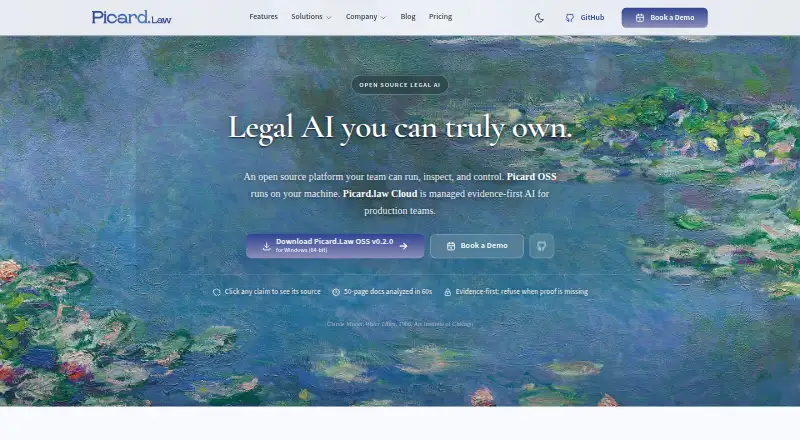
What Picard.law is
Picard.law provides legal document analysis through locally run open-source software and a managed cloud service. Its AI answers questions from uploaded legal documents, grounding responses in citations and refusing when the available evidence does not support an answer. Matter workspaces keep agreements and due-diligence packs together so context remains available across documents. Tabular review extracts information from multiple documents, citing every cell to a page and quotation; the open-source edition can export these tables to Excel. Picard OSS runs on one machine with documents stored locally. It uses BM25 full-text search and CARP retrieval through SQLite FTS5. Picard.law Cloud is managed on Azure and uses Neo4j GraphRAG. The homepage positions OSS for legal engineers and air-gap use, while Cloud targets production legal AI teams. OSS is single-user and has no built-in authentication. Cloud data is encrypted at rest with AES-256 and in transit with TLS 1.3, and documents are not used to train AI models. Users can export or delete their data. The service is available on the web and as self-hosted software.
Good
- Citation-grounded answers with refusal when evidence is absent
- Matter workspaces preserve context across uploaded documents
- Cell-level citations include page and quotation
- OSS offers Excel export for tabular review
- Cloud encryption covers stored and transmitted data
Watch out
- OSS supports one user only
- OSS has no built-in authentication
- OSS users pay model API costs with their own keys
Who it suits
Legal engineers needing locally run, open-source analysis can use Picard OSS, including air-gap environments. Production legal AI teams may prefer the managed cloud deployment with shared matter workspaces and Azure hosting.
Verdict
Choose Picard OSS for local, open-source legal analysis and air-gap workflows, or choose Cloud for managed production deployment. Look elsewhere if you need multi-user authentication in the local edition or want model API costs bundled.
Plans and prices
From Picard.law's own pricing page, checked 8 Oct 2026.
| Plan | Price | What it gives you |
|---|---|---|
| Picard OSS | Free | Zero license cost · AGPL for local development and proof of concept · model API costs paid with your own keys |
| Picard.law Cloud | Priced on request | Managed SaaS / enterprise · contact sales to book a demo |
The facts
Each one read from Picard.law's own pages, with the date it was checked.
What it does
- Data control
- The privacy policy says users can export or delete their data, and that AI providers do not retain document content after processing.checked 8 Oct 2026
- Deployment
- Picard OSS runs on a single machine with documents stored locally, while Picard.law Cloud is managed on Azure.checked 8 Oct 2026
- Document analysis
- The product analyzes legal documents and provides chat answers grounded in citations, with a refusal when evidence is missing.checked 8 Oct 2026
- Founder
- The About page identifies Saurabh as founder and CEO and says Picard.Law was built in 2024.checked 8 Oct 2026
- Integration
- The maker says users can integrate their DMS, but does not name a specific DMS integration on the page.checked 8 Oct 2026
- Intended users
- The homepage describes OSS as suited to legal engineers and air-gap use, and Cloud as suited to production legal AI teams.checked 8 Oct 2026
- Local use limit
- Picard OSS is single-user and has no built-in authentication, according to the product comparison on the homepage.checked 8 Oct 2026
- Matter workspaces
- Matter-scoped workspaces let teams upload agreements and diligence packs and keep context across documents.checked 8 Oct 2026
- Product
- Picard.law offers locally run open-source legal AI and a managed cloud product for production teams.checked 8 Oct 2026
- Search
- Picard OSS uses BM25 full-text search and CARP retrieval on SQLite FTS5, while the cloud version uses Neo4j GraphRAG.checked 8 Oct 2026
- Security
- The privacy policy states that cloud data is encrypted at rest with AES-256 and in transit with TLS 1.3, and documents are not used to train AI models.checked 8 Oct 2026
- Support
- The homepage lists [email protected] as the Help Center contact.checked 8 Oct 2026
- Tabular review
- Tabular review extracts information across documents and cites each cell to a page and quote; the OSS version includes Excel export.checked 8 Oct 2026
The company
- Headquarters
- The homepage says the company is based in Dubai and India and serves global LegalOps teams.checked 8 Oct 2026
The full review of Picard.law
Picard.law is a legal-document analysis platform offered as local open-source software or a managed cloud service. It suits legal engineers, air-gapped projects, and teams that need answers traceable to source documents. The key decision is whether you value local control and your own deployment or a managed production environment.
Overview
Picard.law analyzes uploaded agreements and other legal documents, then answers questions with citations. When the documents do not support an answer, it refuses rather than filling the gap, a useful safeguard for review work that must remain evidence-based.
Matter-scoped workspaces keep agreements and diligence packs together and preserve context across documents. That makes the product more suitable for transaction or matter review than a general chat interface, because answers can be considered against the complete document set.
Picard OSS runs on a single machine and stores documents locally. Picard.law Cloud is managed on Azure. The local deployment is the stronger fit for air-gap requirements and tightly controlled environments; Cloud is aimed at production teams that prefer managed infrastructure.
Key features
Tabular review extracts information across documents and cites every cell to a page and quote. This gives reviewers a direct audit trail for comparisons and diligence tables. The OSS edition can export those tables to Excel, which is useful when findings need to move into an established spreadsheet workflow.
Search technology differs by edition. OSS uses BM25 full-text search and CARP retrieval on SQLite FTS5, while Cloud uses Neo4j GraphRAG. That split gives technically minded buyers a meaningful deployment choice rather than merely a different hosting location.
Users can integrate their document management system, according to the maker. Cloud data is encrypted at rest with AES-256 and in transit with TLS 1.3. The privacy policy also says documents are not used to train AI models, AI providers do not retain document content after processing, and users can export or delete their data. Support is handled through [email protected].
The main local limitation is structural: Picard OSS is single-user and has no built-in authentication. It is therefore appropriate for an individual legal engineer or isolated proof of concept, not a shared departmental installation.
Pricing
Picard OSS
free. This plan has zero license cost and uses the AGPL for local development and proof of concept. You supply and pay for your own model API keys, so the software price is free but model usage is not bundled. Its single-user, unauthenticated design makes it best for personal work, experimentation, or air-gapped deployments rather than collaborative production.
Picard.law Cloud
Custom pricing. Cloud is a managed SaaS and enterprise offering; prospective customers are directed to contact sales to book a demo. It is the relevant option for production legal AI teams that want Azure-managed deployment and do not want to operate the local stack themselves.
Platforms
Picard OSS is self-hosted and runs on a single machine. Picard.law Cloud is delivered on the web as a managed Azure service. The platform split is straightforward: local storage and deployment control on OSS, managed web access on Cloud.
Who it's for
Legal engineers and teams with air-gap requirements should start with OSS, especially when local document storage and open-source development matter more than multi-user administration. It also fits proof-of-concept work where supplying model keys is acceptable.
Production legal AI teams are better served by Cloud because it provides managed deployment. Buyers seeking a shared local edition, built-in authentication, or a license that includes model API consumption should look elsewhere.
Pros and cons
Pros
- Evidence-grounded answers: citations and refusal when evidence is missing reduce unsupported conclusions.
- Useful structured review: cell-level page-and-quote citations make tabular extraction auditable, and OSS adds Excel export.
- Strong deployment control: local storage and self-hosting support air-gap workflows.
- Clear cloud privacy measures: AES-256 at rest, TLS 1.3 in transit, no training use, and export or deletion controls are stated for cloud data.
Cons
- OSS is not collaborative: one user and no built-in authentication rule out a shared local team installation.
- Model costs remain yours: the free OSS license does not include model API fees.
- Cloud pricing requires sales contact: teams cannot compare a public subscription price before arranging a demo.
- Two search stacks add a deployment decision: OSS uses SQLite FTS5-based retrieval while Cloud uses Neo4j GraphRAG, so the editions are not operationally identical.
Alternatives
Lawformer is a better fit when you need macOS, Windows, or web access and a lifetime-free Community package, with a separate Corporate offering.
Kahana suits teams wanting a web workspace with a published free tier: three hubs, 10 counted uploads per hub, unlimited members, 5 MB files, and a 5% transaction fee.
Foundation Firm Intelligence is a paid web alternative.
HighQ is a paid option spanning web, mobile, desktop, API, and self-hosted deployments, with demo-based pricing.
Legal Assistant is a paid web product with pricing provided by demo or contact.
Lexsoft T3 is a paid API, self-hosted, and web platform sold on an annual subscription.
Inmagic Presto is a paid option offered as Lucidea-hosted SaaS or subscription-licensed software.
Litera CAM Litigation Hold is a paid web add-on for CAM C3 and above licenses, available for iManage and NetDocuments.
For broader category comparisons, see Legal Knowledge Management Software and AI Legal Research Software.
Verdict
Choose Picard.law when citation-grounded document analysis, matter context, and deployment control are central to your workflow. Picard OSS is particularly compelling for legal engineers and air-gapped proof-of-concept work. Look elsewhere if your local deployment must support multiple authenticated users or if you want model API costs included in the software price.
Getting started
- Open the Picard.law website
- Choose the self-hosted OSS edition or Picard.law Cloud
- Run Picard OSS on a single machine, or contact sales to book a Cloud demo
- Upload agreements or diligence packs into a matter workspace
- For OSS, supply your own model API keys and pay their usage costs
Limits worth knowing
Picard OSS is single-user and has no built-in authentication. Its free plan covers the AGPL software, while model API costs are paid with your own keys.
Questions
Is Picard.law free?
Picard OSS is free under AGPL for local development and proof of concept. Model API costs are paid with your own keys.
What platforms are supported?
Picard.law is available as self-hosted software and on the web.
Does it provide citations?
Yes. Answers cite supporting legal documents, and tabular review cites each cell to a page and quotation.
Is Picard.law open source?
Picard OSS is open-source software licensed under AGPL for local development and proof of concept.
How is cloud data protected?
Cloud data is encrypted at rest with AES-256 and in transit with TLS 1.3. Documents are not used to train AI models.
Who founded Picard.law?
The About page identifies Saurabh as founder and CEO.
Alternatives to Picard.law
- 1
Lawformer
Free planWebmacOSWindows7.0Free plan - 2
Kahana
Free planWeb6.6From $29.99 a month - 3

Lexis+
AndroidiOSWeb6.5 - 46.3
- 5
Inmagic Presto
AndroidiOSWebAPI6.1 - 6

HighQ
AndroidiOSWebAPI5.9