
Payroll Engine
Payroll Engine is an open-source framework for embedding payroll processing in larger software platforms.
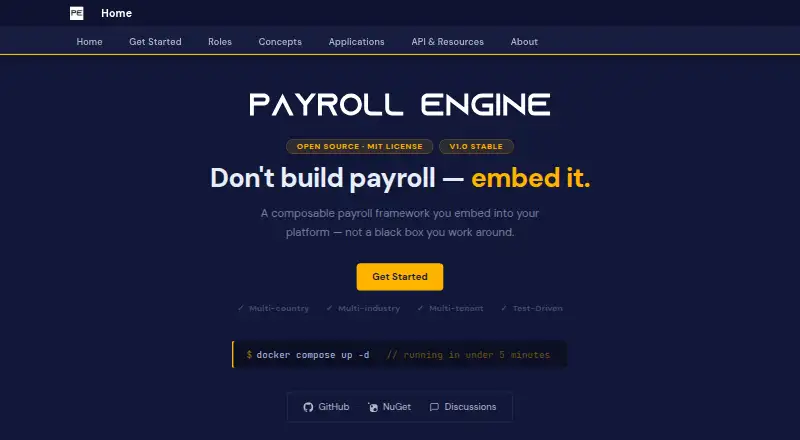
What Payroll Engine is
Payroll Engine is an open-source framework for embedding payroll processing in larger software platforms. Its backend processes payroll data through a REST API with configurable regulation layers, supporting time-stamped data and recurring or non-recurring payruns. It can produce payslip, legal-filing, and data-exchange reports. The framework is released under the MIT License, while country regulations are commercial. Its API covers tenant and employee management, payrun jobs, result queries, report output, and backend event webhooks. A browser application provides management for regulations, case data, tasks, reports, payruns, and developer logs. Developers also get a .NET Client SDK and a built-in test framework for validating cases, payrun results, and regressions. The backend is intended for local or Docker Compose deployment, and users must provide the database separately. API key and OAuth authentication are supported but disabled by default; audit trails are also off by default. The maker cautions against using the backend on the public Internet.
Good
- MIT-licensed framework for embedding payroll processing.
- Supports recurring and non-recurring payruns.
- Built-in tests cover cases, assertions, and regressions.
- REST API includes backend event webhooks.
- Browser app includes payroll and developer management tools.
Watch out
- Country regulations are commercial.
- A separate database must be provided.
- Authentication is disabled by default.
- Maker says not to use the backend on the public Internet.
Who it suits
Payroll Engine is aimed at HR-tech and EOR platforms, payroll consultants, HR specialists, and DevOps or integration engineers embedding payroll capabilities. It suits teams prepared to deploy and configure a backend and supply its database.
Verdict
Payroll Engine provides a framework and developer tools for integrating payroll processing into a larger platform. Plan for commercial country regulations, a separately supplied database, and configuration of authentication before deployment.
Plans and prices
From Payroll Engine's own pricing page, checked 9 Oct 2026.
| Plan | Price | What it gives you |
|---|---|---|
| Open-source framework | Free | MIT licensed framework · no per-employee fees or runtime licenses · country regulations are commercial |
The facts
Each one read from Payroll Engine's own pages, with the date it was checked.
What it does
- Commercial limits
- The framework is MIT licensed, while country regulations are commercial and offered through the companion payrollex.io marketplace.checked 9 Oct 2026
- Commercial regulations
- The framework is open source, while country regulations are commercial.checked 4 Oct 2026
- Compliance and audit
- Audit trails can be configured by category and are disabled by default.checked 4 Oct 2026
- Deployment
- The maker distributes pre-built Docker images for the backend, web app, and Payroll Console, with the full stack started using Docker Compose.checked 9 Oct 2026
- Developer tooling
- The Client SDK supports JSON and Excel payroll or regulation import/export, test runners, bulk operations, and CLI extensions.checked 9 Oct 2026
- Developer tools
- The .NET Client SDK provides typed REST clients, test runners, local script development tools, and JSON schemas for regulation validation.checked 4 Oct 2026
- Features
- The engine supports time-stamped payroll data, recurring and non-recurring payruns, and reports for payslips, legal filings, or data exchange.checked 4 Oct 2026
- Forecasts
- Forecasts support isolated what-if scenarios that do not affect legally valid payruns.checked 9 Oct 2026
- Integration
- A REST API is the programmatic integration surface, and a .NET Client SDK supports automation workflows.checked 9 Oct 2026
- Integrations
- The REST API supports tenant and employee management, payrun jobs, result queries, report output, and backend event webhooks.checked 4 Oct 2026
- Intended users
- The maker identifies HR-tech and EOR platforms, payroll consultants and HR specialists, and DevOps or integration engineers as its main roles.checked 9 Oct 2026
- License
- The framework is released under the MIT License.checked 4 Oct 2026
- Payroll processing
- Its backend processes payroll data through a REST API using configurable regulation layers.checked 4 Oct 2026
- Payroll workflow
- It captures wage-relevant case data, calculates employee wages in payruns, and generates reports such as payslips and legal filings.checked 9 Oct 2026
- Product
- Payroll Engine is an open-source framework for embedding payroll processing into larger software platforms.checked 9 Oct 2026
- Regulation layers
- Payroll rules are configurable, versioned layers that can be combined and shared across tenants.checked 9 Oct 2026
- Security
- The maker warns that the backend should not be used on the public Internet and documents None, API key, and OAuth authentication modes.checked 9 Oct 2026
- Security limit
- The maker says the backend is a service and should not be used on the public Internet.checked 4 Oct 2026
- Support
- Questions and feature requests go to GitHub Discussions, bugs to GitHub Issues, and the maker asks users to allow a few business days for responses.checked 9 Oct 2026
- Testing
- A built-in test framework supports case validation, payrun assertions, and regression testing.checked 4 Oct 2026
- Testing and scripting
- The engine supports No-Code case actions, C# scripting, and automated tests for case data, payruns, and report results.checked 9 Oct 2026
- Time-aware records
- Changes are stored as time-stamped case values with validity periods, enabling retrospective recalculation and audit history.checked 9 Oct 2026
The company
- Founded
- 2018checked 19 Oct 2026
- Headquarters
- Switzerland (author's location; no company headquarters stated)checked 19 Oct 2026
The full review of Payroll Engine
Payroll Engine gives product teams a way to build payroll processing into their own software rather than adopt a finished payroll service. It is best suited to HR-tech and EOR developers, payroll specialists, and integration engineers who can manage a backend. Its developer tools are broad, but commercial country regulations and operational responsibilities make it a poor fit for businesses seeking a ready-to-run payroll product.
Overview
The MIT-licensed framework processes payroll data through a REST API and configurable regulation layers. It supports time-stamped payroll data, recurring and one-off payruns, and reports for payslips, legal filings, or data exchange. That flexibility can suit platforms building payroll into an existing workflow, but it does not remove the need to source country regulations commercially or build the surrounding employee experience.
A browser-based application manages tenants, employees, regulations, case data, payruns, reports, tasks, and developer logs. The framework is designed to run locally or through Docker Compose, but adopters must provide a database separately. These choices favor teams comfortable operating software infrastructure over companies looking for a hosted, turnkey service.
Key features
The REST API covers tenant and employee management, payrun jobs, result queries, report output, and backend event webhooks. This gives integration teams a substantial surface for connecting payroll work to their own platform; it also leaves product teams responsible for the broader product and user experience.
Testing tools support case validation, payrun assertions, and regression testing. For teams that maintain payroll rules over time, that helps check changes systematically rather than treating each payrun as an isolated calculation. The .NET Client SDK adds typed REST clients, test runners, local script development tools, and JSON schemas for validating regulations, making the framework particularly relevant to .NET-oriented engineering teams.
Audit trails can be configured by category, but they are disabled by default. Authentication supports API keys and OAuth, yet is also disabled by default. The maker says the backend is a service and should not be used on the public Internet, so deployment requires deliberate security configuration and an appropriate environment.
Pricing
Payroll Engine is free and open source under the MIT License, with no paid plan described. That makes the framework accessible for evaluation and development, but it is not the whole cost picture: country regulations are commercial, and teams also need to provide a database and operate the backend. The framework’s free status should not be mistaken for free access to commercial regulation layers.
Platforms
Payroll Engine supports API, Linux, macOS, self-hosted, web, and Windows environments. Local and Docker Compose deployment give infrastructure teams deployment options, while the web interface provides browser-based management. Its self-hosted model and separately supplied database mean it is not a conventional hosted payroll service.
Who it's for
The strongest fit is HR-tech and EOR platforms embedding payroll, payroll consultants and HR specialists working with the system, and DevOps or integration engineers responsible for deployment and connections. It is aimed at employee payroll. Organizations without engineering capacity, or those that want a complete payroll service rather than a framework, should look elsewhere.
Project questions and feature requests go to GitHub Discussions, while bug reports go to GitHub Issues; the project asks users to allow a few business days for responses. That community-oriented support route suits teams able to work through technical issues, but may not meet the needs of organizations that require immediate commercial support.
Pros and cons
- Pro: A broad REST API and .NET SDK support integration, regulation development, and local testing without requiring teams to start from a blank slate.
- Pro: Payrun assertions and regression testing help teams validate payroll rule changes.
- Con: Country regulations are commercial, so the open-source framework alone does not provide a complete cost-free payroll solution.
- Con: Authentication and audit trails are disabled by default, and the backend should not be exposed to the public Internet.
- Con: A separate database and self-managed deployment add operational work that a turnkey service would handle.
Alternatives
Global Payroll Software is a useful category starting point for comparing payroll products.
PHPPayroll is worth considering for teams seeking a self-hosted, full-source-code option with a free, open-source edition and no license fees or monthly charges. BIPO HRMS Payroll is an alternative for readers who want to request a free demo and are considering Android, API, iOS, or web access. Ramco Enterprise Asset Management may suit readers evaluating a paid option whose price varies by installation type and industry requirements.
Rippling is an alternative for buyers considering a modular paid platform: its core platform is required, products can be bought separately, and most are billed per employee per month, with some also carrying a monthly base. ADP Workforce Now offers an Essential Payroll plan with payroll processing, tax filing, direct deposit, employee access, and multi-jurisdiction payroll, for readers who want those functions in a paid product.
Dapplon Global Payroll may fit smaller teams wanting a paid product with a free trial: its Basic plan is $29 a month for up to 25 employees, with core HR and payroll, PF, ESI and TDS filing, and email support. Paybooks is another paid option with a free trial; its Xplore plan combines payroll processing, leave management, employee self-service, payroll reports, and Indian statutory compliance. RUN Powered by ADP is an alternative for readers comparing paid payroll plans that include payroll processing, tax filing, direct deposit, employee access, and multi-jurisdiction payroll in its Essential Payroll plan.
Verdict
Choose Payroll Engine if your team needs an embeddable payroll framework and has the engineering capacity to integrate, secure, and operate it. Its strongest reason to choose is the combination of API coverage and developer testing tools under an MIT license; its clearest reason to look elsewhere is that commercial country regulations and self-managed infrastructure remain part of the job.
Getting started
- Visit https://payrollengine.org/
- Deploy the backend locally or through Docker Compose
- Provide a database separately
- Use the browser-based application to manage tenants, employees, regulations, and payruns
- Integrate through the REST API or .NET Client SDK
Limits worth knowing
The framework is free at no cost, with no per-employee fees or runtime licenses. Country regulations are commercial; the database must be supplied separately.
Questions
How much does Payroll Engine cost?
The Open-source framework plan is free. The framework has no per-employee fees or runtime licenses, while country regulations are commercial.
Is Payroll Engine open source?
Yes. The framework is released under the MIT License.
Which platforms does it support?
Listed platforms are API, Linux, macOS, self-hosted, web, and Windows.
How can it integrate with other software?
The REST API is its programmatic integration surface, and the .NET Client SDK supports automation workflows.
Does it include a database?
The backend requires a database that must be provided separately.
How is authentication handled?
The backend supports API key and OAuth authentication, but authentication is disabled by default.
Alternatives to Payroll Engine
- 1
ADP Workforce Now
AndroidiOSWeb7.1 - 2

Rippling
AndroidiOSWeb6.9 - 3

Deel
AndroidiOSWeb6.6From $5 a month - 4

Plaid
AndroidiOSWebAPI6.6 - 5

Merge
WebAPI6.1From $650 a month - 6
Moonworkers
WebAPI6.1From £6.49 a month