Paperwall
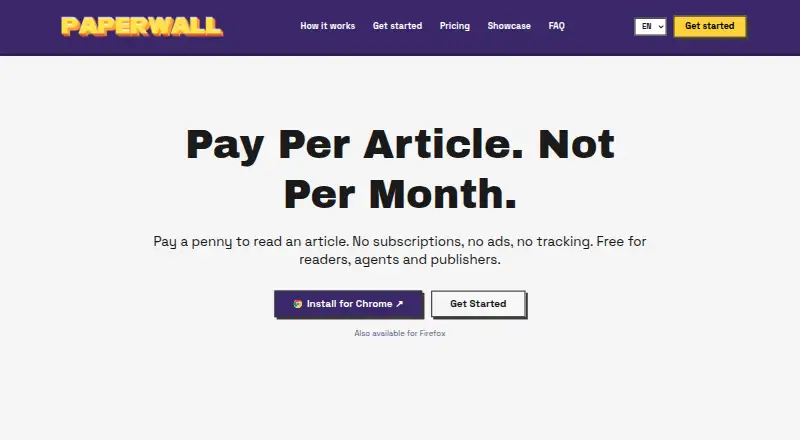
Paperwall is an open protocol for paying small amounts to read individual web articles.
What Paperwall is
Paperwall is an open protocol for paying small amounts to read individual web articles. Publishers set article prices, and most are said to cost between $0.01 and $0.10; a publisher enables payments by adding one script tag to a site. Readers pay per article from funds kept in an encrypted wallet on their device and accessed with their password. Paperwall says publishers receive payments instantly and keep all content payments, though facilitators may charge processing fees.
Paperwall is licensed under GPL-3.0 and can be forked, audited, or self-hosted. Publishers can use SKALE Mainnet or Base Mainnet and choose client mode or server mode; server mode requires a backend and offers full control. Developer tools include an SDK, browser extension, CLI, and A2A server, which the maker says cost nothing to use or self-host. An MCP server supports named clients including Claude Code, Cursor, Windsurf, Claude Desktop, Codex, OpenCode, Gemini CLI, and Antigravity. The protocol plan is free, and the listed subscription costs $10/mo. Users currently need to fund accounts manually, and publisher allowlists and denylists remain in development.
Good
- Publishers enable payments with one script tag.
- Readers pay per article.
- Wallet funds are encrypted on the device.
- SDK, extension, CLI, and A2A server are free.
Watch out
- Users currently fund accounts manually.
- Publisher allowlists and denylists remain in development.
- Firefox and Safari are on the roadmap.
- The subscription costs $10/mo.
Who it suits
Paperwall suits publishers seeking per-article payments, readers who want to pay for individual articles, and developers building apps or agents that pay for content. Its tools also suit users interested in self-hosting or integrating the protocol.
Verdict
Paperwall provides a per-article payment protocol alongside tools for publishers and developers. Consider the manual funding requirement and listed browser support when deciding whether it fits your use.
Plans and prices
From Paperwall's own pricing page, checked 8 Oct 2026.
| Plan | Price | What it gives you |
|---|---|---|
| Paperwall protocol | Free | Free to use; SDK, extension, CLI, and A2A server cost nothing to use or self-host |
| Subscription | $10 a month | Pay even if you read just 1 article |
The facts
Each one read from Paperwall's own pages, with the date it was checked.
What it does
- AI integrations
- Paperwall offers an MCP server for AI assistants and names Claude Code, Cursor, Windsurf, Claude Desktop, Codex, OpenCode, Gemini CLI, and Antigravity as supported clients.checked 8 Oct 2026
- Developer tools
- The product offers an SDK, browser extension, CLI, and A2A server, which the maker says cost nothing to use or self-host.checked 8 Oct 2026
- Early-stage limitation
- The maker says users currently need to fund their account manually and is still developing publisher allowlists and denylists.checked 8 Oct 2026
- Open source
- Paperwall is licensed under GPL-3.0 and can be forked, audited, or self-hosted.checked 8 Oct 2026
- Payment modes
- Client mode is recommended for most publishers, while server mode requires a backend and offers full control.checked 8 Oct 2026
- Payment networks
- The publisher setup lists SKALE Mainnet and Base Mainnet as production network options.checked 8 Oct 2026
- Publisher payouts
- The site says publishers receive payments instantly and keep 100% of content payments, while facilitators may charge processing fees.checked 8 Oct 2026
- Publisher setup
- Publishers add a single script tag to their site to enable article payments.checked 8 Oct 2026
- Reader payments
- Readers pay per article, with publishers setting prices and most articles said to cost between $0.01 and $0.10.checked 8 Oct 2026
- Reader wallet
- Reader funds are stored in an encrypted wallet on the device and are accessible with the user's password.checked 8 Oct 2026
- Supported users
- The maker describes Paperwall for publishers, readers, AI agent users, and developers building apps or agents that pay for content.checked 8 Oct 2026
- What it does
- Paperwall is an open protocol for micropayments that lets readers pay tiny amounts per web article.checked 8 Oct 2026
Where it runs
- Supported browsers
- The FAQ lists Chrome and Chromium-based browsers including Edge, Brave, and Arc as currently supported, with Firefox and Safari on the roadmap.checked 8 Oct 2026
Alternatives to Paperwall
- 1
Pelcro
Free planAndroidiOSWebAPI8.0From $450 a month - 2
codoc
Free planWebAPIExtension7.3From ¥9,800 a month - 3

Cleeng
Free planAndroidiOSWebAPI6.8Free plan - 4
Leaky Paywall
AndroidiOSWebAPI6.8From $299 a month - 5
Wallkit
AndroidiOSWebAPI6.7From $799 a month - 6
Pay-To-View Lite
Free planWeb6.6$29 one-time