PaddlePaddle
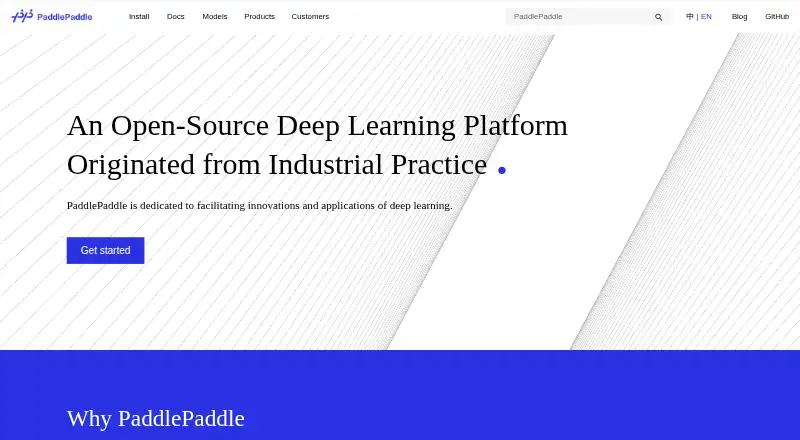
The facts below are what the maker publishes about PaddlePaddle, checked and dated. Our editors have not written about it yet.
The facts
Each one read from PaddlePaddle's own pages, with the date it was checked.
What it does
- APIs
- The API reference describes tensor operations such as matrix multiplication, concatenation, addition, and argmax.checked 4 Oct 2026
- CPU and GPU packages
- The guide provides separate pip installation commands for CPU and GPU packages.checked 4 Oct 2026
- Distributed training
- The guides include distributed training with PaddlePaddle.checked 4 Oct 2026
- Ecosystem
- The official site lists PaddleHub, PARL, ERNIE, AI Studio, EasyDL, and EasyEdge among its tools and platforms.checked 4 Oct 2026
- GPU support
- The package appendix lists NVIDIA GPU architectures through Blackwell and CUDA package options through CUDA 13.0.checked 4 Oct 2026
- Graph modes
- The guides explain transforming dynamic graphs to static graphs.checked 4 Oct 2026
- Hardware limits
- The installation guide specifies 64-bit x86_64 processors and says PaddlePaddle currently does not support arm64.checked 4 Oct 2026
- Hardware requirements
- The Linux source build guide specifies 64-bit Linux and Python 3.9 through 3.13, and recommends NVIDIA GPU support when the listed CUDA and hardware conditions are met.checked 3 Oct 2026
- Inference and deployment
- The guides describe using trained models for inference and deployment.checked 4 Oct 2026
- Installation
- The installation guide offers pip, Docker, and source compilation methods.checked 4 Oct 2026
- Integrations
- Paddle Inference documents integrations with TensorRT, cuDNN, oneDNN, and Paddle Lite.checked 3 Oct 2026
- Intended users
- The documentation recommends pip installation for users who only need to use PaddlePaddle and source compilation for developers who need to develop the framework.checked 3 Oct 2026
- Limits
- The Windows source build guide says distributed training and NCCL are not supported on Windows and its GPU build supports only one GPU.checked 3 Oct 2026
- Mixed precision
- Its automatic mixed precision API can select FP16 or FP32 for different operators during training.checked 3 Oct 2026
- Model conversion
- The guides include converting models to PaddlePaddle.checked 4 Oct 2026
- Model development
- Its guides cover model development and additional uses for model development.checked 4 Oct 2026
- Operating systems
- The current installation guide lists Windows 10/11, Ubuntu 20.04/22.04/24.04, AlmaLinux 8, and macOS 12.x through 15.x.checked 4 Oct 2026
- Product
- PaddlePaddle is an efficient, flexible, and extensible deep learning framework.checked 4 Oct 2026
- Purpose
- PaddlePaddle describes itself as an efficient, flexible, extensible deep learning framework intended to make deep learning innovation and application easier.checked 3 Oct 2026
- Python support
- The installation guide lists Python 3.9 through 3.13 and pip 20.2.2 or later.checked 4 Oct 2026
- Self hosting
- The framework can be compiled from source on Linux, and its documentation recommends Docker as a simpler compilation environment.checked 3 Oct 2026
- Support resources
- The official guides link to GitHub and release notes for framework details and version features.checked 4 Oct 2026
- Training and inference
- Its APIs cover tensor operations, neural networks, optimizers, model training, and inference.checked 3 Oct 2026
The company
- Maker
- The project’s official GitHub repository identifies PaddlePaddle as its core framework; Baidu’s investor FAQ lists its headquarters as Beijing and says it was incorporated in 2000.checked 3 Oct 2026
Alternatives to PaddlePaddle
- 1
Paperspace Gradient
Free planOpen sourceWebAPIExtensionLinux8.3From $8 a month - 2
Apache TVM
Free planOpen sourceAndroidiOSWebAPI7.8Free plan - 3
Lightning AI Studios
Free planWebAPILinuxmacOS7.8From $20 a month - 4
ONNX Runtime
Free planAndroidiOSWebLinux7.2Free plan - 5
Ludwig
Free planAPILinuxmacOSSelf-hosted6.7Free plan - 6
MegEngine
Free planAndroidiOSLinuxmacOS6.7Free plan