Pact
Pact is web-based foster and rescue management software for coordinators.
What Pact is
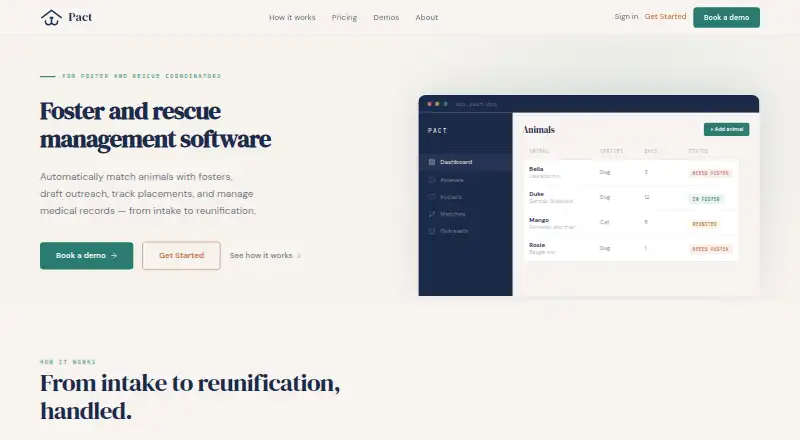
Pact is web-based foster and rescue management software for coordinators. It organizes animal intake, foster matching, outreach, placements, and medical records through reunification. Animal profiles can record details such as species, temperament, medical notes, and urgency. Pact surfaces potential foster matches using location, experience, and availability, while its foster network CRM keeps track of each foster’s experience history, preferences, and availability. Coordinators can draft first-contact messages, follow-ups, and placement confirmations, and track outreach. For active placements, the software records check-ins, updates, and status changes. Program reports cover placement rates, time-to-match, and capacity data. A portal lets pet owners in crisis submit a placement request. Pact runs on the web and is paid, with pricing available on request. The site invites organizations to book a demo by emailing [email protected].
Good
- Animal profiles include medical notes and urgency
- Matches fosters by location, experience, and availability
- Tracks outreach and placement updates
- Reports on placement rates and capacity
- Offers an owner placement-request portal
Watch out
- Runs on the web only
- Pricing is available on request
Who it suits
Pact suits foster and rescue coordinators who need to organize animal records, foster matching, outreach, and placements. It may also help programs tracking placement timing and capacity.
Verdict
Pact brings foster coordination tasks and program reporting into one web service. Organizations can contact the company to arrange a demo and ask about pricing.
The facts
Each one read from Pact's own pages, with the date it was checked.
What it does
- Animal profiles
- Animal profiles can include species, temperament, medical notes, and urgency level.checked 4 Oct 2026
- Demo contact
- The site invites organizations to book a demo by emailing [email protected].checked 4 Oct 2026
- Foster CRM
- The foster network CRM tracks experience history, preferences, and availability.checked 4 Oct 2026
- Matching
- Pact surfaces compatible fosters based on location, experience, and availability.checked 4 Oct 2026
- Outreach
- Pact drafts first-contact messages, follow-ups, and placement confirmations, and tracks outreach.checked 4 Oct 2026
- Placement tracking
- The product logs check-ins, updates, and status changes for placements.checked 4 Oct 2026
- Product
- Pact is foster and rescue management software for foster and rescue coordinators.checked 4 Oct 2026
- Purpose
- Pact manages animal intake, foster matching, outreach, placements, and medical records from intake to reunification.checked 4 Oct 2026
- Reporting
- Program reporting covers placement rates, time-to-match, and capacity data.checked 4 Oct 2026
The company
- Owner portal
- A portal lets pet owners in crisis submit a placement request.checked 4 Oct 2026
The full review of Pact
Pact is foster and rescue management software for coordinators who need one workflow for animals, foster homes, outreach, and placements. It suits organizations running an active foster network rather than teams needing only an adoption listing or simple database. The main reason to choose it is the connection between day-to-day coordination and program reporting; the main drawback is that organizations must request a demo and custom pricing before they can judge cost.
Overview
Pact follows an animal from intake through reunification, combining animal records with foster matching, communication, placement follow-up, and medical information. Profiles can record species, temperament, medical notes, and urgency level, giving coordinators a shared basis for deciding what care and placement are appropriate. An owner portal lets pet owners in crisis submit placement requests, so intake can begin through the same service used to coordinate the response.
This end-to-end scope is more useful to a foster program than a tool focused solely on public adoption. Placement records include check-ins, updates, and status changes, while reporting covers placement rates, time-to-match, and capacity. Those measures help a coordinator see both individual case progress and how the overall program is performing.
Key features
Matching and foster CRM
Pact surfaces potential fosters using location, experience, and availability. Its foster CRM retains experience history, preferences, and current availability, allowing coordinators to consider the network's context instead of treating every request as a new search. This is a strong fit for organizations with many foster homes or recurring placements. Smaller groups with few homes may find the broader coordination model more than they need.
Outreach and placement follow-up
The service drafts first-contact messages, follow-ups, and placement confirmations, then tracks that outreach. That can reduce the administrative burden of contacting prospective fosters and provide a record of what has been sent. Placement tracking continues after the initial match with logged check-ins, updates, and status changes, which is valuable when responsibility is shared across coordinators.
Records and reporting
Medical notes sit alongside intake and placement information, keeping care context attached to the animal record. Reporting on placement rates, time-to-match, and capacity gives managers concrete indicators for reviewing throughput and available foster space. These reports are aimed at program oversight rather than general business analytics.
Pricing
Pact is paid software with pricing on request. Organizations are invited to book a demo by emailing [email protected]. There is no published free plan, trial period, seat allowance, storage quota, or renewal term to compare, so teams must discuss their expected scale and commercial terms directly with the company.
Custom pricing is reasonable for a coordinator-focused system whose value depends on an organization's workflow and foster network, but it makes budgeting harder than with products that publish monthly plans. Pact is therefore better suited to established programs willing to have a sales conversation than to a small volunteer group looking for an immediately priced tool.
Platforms
Pact runs on the web. A browser-based service is practical for coordinators working across offices, foster homes, and field locations, provided their organization is comfortable managing operations through an online system.
Who it's for
Pact is aimed at foster and rescue coordinators handling intake, matching, outreach, placements, medical records, and reunification in the same operation. It is particularly appropriate for programs that need a foster-network CRM and want reporting on time-to-match, placement rates, and capacity. Organizations seeking only a public adoption portal, a lightweight animal list, or a free self-service product should look elsewhere.
Pros and cons
Pros
- One workflow from intake to reunification: animal records, medical notes, foster matching, outreach, and placement updates stay connected.
- Matching uses operational context: location, experience, and availability provide practical filters for coordinators assigning foster homes.
- Follow-up is recorded: outreach history and placement check-ins make ongoing coordination easier to monitor.
- Program-level reporting: placement rates, time-to-match, and capacity metrics support oversight of foster operations.
- Owner-submitted requests: the crisis placement portal gives pet owners a direct intake route.
Cons
- Custom pricing only: organizations cannot evaluate the cost from a public plan table.
- Demo required: prospective users must contact the company before assessing fit and terms.
- Web-only access: Pact does not provide a listed Android or iOS application.
- Specialized scope: teams wanting only adoption publishing or a basic database may be paying for coordination functions they will not use.
Alternatives
Cara is the better choice for a small operation that wants a free starting point: its Free plan supports up to five animals, a public adoption portal, application management, basic email notifications, and Cara branding. Its Pro plan costs $34.99 a month, making it easier to budget, though the free tier is capped and branded.
RescueRM suits teams interested in a freemium model, with a Free plan for up to two team members, one AI match per 48 hours, and six assistant queries per 48 hours. Choose it when those limits fit a small team and a low-commitment entry matters more than Pact's broader stated workflow.
PawPlacer is a free alternative with all features included, full exports and SDK/API access, and no contracts or usage limits. It is the clearest option when avoiding paid plans and usage restrictions is the priority.
Pet Friend offers Android, iOS, and web access. Its Rescue plan is $25 a month, billed monthly with cancellation anytime, 10 GB storage, and 50 GB monthly data usage; its Shelter plan is $50 a month. Pick it when mobile apps and published monthly pricing matter.
ShelterBuddy is a paid shelter-management alternative available on Android, iOS, and the web.
RescueBase is a freemium web option with a free plan.
RescueGroups.org Data Management Service is a free, web-based alternative.
For a broader category comparison, see Animal Shelter Software.
Verdict
Choose Pact if your organization coordinates a substantial foster network and wants intake, matching, outreach, placement follow-up, records, and capacity reporting in one web service. Its strongest advantage is continuity across the whole foster process. Look elsewhere if you need a published price, a free tier, mobile apps, or only a simple adoption and animal-record system.
Alternatives to Pact
- 1
Cara
Free planWeb7.3Free plan - 2
ShelterBuddy
AndroidiOSWebAPI6.6 - 3
Pet Friend
AndroidiOSWeb6.1From $25 a month - 4
RescueRM
Free planWeb5.5Free plan - 5
PawPlacer
Free planWeb5.4Free plan - 64.6