Origami Risk GRC
Origami Risk GRC helps organizations identify, assess, and mitigate enterprise risk while managing governance and compliance.
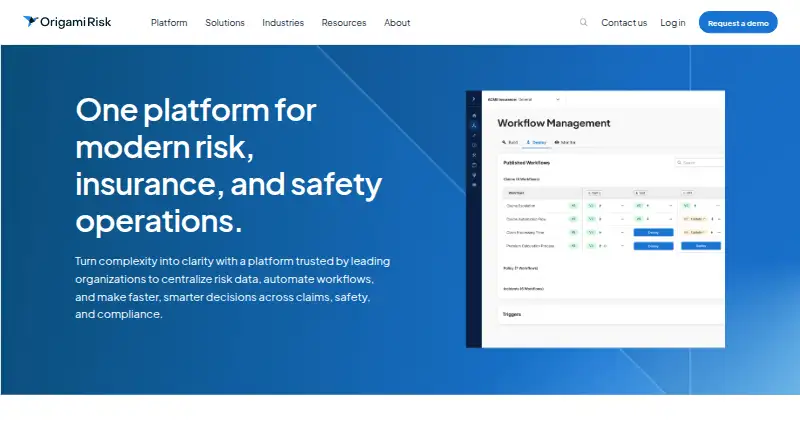
What Origami Risk GRC is
Origami Risk GRC helps organizations identify, assess, and mitigate enterprise risk while managing governance and compliance. Its coverage includes enterprise risk management, business continuity, third-party risk, policy and procedure management, internal controls, internal audit, and compliance management. The cloud-native, low-code platform includes drag-and-drop workflow builders and API-driven integrations for exchanging data with existing tools. Teams can structure risk scoring with heat maps, lenses, and multifactor models aligned to their risk appetite. They can manage control effectiveness, link controls to frameworks and mitigation plans, and track issues through assigned action plans and workflows. Interactive Bowtie models show relationships among risks, consequences, and controls. The native AI Risk and Control Explorer analyzes GRC data to help identify risk relationships, assess controls, and surface emerging risks; AI-enabled workflows can route assessments, send escalation alerts, and remind teams about control testing. The vendor describes implementation support for configuration, historical data migration, and phased rollout. Pricing is available on request.
Good
- Covers enterprise risk, continuity, and third-party risk.
- Risk scoring includes heat maps and multifactor models.
- Tracks control effectiveness and issue action plans.
- AI tools analyze GRC data and surface emerging risks.
- API access supports data connections.
Watch out
- Pricing is available on request.
- The Trust Center page opened without readable detail.
Who it suits
Origami Risk GRC is designed for organizations managing risk across departments, including enterprise risk, continuity, and vendor risk programs. Its mobile app may suit teams that need to capture data on the go.
Verdict
Origami Risk GRC brings risk, compliance, controls, and continuity workflows together in a cloud-native, low-code platform. Request pricing to learn the cost for an organization’s needs.
Plans and prices
From Origami Risk GRC's own pricing page, checked 4 Oct 2026.
| Plan | Price | What it gives you |
|---|---|---|
| Origami Risk GRC | Priced on request | Pricing not shown; request a demo |
The facts
Each one read from Origami Risk GRC's own pages, with the date it was checked.
What it does
- AI
- The AI Risk and Control Explorer provides recommendations and helps surface blind spots, verify risk data, and identify emerging threats using natural-language prompts.checked 4 Oct 2026
- AI analysis
- The native AI Risk and Control Explorer analyzes GRC data to help teams identify risk relationships, assess controls, and surface emerging risks.checked 4 Oct 2026
- API
- Origami provides API access for connecting data sources and a developer hub with API references and guides.checked 4 Oct 2026
- Automation
- AI-enabled workflows can automate routine risk and compliance activities, including assessment routing, escalation alerts, and control testing reminders.checked 4 Oct 2026
- Bowtie modeling
- Interactive, shareable Bowtie models show connections between risks, consequences, and controls.checked 4 Oct 2026
- Centralized data
- The GRC page describes unifying organizational data into a single source of truth for cross-departmental risk visibility.checked 4 Oct 2026
- Controls and issues
- Users can manage control effectiveness, link controls to frameworks and mitigation plans, and track issues through assigned action plans and automated workflows.checked 4 Oct 2026
- GRC coverage
- The GRC solution includes enterprise risk management, business continuity, third-party risk, policy and procedure management, internal controls, and compliance management.checked 4 Oct 2026
- GRC modules
- Its GRC offerings include business continuity, compliance, enterprise risk management, internal audit, internal controls, policy and procedure management, and third-party risk management.checked 4 Oct 2026
- Integrations
- Origami Risk describes API-driven integration for connecting and exchanging data with existing tools.checked 4 Oct 2026
- Intended users
- The ERM page describes support for enterprise risk programs, including risk leaders coordinating risk planning, response, and reporting.checked 4 Oct 2026
- Mobile
- Origami Mobile supports audits, inspections, findings, incident reports, and photo and video uploads, including when connectivity is unavailable.checked 4 Oct 2026
- Purpose
- Origami Risk GRC helps organizations identify, assess, and mitigate enterprise risk.checked 4 Oct 2026
- Risk assessment
- The ERM solution supports structured risk scoring with heat maps, lenses, and multifactor models aligned to an organization’s risk appetite.checked 4 Oct 2026
- Risk workflows
- Its GRC workflows support identifying, assessing, managing, and monitoring risks in line with an organization’s strategic objectives.checked 4 Oct 2026
- Security
- The vendor links to a Trust Center and describes its platform as built for security; the Trust Center page opened without readable detail.checked 4 Oct 2026
- Support
- The company says its implementation team helps configure the platform, migrate historical data, and phase in capabilities.checked 4 Oct 2026
- Third-party risk
- The GRC solution includes tools to identify, assess, and mitigate risks across an organization’s third-party network.checked 4 Oct 2026
The company
- Headquarters
- Chicago, Illinois, United Stateschecked 28 Sep 2026
Where it runs
- Platform
- Origami Risk describes its platform as cloud-native and presents GRC as part of a connected platform for risk, insurance, and safety operations.checked 4 Oct 2026
The full review of Origami Risk GRC
Origami Risk GRC is a configurable platform for coordinating enterprise risk, compliance, controls, continuity, and vendor-risk programs. It suits organizations that need several departments working from shared risk data and adaptable workflows. Its broad coverage is a strength, while custom pricing and a substantial implementation project make it a poor fit for buyers seeking a simple, low-cost tool.
Overview
The platform combines enterprise risk management, business continuity, third-party risk, policy and procedure management, internal controls, internal audit, and compliance management. Teams can identify, assess, manage, and monitor risks against strategic objectives, with organizational data consolidated into a single source of truth for cross-department visibility.
Origami Risk describes the product as cloud-native and low-code. Drag-and-drop workflow builders allow processes to be adapted, while API-driven integration and a developer hub support data exchange with existing systems. The vendor’s implementation team can configure the platform, migrate historical data, and phase in capabilities. That assistance is valuable for a staged rollout, but organizations should budget time for configuration and migration rather than expecting an instant deployment. A mobile app supports data capture away from a desk.
Key features
Risk, controls, and issues
Structured risk assessment uses scoring, heat maps, lenses, and multifactor models aligned with an organization’s risk appetite. This gives risk teams a consistent way to compare exposures while preserving room for different assessment perspectives. Users can manage control effectiveness, link controls to frameworks and mitigation plans, and follow issues through assigned action plans and automated workflows. Interactive, shareable Bowtie models clarify relationships between a risk, its consequences, and its controls, which is useful when communicating cause-and-effect to stakeholders.
AI-assisted analysis and automation
The native AI Risk and Control Explorer examines GRC data to identify relationships, assess controls, surface emerging risks, verify risk data, and expose blind spots through natural-language prompts. AI-enabled workflows can route assessments, send escalation alerts, and remind teams about control testing. These capabilities can reduce repetitive coordination work, but they are most valuable when an organization already maintains sufficiently structured, current data for the analysis to use.
Program coverage
Policy management, a risk register, audit management, and evidence collection are included. Supported frameworks include NIST, COSO, COBIT, ISO 27001, ISO 31000, SOX, Title IX, OSHA, HIPAA, and GDPR. Third-party risk tools extend assessment and mitigation across a vendor network, while business-continuity and compliance modules help connect related programs instead of maintaining separate systems.
Pricing
Origami Risk GRC has paid, custom pricing; the vendor asks prospective customers to request a demo. There is no published seat allowance, usage quota, free tier, trial duration, or renewal term to compare. This model is aimed at organizations prepared for a sales-led evaluation and an implementation discussion. It also means smaller teams cannot estimate cost from the product page or start with a self-service free plan, so the scope of users, modules, integrations, migration, and ongoing terms should be settled during the quote process.
Platforms
Origami Risk GRC is offered on Android, iOS, and the web, with API access for connected systems. The mobile apps are suited to collecting information in the field, while the web platform and APIs support centralized administration and integration work.
Who it's for
This is a strong candidate for organizations managing enterprise risk, continuity, compliance, internal controls, audits, and third-party exposure across departments. It is especially appropriate when a shared data model, configurable workflows, framework-linked controls, and phased implementation matter more than transparent pricing. A team with one narrow compliance requirement, limited configuration resources, or a preference for self-hosted free software should look elsewhere.
Pros and cons
Pros
- Broad GRC scope: Risk, continuity, vendors, policies, audits, controls, and compliance can be coordinated in one platform.
- Adaptable workflows: Low-code builders and API connections support varied processes and existing systems.
- Structured risk analysis: Heat maps, lenses, multifactor scoring, and Bowtie modeling support practical assessment and communication.
- Automation and AI: Routing, alerts, reminders, and the Risk and Control Explorer can reduce manual follow-up and reveal relationships in GRC data.
- Implementation support: Configuration, historical-data migration, and phased rollout assistance address the hardest parts of a broad deployment.
Cons
- Custom pricing: Buyers cannot compare published plans, quotas, or trial terms before engaging sales.
- Implementation overhead: A platform spanning many programs requires configuration, migration, and rollout planning.
- Potentially excessive scope: Smaller teams with a single compliance process may gain little from the full breadth.
Alternatives
CISO Assistant is a better starting point for buyers wanting a free, self-hosted Community plan with unlimited users, or a freemium path that also offers SaaS.
Eramba fits organizations prioritizing an open, free self-hosted edition and an enterprise on-premise option.
SimpleRisk is worth choosing when an unlimited-user self-hosted Core plan and a clearly priced Starter package are more important than Origami’s broader platform approach.
OpenGRC suits teams seeking open-source, self-hosted deployment with a free Community edition.
NAVEX EthicsPoint Incident Management is an alternative for organizations focused on incident-management workflows.
Corporater Investment Portfolio Management is an alternative with quote-based pricing.
Mitratech CaseCloud is an alternative for organizations wanting a paid, demo-led case-management product.
Ncontracts is an alternative for buyers seeking paid risk and compliance solutions through a demo or contact-led process.
For more options, see Governance, Risk and Compliance Software.
Verdict
Choose Origami Risk GRC when your organization needs one configurable environment for interconnected risk, compliance, controls, continuity, audit, and third-party programs, backed by implementation support and API integration. Look elsewhere if transparent pricing, a free starting tier, self-hosting, or a narrowly focused deployment is the priority.
Alternatives to Origami Risk GRC
- 1

CISO Assistant
Free planOpen sourceWebAPILinuxmacOS8.3From €39 a month - 2
OpenGRC
Free planOpen sourceWebAPISelf-hosted7.9From $4,500 a year - 3
VComply
AndroidiOSWebAPI7.8From $120 a month - 4

Eramba
Free planWebAPILinuxSelf-hosted7.6From €2,500 a year - 5
SimpleRisk
Free planWebAPILinuxSelf-hosted6.9From $5,000 a year - 6

Workiva Audit Management
AndroidiOSWebAPI6.9