
Eramba
Eramba is governance, risk, and compliance software for managing organizational activities such as risk, compliance, data privacy, incidents, awareness progr…
What Eramba is
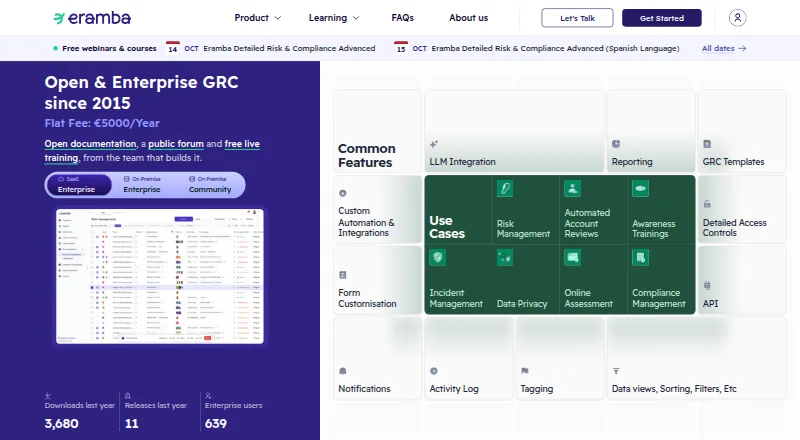
Eramba is governance, risk, and compliance software for managing organizational activities such as risk, compliance, data privacy, incidents, awareness programs, account reviews, and online assessments. It lists more than 70 ready-to-import compliance packages and allows users to upload a custom framework as a CSV file. Common tools include notifications, granular access controls, status tracking, custom fields, reporting, automations, and REST APIs. Eramba can receive API requests and send webhooks to other systems, with examples including SIEM incident creation and Jira issue creation. Authentication options include LDAP, SAML, and Google OAuth, and its documentation describes LDAP synchronization. It is available as self-hosted software or SaaS. For SaaS, Eramba says it hosts in Europe or the USA and manages daily backups and upgrades when releases are available. Eramba is not a network scanner; its documentation recommends syncing asset information from a CMDB through its REST API.
Good
- More than 70 compliance packages are listed.
- Custom frameworks can be uploaded as CSV files.
- Supports LDAP, SAML, and Google OAuth authentication.
- Community version is free.
Watch out
- Community has no support included.
- Eramba is not a network scanner.
Who it suits
Eramba suits GRC teams managing risks, controls, policies, compliance, or related review workflows. Other departments and suppliers can provide review feedback, while organizations needing asset discovery should note its network-scanner limitation.
Verdict
Eramba brings a range of GRC activities, framework packages, and integrations into one system. Consider the self-hosted or SaaS option and account for the fact that it does not scan networks.
Plans and prices
From Eramba's own pricing page, checked 21 Sep 2026.
| Plan | Price | What it gives you |
|---|---|---|
| Community | Free | Open and free version · Self-hosted deployment · Free |
| Enterprise On-Premise | €2,500 a year | Unlimited users and data · All modules included · Email support included · From 2500€/year |
| Enterprise SaaS | €5,000 a year | unlimited users · unlimited data · EU or US hosting · backups and updates managed by eramba · €5,000 per year |
| Community on-premises | Free | self-hosted · no user limit · no time limit · 4 of 7 use cases |
| Community On Premise | Free | Unlimited users and data · manual upgrades and backups · no support included |
| Implementation workshop | €800, paid once | optional fixed-price workshop · €800 each |
| Enterprise On Premise | €2,500 a year | Unlimited users and data · all modules included · email support · €2,500 / year |
| Enterprise on-premises | €2,500 a year | unlimited users · unlimited data · all modules · email support · updates · €2,500 per year |
The facts
Each one read from Eramba's own pages, with the date it was checked.
What it does
- Account reviews
- Enterprise includes automated account-review use cases and connectors for systems such as AWS and LDAP.checked 14 Oct 2026
- API documentation
- API documentation is exposed through Swagger within each module to administrators or members of the Admin group.checked 14 Oct 2026
- API limitations
- The API documentation notes pagination but no sorting, and PATCH requests require the full object fields.checked 14 Oct 2026
- Automation extensibility
- Automations run user-provided PHP code, can use Composer dependencies and can execute on schedules or record-change events.checked 14 Oct 2026
- Awareness programs
- Enterprise includes awareness training programs that track participation and results.checked 14 Oct 2026
- Compliance management
- The compliance module supports imported requirements such as ISO 27001, PCI-DSS, NIST, SOC 2 and other frameworks.checked 14 Oct 2026
- Customisation
- Enterprise supports custom fields, custom module associations and configurable forms.checked 14 Oct 2026
- Data privacy
- Data Privacy is listed as a supported eramba use case alongside risk, compliance and incidents.checked 14 Oct 2026
- Deployment components
- The Docker stack includes eramba, MySQL, Redis, cron, Caddy, triggers Caddy and an MCP server.checked 14 Oct 2026
- Documentation
- The vendor publishes free installation, implementation and operating courses, plus a public forum and release notes.checked 14 Oct 2026
- Dynamic statuses
- Dynamic Status lets administrators define conditions that label records, create KPIs, filter views and trigger notifications or automations.checked 14 Oct 2026
- Features
- Common features include custom notifications, granular access controls, dynamic status, custom fields, REST APIs, reporting and automations.checked 28 Sep 2026
- Frameworks
- The maker lists more than 70 ready-to-import compliance packages and says users can upload a custom framework as a CSV.checked 28 Sep 2026
- Identity
- The product supports external authentication using LDAP, SAML or Google OAuth, and its documentation describes LDAP synchronization.checked 28 Sep 2026
- Incident management
- Incident Management records incidents, analysis stages, response actions, evidence, owners, deadlines and closure.checked 14 Oct 2026
- Integrations
- Authentication integrations include LDAP, SAML and Google OAuth, with SCIM, CSV and LDAP synchronization options for accounts.checked 14 Oct 2026
The company
- Company founded
- LinkedIn lists Eramba as founded in 2011.checked 14 Oct 2026
- Company headquarters
- LinkedIn lists London, United Kingdom as headquarters, with 11–50 employees and a Bratislava location.checked 14 Oct 2026
- Company history
- Eramba’s about page says the team started building and sharing the tool in 2007 and describes its first version as emerging from that effort.checked 28 Sep 2026
- Company legal entity
- Eramba is managed by Eramba Limited, a business registered in the United Kingdom.checked 14 Oct 2026
- Company origin
- The company story says the first eramba version was built in 2007 and the team became full-time in 2015.checked 14 Oct 2026
- Founded
- 2007checked 28 Sep 2026
- Funding and ownership
- The company says it declined venture investment and operates independently without debt or outside investment.checked 14 Oct 2026
- Headquarters
- London, United Kingdom, and Bratislava, Slovak Republicchecked 28 Sep 2026
The full review of Eramba
Overview
Eramba is governance, risk and compliance software for organizations that want to coordinate risk, controls, policies and compliance work. It is best suited to GRC teams that need configurable workflows and room to involve other departments or suppliers. Its strongest case is breadth and flexibility; its clearest boundary is that it does not discover assets by scanning networks.
The product covers risk and compliance management, data privacy, incident management, awareness programs, automated account reviews and online assessments. Its team says it began building and sharing the tool in 2007. In practice, Eramba is a system for managing GRC information, not a replacement for asset discovery: organizations can bring asset information from a CMDB through its REST API.
Key features
Eramba combines configurable records with workflow and reporting tools. Custom fields, granular access controls, notifications and dynamic status let teams adapt how information is captured and tracked. Quantitative analysis, custom risk fields, workflow automation and scheduled risk reporting support ongoing risk work rather than a collection of static registers. That configurability suits organizations with established processes, though the range of GRC activity means teams should be prepared to define how they want those processes represented.
More than 70 compliance packages are ready to import, and teams can upload a custom framework as a CSV. That gives organizations a useful starting point for common frameworks while leaving a path for their own requirements.
REST APIs and webhooks connect Eramba with other systems. It can receive API requests and send webhooks; examples include creating SIEM incidents and Jira issues. External authentication supports LDAP, SAML and Google OAuth, and LDAP synchronization is documented. Locally authenticated accounts have brute-force protection by default, blocking additional login attempts after incorrect credentials.
GRC team members can manage risks, controls and policies, while other departments and suppliers can provide review feedback. This division makes Eramba relevant to organizations whose GRC work depends on input from people outside the core team.
Pricing
Eramba has a free Community option and paid Enterprise plans. Community is open and free as a self-hosted deployment, with unlimited users and data. The trade-off is operational: upgrades and backups are manual, and support is not included. It fits organizations able to run the system themselves and handle maintenance without vendor support.
Enterprise On-Premise starts at €2,500 per year and includes unlimited users and data, all modules and email support. It is the stronger fit for organizations that want to host their own installation but need vendor support and the complete module set. Enterprise SaaS starts at €5,000 per year, also with unlimited users and data; Eramba hosts it, manages updates and backups, and offers cloud hosting in Europe or the USA. The higher starting price buys less operational burden rather than a larger user allowance.
For SaaS, Eramba says it performs daily backups and applies upgrades when releases become available. The plans have no stated user or data caps, so the practical choice is chiefly between self-management and managed hosting, alongside the difference in starting price.
Platforms
Eramba supports web, Linux, API and self-hosted use. Community and Enterprise on-premise deployments are documented for Docker and VMware, with the Docker guide covering Linux host configuration. Its hybrid deployment options give organizations a choice between managing an installation themselves and using Eramba-hosted SaaS.
Who it's for
Eramba is a good fit for GRC teams that need to manage several related programs, tailor records and workflows, and gather feedback across departments or suppliers. The framework packages, APIs and authentication choices will matter most to organizations connecting compliance work to existing systems and identity services. It is less suitable as a stand-alone tool for discovering network assets; that information needs to come from another system such as a CMDB.
Pros and cons
- Broad GRC coverage: risk, compliance, privacy, incidents, awareness, account reviews and assessments can sit within one system.
- Flexible framework support: more than 70 importable packages and CSV framework uploads give teams both a starting library and a route for custom requirements.
- Integration options: REST APIs, webhooks and external authentication can connect GRC processes with other systems and identity providers.
- Community shifts operations to the customer: manual upgrades and backups, with no included support, make the free self-hosted plan a better fit for teams able to maintain it.
- No network scanning: teams need another source for asset discovery and can sync CMDB information through the API.
Alternatives
Pirani may suit teams that want Android or iOS access and a free plan capped at 200 records, five user seats, one heat map report and 2.5 GB of cloud storage. Eramba's Community plan instead offers unlimited users and data but requires self-hosting and manual maintenance.
EasyRisk is worth considering for a free, self-hosted option with unlimited risks, one risk board, one editor, one attachment per risk and standard email support. Eramba is the broader choice for teams seeking multiple GRC activities and compliance packages, while EasyRisk's free plan makes its limits explicit.
Protecht is an alternative for teams considering paid ERM software with annual license fees based on the number and type of named active users; marketplace templates and its Operational Resilience module cost extra.
NAVEX IRM is another paid option, with pricing tailored to organizational size, solutions, program scope and requirements.
Riskware is a paid alternative with a free trial and Android, iOS, macOS, web and API platforms.
ShipManager Crewing is a paid web, iOS and Android option without a free plan.
AuditBoard (now Optro) offers flexible plans with unlimited stakeholder licenses, tailored to business needs, along with Optro Success and Services.
For broader comparisons, see Risk Management Software, Internal Controls Software and Governance, Risk and Compliance Software.
Verdict
Choose Eramba if your organization needs a configurable home for multiple GRC activities, wants framework packages and integrations, and can decide between self-managed infrastructure and paid hosting. The main reason to look elsewhere is equally clear: it will not scan your network, and the free self-hosted plan leaves upgrades, backups and support to you.
Getting started
- Choose a Community or Enterprise deployment: self-hosted installations are documented for Docker and VMware.
- For SaaS, select Enterprise SaaS, hosted in Europe or the USA by Eramba.
- For a self-hosted installation, follow the Docker or VMware installation documentation; the Docker guide covers Linux host configuration.
- Configure external authentication with LDAP, SAML or Google OAuth if needed.
- Import a ready-made compliance package or upload a custom framework as a CSV file.
- Connect asset information from a CMDB through the REST API if needed.
Limits worth knowing
Community is free but has no support included, and upgrades and backups are manual. Enterprise On-Premise starts at €2,500 per year; Enterprise SaaS starts at €5,000 per year.
Questions
Is Eramba free?
Yes. Community is free and available as a self-hosted deployment.
Which platforms and deployment options does Eramba support?
The listed platforms are API, Linux, self-hosted and web. Community and Enterprise on-premise installations are documented for Docker and VMware; Enterprise SaaS is also available.
Can Eramba connect to other systems?
Yes. It can receive REST API requests and send webhooks. Examples include creating SIEM incidents and Jira issues.
Which authentication options are supported?
External authentication supports LDAP, SAML and Google OAuth. LDAP synchronization is also documented.
Does Eramba scan networks?
No. Its documentation recommends syncing asset information from a CMDB through the REST API.
Alternatives to Eramba
- 1
VComply
AndroidiOSWebAPI7.8From $120 a month - 2

RiskWatch SOX Compliance
AndroidiOSWebAPI7.5From $99 a month - 3

FloQast
WebAPImacOSWindows7.1From $999 a month - 4

HighRadius
AndroidiOSWebAPI7.1 - 5

Workiva Audit Management
AndroidiOSWebAPI6.9 - 6

ControlHatch
Free planWeb6.7Free plan