EasyRisk
EasyRisk is an operational risk register for identifying, analyzing, evaluating, treating, and monitoring risks.
What EasyRisk is
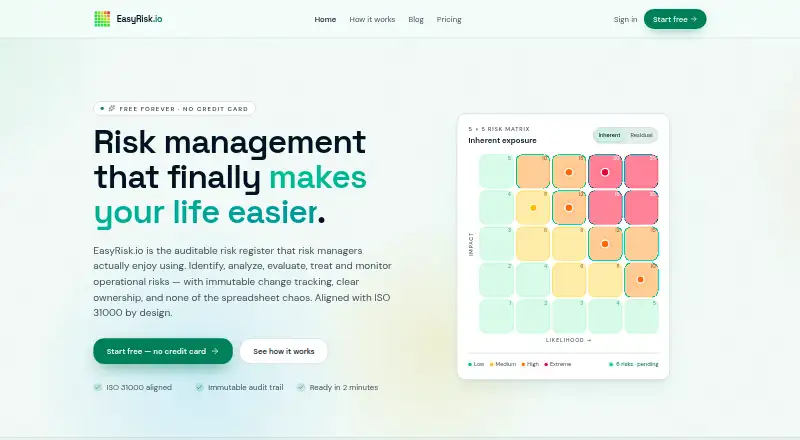
EasyRisk is an operational risk register for identifying, analyzing, evaluating, treating, and monitoring risks. Its qualitative 5×5 matrix shows inherent and residual risk and computes severity bands. The workflow is described as aligned with ISO 31000, though EasyRisk explicitly says it is not certified to that standard. Risk and treatment changes record who made them, when, and the old and new values; entries cannot be edited or deleted through the application. Dashboards highlight overdue reviews and high-severity risks, and each risk has a next-review date. Teams can assign owners and roles, set treatment actions and due dates, and discuss risks in comment threads. A REST API and MCP server are listed, while Enterprise supports SAML and OIDC SSO. EasyRisk can run on an organization's own infrastructure or servers. The Free plan includes unlimited risks, one board, one editor, and one attachment per risk. Team is €14 per editor per month billed annually; Business is €29 per editor per month billed annually.
Good
- Tracks inherent and residual risk in a 5×5 matrix.
- Audit entries record old and new values.
- Supports risk owners, treatment actions, and comment threads.
- Can run on an organization's own infrastructure.
- Free plan includes unlimited risks.
Watch out
- Free plan allows one board and one editor.
- Free plan limits attachments to one per risk.
- EasyRisk is not certified to ISO 31000.
- Enterprise pricing is tailored and not stated.
Who it suits
EasyRisk suits teams managing operational risks with assigned owners, review dates, and treatment actions. Business is described for multi-team organizations and board reporting; Enterprise is presented for regulated organizations with formal second- and third-line defenses.
Verdict
EasyRisk combines risk scoring, review monitoring, and change history, with limits that vary by plan. Its ISO 31000 alignment is not certification, and the Free plan restricts boards, editors, and attachments.
Plans and prices
From EasyRisk's own pricing page, checked 30 Sep 2026.
| Plan | Price | What it gives you |
|---|---|---|
| Free | Free | Unlimited risks · 1 risk board · 1 editor · 1 attachment per risk · Standard email support · free forever |
| Business | $29 | 10 risk boards · 25 attachments per risk · Custom risk categories and scales · Quarterly PDF reports · AI risk copilot · REST API · TOTP · Time-boxed access delegation · Priority support · per editor / month, billed yearly |
| Team | $168 a year | 5 risk boards · Unlimited editors · 5 attachments per risk · Priority support · $168.00 per editor per year (= $14.00 per editor/month, billed annually) |
| Enterprise | Priced on request | Unlimited risk boards, editors, viewers, and attachments · SAML/OIDC SSO · SCIM provisioning · Dedicated tenant and EU/CH data residency · Custom scoring frameworks · Dedicated customer success · Onboarding and training · tailored to your organization |
The facts
Each one read from EasyRisk's own pages, with the date it was checked.
What it does
- Assurance
- For organizations requiring ISO 27001 certification, a SOC 2 report, or penetration-test reports, the Trust Center asks them to contact EasyRisk to confirm whether the requirement can be met.checked 30 Sep 2026
- Audience
- The Enterprise plan is presented for regulated organizations with formal second- and third-line defenses; Business is described for multi-team organizations and board reporting.checked 30 Sep 2026
- Audit history
- Risk and treatment changes record who made the change, when it happened, and the old and new values; audit entries cannot be edited or deleted through the application.checked 30 Sep 2026
- Hosting and backups
- Application data and backups remain within the EU/EEA and Switzerland; the database is backed up daily, with the latest 30 backup runs retained in encrypted form.checked 30 Sep 2026
- Integrations
- The pricing comparison lists a REST API and MCP server for AI assistants; Enterprise SSO supports SAML and OIDC with MS Entra ID, Okta, and Google Workspace.checked 30 Sep 2026
- Purpose
- EasyRisk is an operational risk register for identifying, analyzing, evaluating, treating, and monitoring risks.checked 30 Sep 2026
- Review monitoring
- Dashboards surface overdue reviews and high-severity risks, and each risk has a next-review date.checked 30 Sep 2026
- Risk scoring
- It provides a qualitative 5×5 matrix with inherent and residual risk views and computed severity bands.checked 30 Sep 2026
- Security
- The Trust Center says workspace isolation is enforced with database Row-Level Security and tested automatically before each release.checked 30 Sep 2026
- Self-hosting
- EasyRisk says it can run on an organization's own infrastructure or servers.checked 30 Sep 2026
- Support
- The Free plan includes standard email support, paid Team and Business plans include priority support, and Enterprise includes a dedicated customer success manager.checked 30 Sep 2026
- Workflow
- The product describes its risk workflow as ISO 31000 aligned and explicitly says it is not certified to ISO 31000.checked 30 Sep 2026
The company
- Headquarters
- Wilen b. Wollerau, Switzerlandchecked 28 Sep 2026
- Team collaboration
- Users can assign risk owners and roles, treatment actions and due dates, and discuss risks in comment threads.checked 30 Sep 2026
The full review of EasyRisk
Overview
EasyRisk is an operational risk register for teams that need a repeatable way to assess risks and keep treatment work under review. It is a strong fit for organizations building a formal risk process, from a small workspace to multi-team operations.
Its useful distinction is that it pairs comparable scoring with a traceable change history and review reminders, rather than treating the register as a static list. Teams that need ISO 31000 certification or a particular assurance report should look elsewhere unless EasyRisk confirms it can meet that requirement.
Key features
A qualitative 5×5 matrix presents inherent and residual risk with computed severity bands. This gives teams a common frame for comparing exposure before and after treatment; organizations that need a different scoring framework will need Enterprise, the only plan with custom scoring frameworks.
Risks can be assigned owners and roles, treatment actions and due dates, and comment threads. Each risk also has a next-review date, while dashboards surface overdue reviews and high-severity risks. That combination supports active follow-up, though the value depends on teams keeping ownership and review dates current.
Changes to risks and treatments record who made them, when, and the old and new values. Users cannot edit or delete those audit entries through the application, a useful safeguard for organizations that need an accountable record of change. EasyRisk describes its workflow as aligned with ISO 31000, but explicitly says it is not certified to the standard.
The pricing comparison includes a REST API and an MCP server for AI assistants. Enterprise adds SAML and OIDC single sign-on with MS Entra ID, Okta, and Google Workspace. EasyRisk says workspace isolation is enforced through database Row-Level Security and automatically tested before each release. Application data and backups stay within the EU/EEA and Switzerland; backups run daily, with the latest 30 runs retained in encrypted form. Organizations needing ISO 27001 certification, a SOC 2 report, or penetration-test reports should contact EasyRisk to confirm whether it can meet the requirement.
Deployment spans web, API, and self-hosted use, with hybrid deployment also supported. EasyRisk can run on an organization’s own infrastructure or servers, which may suit teams with deployment constraints, but the plan comparison reserves a dedicated tenant and EU/CH data residency for Enterprise.
Pricing
EasyRisk is freemium, with no free trial. The Free plan costs nothing and is billed free forever. It allows unlimited risks but only one risk board, one editor, and one attachment per risk. That is a meaningful way to start a register, but the single-editor cap makes it unsuitable for team collaboration beyond one person. Standard email support is included.
Team costs $168 a year, billed $168.00 per editor per year ($14.00 per editor/month, billed annually). It includes five risk boards, unlimited editors, five attachments per risk, and priority support. It is the practical step up for a team that needs multiple contributors, but its board and attachment caps remain.
Business is priced at $29 a year, billed per editor / month, billed yearly. It includes 10 risk boards, 25 attachments per risk, custom risk categories and scales, quarterly PDF reports, an AI risk copilot, REST API, TOTP, time-boxed access delegation, and priority support. The added reporting and customization suit multi-team organizations and board reporting; the stated price and billing wording do not clarify a per-editor monthly amount.
Enterprise uses custom pricing tailored to the organization. It provides unlimited risk boards, editors, viewers, and attachments, SAML/OIDC SSO, SCIM provisioning, a dedicated tenant and EU/CH data residency, custom scoring frameworks, a dedicated customer success manager, onboarding, and training. It is aimed at regulated organizations with formal second- and third-line defenses, but organizations requiring specific assurance evidence should confirm fit directly. Paid Team and Business plans include priority support; Enterprise adds dedicated customer success.
Platforms
EasyRisk supports web, API, and self-hosted deployment. The self-hosting option lets organizations run it on their own infrastructure or servers.
Who it's for
EasyRisk makes the most sense for organizations that want a structured register with risk scoring, treatment tracking, review monitoring, and a change history. Free is suitable for a solo editor exploring the workflow; Team fits collaborative registers, while Business is better suited to multi-team work and board reporting. Enterprise targets regulated organizations that need broader access controls, custom scoring, or a dedicated tenant. It is a weaker fit for buyers who require ISO 31000 certification or a confirmed assurance report as a condition of adoption.
Pros and cons
- Pros: Inherent and residual scoring, severity bands, and review dashboards help teams prioritize risks and follow-up in one register.
- Pros: Application-protected audit entries preserve who changed risk and treatment records, when, and from what to what.
- Pros: Self-hosting, EU/EEA and Switzerland data location, and daily encrypted backups give organizations deployment and data-residency options.
- Cons: Free limits use to one board, one editor, and one attachment per risk, so a collaborative workflow requires a paid plan.
- Cons: ISO 31000 alignment is not certification, and required assurance reports need confirmation from EasyRisk.
- Cons: Team retains caps of five boards and five attachments per risk; Enterprise is required for unlimited boards and attachments.
Alternatives
Consider Risk Management Software to compare the wider category. Eramba is worth considering if a free, open self-hosted version is the priority; it also has a paid Enterprise On-Premise plan. Choose Pirani if mobile access or a free tier with five user seats and 200 records matters more; it also offers a free trial. Riskware is a paid alternative with a free trial and mobile apps. Qualsys EQMS is another paid option with web and mobile apps. ShipManager Crewing is a paid option for readers considering a different product. Corporater Operational Risk Management is a paid alternative with API and self-hosted platforms. Ncontracts is a paid alternative with API and web platforms. Protecht is a paid alternative with API and web platforms; its annual license fees depend on the number and type of named active users, and marketplace templates and the Operational Resilience module cost extra.
Verdict
EasyRisk is a sensible choice for organizations that want scoring, review follow-up, and a traceable register without starting with a large enterprise system. Team removes the Free plan’s single-editor bottleneck, and Business adds reporting and customization for broader use. Look elsewhere if certification or assurance evidence is mandatory, or if the free plan’s board and editor caps are too restrictive.
Getting started
- Visit https://easyrisk.io/.
- Choose the Free plan or a paid plan that fits your team.
- Use the web platform, API, or self-hosted deployment route.
- For self-hosting, run EasyRisk on your organization's infrastructure or servers.
Limits worth knowing
The Free plan includes unlimited risks but is limited to one risk board, one editor, and one attachment per risk. Team is listed at $168 a year per editor, billed annually, and includes five boards and five attachments per risk; Business is listed at $29 a year, billed per editor monthly on a yearly basis.
Questions
Is there a free plan?
Yes. Free costs nothing and includes unlimited risks, one risk board, one editor, and one attachment per risk.
What does Team cost?
Team is listed at $168 a year per editor, equivalent to $14.00 per editor per month when billed annually.
What does Business cost?
Business is listed at $29 a year, billed per editor per month yearly.
Which platforms and deployment options are available?
EasyRisk lists API, self-hosted, and web platforms. It says it can run on an organization's own infrastructure or servers.
Does EasyRisk offer single sign-on?
Enterprise includes SAML/OIDC SSO and SCIM provisioning. Enterprise also lists a dedicated tenant and EU/CH data residency.
Is EasyRisk ISO 31000 certified?
No. Its workflow is described as ISO 31000 aligned, but EasyRisk explicitly says it is not certified to ISO 31000.