OpenTMI
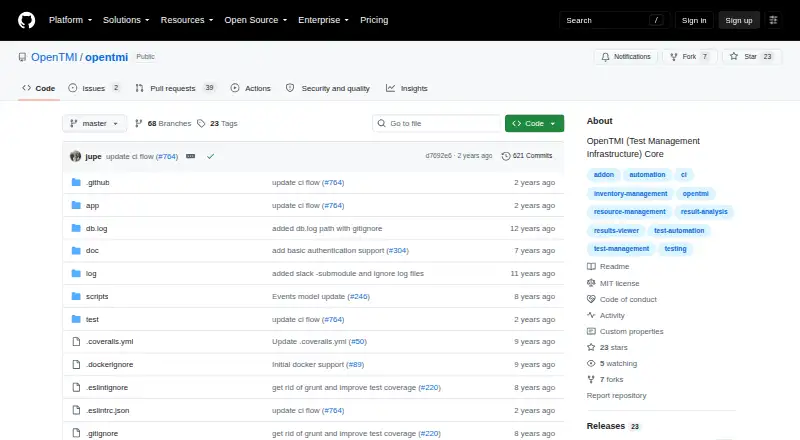
The facts below are what the maker publishes about OpenTMI, checked and dated. Our editors have not written about it yet.
The facts
Each one read from OpenTMI's own pages, with the date it was checked.
What it does
- API
- The backend provides a REST JSON API and WebSockets through Socket.IO.checked 11 Oct 2026
- Architecture
- The core provides a REST JSON API, WebSockets through Socket.IO, an internal load balancer, and worker restart behavior.checked 11 Oct 2026
- Audience
- The project says it targets testing challenges in IoT hardware, including unstable devices, multiple hardware configurations, and test execution efficiency.checked 11 Oct 2026
- Authentication
- The Python client README describes username/password, access-token, environment-variable, and token-in-host authentication options.checked 11 Oct 2026
- Automation client
- The pytest plugin uploads test results and metadata to an OpenTMI server and can optionally store logs.checked 11 Oct 2026
- Client libraries
- The maker provides Python and JavaScript clients, including a JavaScript client for Node.js and browsers.checked 11 Oct 2026
- Customization
- The project says it is customizable through addons.checked 11 Oct 2026
- Dependencies
- The core README lists Node.js and MongoDB as prerequisites and says MongoDB is the backing store.checked 11 Oct 2026
- Deployment
- The core README documents Docker installation as well as cloning the repository, installing dependencies, and starting the service.checked 11 Oct 2026
- GUI limitation
- The default GUI README says GitHub login is not ready yet.checked 11 Oct 2026
- License
- The core repository is published under the MIT license.checked 11 Oct 2026
- Purpose
- OpenTMI describes itself as open source test management infrastructure for IoT and embedded systems.checked 11 Oct 2026
- Pytest integration
- The pytest plugin uploads test results and metadata to an OpenTMI server and can store logs.checked 11 Oct 2026
- Python client
- The Python client provides a CLI and API for communicating with the OpenTMI backend, including posting results and events.checked 11 Oct 2026
- Requirements
- The README lists Node.js and MongoDB as prerequisites and recommends using their latest versions.checked 11 Oct 2026
- Scaling
- The README says clustered mode can improve performance, provide zero-downtime updates, restart on failure, and serve more clients.checked 11 Oct 2026
- Security
- The README supports HTTPS but cautions that self-signed certificates are not recommended for production use.checked 11 Oct 2026
- Security configuration
- The README documents HTTPS startup with generated self-signed certificates and says self-signed certificates are not recommended for production.checked 11 Oct 2026
- Slack integration
- The maker’s organization lists a repository described as a Slack integration for OpenTMI.checked 11 Oct 2026
- Support
- The README directs users to the repository owner or admin, or to community or team contacts.checked 11 Oct 2026
- Test data
- It stores test execution information such as software under test, builds, test logs, test cases, and device resources so they can be linked and analyzed.checked 11 Oct 2026
- Web interface
- The default GUI includes a dashboard, test case list, result list, pivot and tree views, and a resource list.checked 11 Oct 2026
Alternatives to OpenTMI
- 1

TestMu AI
Free planAndroidiOSWebAPI8.3From $17 a month - 2

TestQuality
Free planWebAPILinuxmacOS7.9From $8 a month - 3

aqua
Free planWebAPIExtensionLinux7.8Free plan - 4
Klaros-Testmanagement
Free planAndroidWebAPILinux7.6Free plan - 5
Kualitee
Free planAndroidiOSWebWindows7.5From $292 a year - 6
Tuskr
Free planAndroidiOSWebAPI7.5From $90 a year