OpenTax by Invaro
OpenTax by Invaro is a deterministic tax computation engine designed to run beneath AI agents.
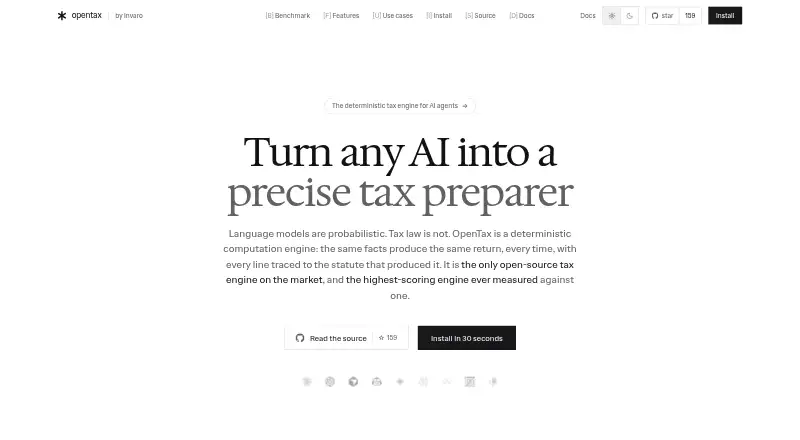
What OpenTax by Invaro is
OpenTax by Invaro is a deterministic tax computation engine designed to run beneath AI agents. It supports complete line sets for individual Form 1040, corporate Form 1120, and fiduciary Form 1041 returns; the maker says state coverage spans 29 states and is growing. Its tax rules include statutory citations and effective dates, and computations can return a Merkle-rooted proof for offline verification. A compiler converts W-2 and 1099 boxes and birth dates into engine facts. When the available rules cannot resolve a case, OpenTax returns a reason for refusing rather than estimating. The hosted service documents REST, MCP, and OpenAPI interfaces, with a connector for assistants, IDEs, agents, and automation platforms; named examples include Claude, ChatGPT, Cursor, n8n, Zapier, and Make. An installable package combines an MCP server, CLI, and HTTP host, and the HTTP server can be self-hosted. The free Evaluation plan has no expiry and allows 600 requests per hour anonymously or 6,000 with a key. The engine is offered under AGPL-3.0, with a commercial license also available.
Good
- Supports individual, corporate, and fiduciary return line sets
- Rules include citations and effective dates
- Computations can return proofs for offline verification
- Free evaluation has no expiry
- Offers REST, MCP, and OpenAPI interfaces
Watch out
- Coverage is limited to 29 states and growing
- Anonymous use is limited to 600 requests per hour
- Cases outside the rules corpus are refused
Who it suits
OpenTax may suit tax and accounting firms, freelancers with S-corp clients, advisory engagements, and financial planners seeking computation beneath AI workflows. It also fits developers looking for hosted or self-hosted interfaces to tax computations.
Verdict
OpenTax emphasizes deterministic results, cited rules, and a refusal when its rules cannot answer. Its form coverage, state scope, and request allowance are key points to check for a particular tax workflow.
Plans and prices
From OpenTax by Invaro's own pricing page, checked 8 Oct 2026.
| Plan | Price | What it gives you |
|---|---|---|
| Evaluation | Free | No expiry · 600 requests/hour anonymous or 6,000/hour with a key |
The facts
Each one read from OpenTax by Invaro's own pages, with the date it was checked.
What it does
- Citations and proofs
- Tax rules include statutory citations and effective dates, and computations can return a Merkle-rooted proof for offline verification.checked 8 Oct 2026
- Data handling
- The docs say request facts are computed in memory and not stored; usage records retain limited metadata rather than request arguments.checked 8 Oct 2026
- Document processing
- A deterministic compiler converts W-2 and 1099 boxes and birth dates into engine facts.checked 8 Oct 2026
- Integrations
- The hosted MCP connector is presented for assistants, IDEs, agents, and automation platforms; named examples include Claude, ChatGPT, Cursor, n8n, Zapier, and Make.checked 8 Oct 2026
- Intended users
- The maker describes use cases for tax and accounting firms, freelancers and S-corp clients, advisory engagements, and financial planners.checked 8 Oct 2026
- Interfaces
- The maker documents REST, MCP, and OpenAPI interfaces for the hosted service.checked 8 Oct 2026
- License
- The engine is offered under AGPL-3.0 with a commercial license also available.checked 8 Oct 2026
- Local use
- The maker offers an installable package combining an MCP server, CLI, and HTTP host, and says the HTTP server can be self-hosted.checked 8 Oct 2026
- Out-of-scope cases
- When the corpus cannot answer, the engine refuses with a reason instead of estimating.checked 8 Oct 2026
- Privacy telemetry
- The privacy page says the hosted MCP endpoint does not store or log tax facts, while the CLI and MCP package send an anonymous usage ping that can be disabled.checked 8 Oct 2026
- Purpose
- OpenTax is a deterministic tax computation engine designed to work beneath AI agents.checked 8 Oct 2026
- State coverage
- The maker says state coverage spans 29 states and is growing.checked 8 Oct 2026
- Tax forms
- It supports complete line sets for individual Form 1040, corporate Form 1120, and fiduciary Form 1041 returns.checked 8 Oct 2026
Money
- Free evaluation
- The evaluation plan is free with no expiry; anonymous calls are limited to 600 requests an hour and a key raises the allowance to 6,000.checked 8 Oct 2026
The full review of OpenTax by Invaro
OpenTax by Invaro is a tax computation engine built for use beneath AI agents, rather than a conventional consumer filing app. It is best suited to firms and developers who need repeatable, traceable calculations and local deployment options. Its broad form support and free, non-expiring evaluation are compelling, but the 29-state scope and refusal to estimate make coverage decisive.
Overview
OpenTax favors results that can be traced and checked over answers that merely appear plausible. Its rules carry statutory citations and effective dates, and computations can return a Merkle-rooted proof for offline verification. When a case falls outside the rule corpus, it stops and gives a reason instead of guessing. That is a useful safeguard for professional workflows, but it also means unsupported cases need another path, such as manual review.
A deterministic compiler translates W-2 and 1099 boxes and birth dates into engine facts. The maker says request facts are computed in memory and not stored; usage records retain limited metadata rather than request arguments. The hosted MCP endpoint does not store or log tax facts. The CLI and MCP package send an anonymous usage ping, which can be disabled.
Key features
Tax calculations with an audit trail
Complete line sets cover individual Form 1040, corporate Form 1120, and fiduciary Form 1041 returns. Citations and effective dates let reviewers examine the rules behind a result, while the optional Merkle-rooted proof supports offline verification. That combination is more relevant to firms and developers checking computational output than to people seeking a guided, end-to-end filing experience.
Document input and explicit boundaries
The compiler handles W-2 and 1099 boxes and birth dates, turning those inputs into facts for the engine. The maker says state coverage currently spans 29 states and is growing. Because the engine refuses cases its corpus cannot answer, users should confirm that their states and tax situations are covered before relying on it; the refusal behavior is safer than an estimate, but it is not a substitute for coverage.
Interfaces and deployment
The hosted service documents REST, MCP, and OpenAPI interfaces. Its MCP connector is intended for assistants, IDEs, agents, and automation platforms, with Claude, ChatGPT, Cursor, n8n, Zapier, and Make among the named examples. An installable package combines an MCP server, CLI, and HTTP host, and the HTTP server can be self-hosted. This gives technical teams several integration and deployment routes, though it is a more infrastructure-oriented proposition than a standard tax-preparation app.
Pricing
The Evaluation plan costs nothing, has no expiry, and allows 600 requests per hour anonymously or 6,000 per hour with a key. That is a useful way for firms and developers to assess workflows without a trial countdown. The allowance is measured hourly, so teams expecting heavier request volume should account for the cap. The engine is offered under AGPL-3.0, with a commercial license also available.
Platforms
OpenTax supports API, Linux, macOS, self-hosted, web, and Windows use. The API and MCP options suit software integrations, while the installable package and self-hostable HTTP server give teams a local route. Its range is useful for technical deployments, but does not make it a consumer filing interface by itself.
Who it's for
The maker identifies tax and accounting firms, freelancers and S-corp clients, advisory engagements, and financial planners as intended users. It is a strong candidate where repeatability, rule citations, and verifiable calculations matter, particularly when a team can integrate an engine into an existing workflow. It is a weaker fit for someone who needs a guided return covering states or circumstances beyond its corpus.
Pros and cons
- Pros: Complete line sets for Forms 1040, 1120, and 1041 make it relevant across individual, corporate, and fiduciary work.
- Pros: Citations, effective dates, and offline-verifiable proofs give reviewers concrete ways to inspect and validate calculations.
- Pros: No-expiry evaluation with an hourly allowance makes it possible to assess integrations without a paid plan.
- Pros: REST, MCP, OpenAPI, and self-hosting options give technical teams flexibility over integration and deployment.
- Cons: Coverage spans 29 states, so some workflows may fall outside its current scope.
- Cons: The engine refuses unresolved cases instead of estimating, which protects against unsupported answers but can require a separate review path.
- Cons: The hourly evaluation limits of 600 anonymous requests or 6,000 with a key may constrain high-volume assessment.
Alternatives
TelosTax is a free, open-source tax preparation app for tax year 2025, and is the more direct option for someone seeking tax-preparation software rather than an engine beneath agents. Taxfix offers a self-prepared individual tax return for €39.99 a year, billed as an annual subscription and free until submission; choose it when that individual-return workflow is a closer fit. H&R Block Online has a free online option for simple tax situations and Form 1040, billed per state filed, making it a candidate for eligible simple returns.
TaxAct offers free federal filing for eligible standard returns, with state filing additional; it may suit someone seeking that consumer filing route. Quicko has a free Basic plan for total income up to 12 lac, with one app connection and support for salary, house property, and IFOS, so it is an option for users within those stated limits. EZTax offers a self-service ITR filing plan at ₹249 a month, billed ₹249+; choose it when a paid self-filing service better matches the need.
TurboTax has a free edition for eligible simple Form 1040 returns, with federal and state filing priced at $0, making it an alternative for that narrow filing need. Taxation.ai offers a free-forever plan with one federal return per year, five document uploads, a basic AI assistant and deduction finder, and community support; it is more appropriate when those stated return and upload allowances fit.
For a broader comparison of products in this category, see AI Tax Software.
Verdict
OpenTax is a good choice for firms and developers who need tax calculations that can be inspected, verified, and integrated into AI or automation workflows. Its citations, proofs, broad form coverage, and free evaluation are the main reasons to choose it. Look elsewhere if you need a guided filing app or your work depends on states and cases outside its current coverage.