OpenAgree
OpenAgree is a cloud-based web platform for drafting, negotiating, and completing agreements with AI assistance.
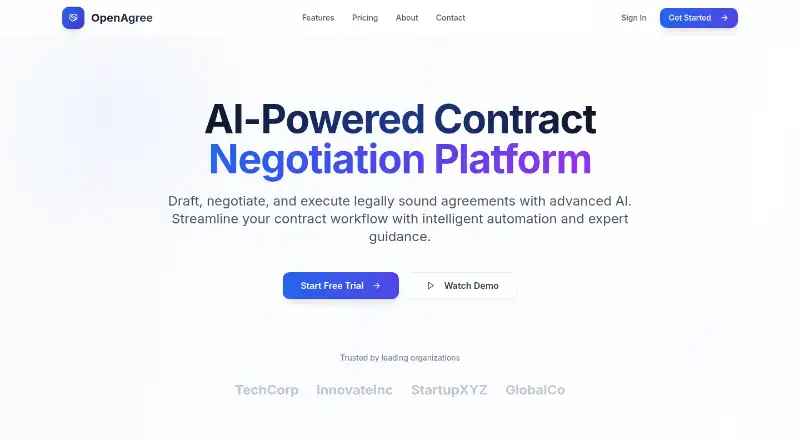
What OpenAgree is
OpenAgree is a cloud-based web platform for drafting, negotiating, and completing agreements with AI assistance. A user describes an agreement in everyday language, and OpenAgree turns it into a legally structured contract. Its negotiation engine evaluates proposed changes and recommends compromises; automated risk assessment reviews agreement terms in real time. The platform also tracks milestones, manages payments, and sends notifications and status updates over an agreement’s lifecycle. Digital signature workflows include validation, and OpenAgree states that it checks legal compliance in real time.
The first two contracts or agreements are free, with no credit card required. Light Agreements are intended for freelancers and small projects, with charges of $1 to create an agreement, $5 for an AI change proposal, and $2 for milestone tracking. The Business offering is for complex agreements and includes advanced AI negotiation features and detailed analytics and reporting; listed charges are $5 to create a contract, $10 for an AI change proposal, and $3 for milestone tracking. The site displays SOC 2 Type II and GDPR Compliant badges. OpenAgree says its approach draws on research into AI-powered negotiation and contract law, and references the University of Chicago Law Review.
Good
- Turns everyday-language descriptions into legally structured contracts.
- AI reviews proposed changes and suggests compromises.
- Automated risk assessment evaluates terms in real time.
- Tracks milestones, payments, notifications, and agreement status.
- Integrated digital signature workflows include validation.
- First two contracts or agreements are free without a credit card.
Watch out
- Only web is listed as a platform.
- Light Agreements charge separately for creation, change proposals, and milestone tracking.
- Business charges separately for contract creation, change proposals, and milestone tracking.
Who it suits
OpenAgree may suit freelancers and small-project users who need simple agreements and pay-per-use charges. Its Business offering targets users handling complex agreements who want advanced AI negotiation and analytics and reporting.
Verdict
OpenAgree is a fit for users who want agreement drafting, negotiation support, lifecycle tracking, and signatures in one web platform. Freelancers and small projects can consider Light Agreements; users needing advanced negotiation and analytics can consider the Business offering, with per-action charges applying.
Plans and prices
From OpenAgree's own pricing page, checked 15 Oct 2026.
| Plan | Price | What it gives you |
|---|---|---|
| Free to Start | Free | first 2 contracts or agreements · no credit card · no subscription · no hidden fees |
| For Business | Priced on request | creating contract $5 · AI change proposal $10 · milestone tracking $3 · complex agreements · advanced AI negotiation · detailed analytics and reporting |
| Light Agreements | — | creating agreement $1 · AI change proposal $5 · milestone tracking $2 · simple contracts · freelancers and small projects · monthly billing |
The facts
Each one read from OpenAgree's own pages, with the date it was checked.
What it does
- Academic reference
- OpenAgree links its negotiation concept to the University of Chicago Law Review essay Game Over: Facing the AI Negotiator.checked 15 Oct 2026
- AI negotiation
- The smart negotiation engine analyzes proposed changes and suggests fair compromises using legal best practices, industry standards, and historical data.checked 1 Oct 2026
- AI negotiation chat
- The product includes an interactive AI negotiation chat for discussing contract terms.checked 15 Oct 2026
- Analytics
- The Business offering includes detailed analytics and reporting.checked 15 Oct 2026
- Business audience
- The Business tier is positioned for complex agreements and advanced negotiation work.checked 15 Oct 2026
- Business capabilities
- The business offering includes advanced AI negotiation features and detailed analytics and reporting.checked 1 Oct 2026
- Collaboration
- Stakeholders can securely share agreements and collaborate during negotiation.checked 15 Oct 2026
- Compliance
- OpenAgree states that it provides real-time legal compliance validation to ensure terms meet legal standards.checked 1 Oct 2026
- Compliance validation
- OpenAgree states that it performs real-time legal-compliance validation of terms.checked 15 Oct 2026
- Compromise suggestions
- Its negotiation engine analyzes proposed changes and recommends compromises using legal practices, industry standards and historical data.checked 15 Oct 2026
- Electronic signatures
- The service provides integrated digital-signature workflows and signature validation.checked 15 Oct 2026
- Fairness analysis
- OpenAgree advertises analysis intended to support balanced negotiation outcomes.checked 15 Oct 2026
- Independent context: AI negotiation benefits
- The linked University of Chicago Law Review essay argues that AI could increase information available to negotiators and reduce transaction costs.checked 15 Oct 2026
- Independent context: automation limits
- The essay explains that fully automated negotiation can reduce transaction costs while limiting tailored value creation.checked 15 Oct 2026
- Independent context: bargaining risk
- The same essay warns that sophisticated AI negotiators may exploit information asymmetries to shift bargaining outcomes toward larger businesses.checked 15 Oct 2026
- Independent context: market power
- The essay concludes that large companies with market power are best positioned to design and deploy sophisticated automated negotiation strategies.checked 15 Oct 2026
- Independent context: publication date
- The University of Chicago Law Review page dates Game Over: Facing the AI Negotiator to November 18, 2024.checked 15 Oct 2026
- Independent context: symposium date
- Oxford’s law blog records that the AI negotiation essay belonged to the How AI Will Change the Law symposium held on April 12–13, 2024.checked 15 Oct 2026
- Lifecycle tracking
- OpenAgree tracks milestones, manages payments, and provides automated notifications and status updates throughout an agreement lifecycle.checked 1 Oct 2026
- Light-agreement audience
- Light Agreements are described as suitable for freelancers and small projects.checked 1 Oct 2026
- Limit: no deployment detail
- The opened homepage gives no self-hosting, installation or system-requirement information.checked 15 Oct 2026
Money
- Free allowance
- The first two contracts or agreements are free and no credit card is required to try the service.checked 15 Oct 2026
- Free usage
- The first two contracts or agreements are completely free and no credit card is required to try the platform.checked 1 Oct 2026
- Light-plan audience
- Light Agreements is presented for simple contracts, freelancers and small projects.checked 15 Oct 2026
The full review of OpenAgree
OpenAgree combines agreement drafting, negotiation, signing, and lifecycle management in a web platform. It is most compelling for users who want those steps together and can work with per-action pricing. Its pay-as-you-go structure avoids a subscription, but repeated drafting, change proposals, and tracking each add cost.
Overview
Users describe an agreement in everyday language, and OpenAgree turns that description into a structured contract. The platform also supports negotiation, automated risk assessment, compliance validation, digital signatures, and tracking for milestones, payments, notifications, and status updates. That breadth can reduce the need to move an agreement between separate tools, though automated drafting and review do not replace a person’s judgment about whether the terms are suitable.
OpenAgree says its approach draws on research into AI negotiation and contract law, and references the University of Chicago Law Review. Its site displays SOC 2 Type II and GDPR Compliant badges, and its homepage reports that all systems are operational.
Key features
- Plain-language drafting: Starting with an everyday description may help users who do not want to build a contract from a blank page. This is especially relevant to simple agreements, but users still need to check that the structured draft reflects their intent.
- AI negotiation and review: The engine analyzes proposed changes and suggests compromises informed by legal best practices, industry standards, and historical data. This can help frame a negotiation; it does not establish that a proposed compromise is right for every party or agreement.
- Risk and compliance checks: Automated risk assessment evaluates terms in real time, while compliance validation is intended to check legal standards. These checks add review support, but the platform’s claims should not be treated as a substitute for professional advice when the stakes warrant it.
- Lifecycle tracking and signatures: Milestone and payment tracking, notifications, status updates, and integrated signature workflows extend the product beyond drafting. The combination suits users who want to follow an agreement through execution and subsequent milestones.
Pricing
OpenAgree is freemium, with the first two contracts or agreements free and no credit card required. The free offer has no subscription or hidden fees, making it a low-commitment way to try the workflow, but it covers only those first two agreements.
| Plan | Price and charges | Best fit |
|---|---|---|
| Free to Start | free; first 2 contracts or agreements free | Trying the platform or handling up to two initial agreements without a subscription. |
| Light Agreements | Custom pricing; creating agreement $1, AI change proposal $5, milestone tracking $2 | Freelancers and small projects with simple contracts and occasional use. |
| For Business | Custom pricing; creating contract $5, AI change proposal $10, milestone tracking $3 | Complex agreements needing advanced AI negotiation features and detailed analytics and reporting. |
Both paid offerings charge by action rather than by a listed subscription rate. Light Agreements has lower creation, proposal, and tracking charges, but is positioned for simple contracts; Business costs more per action and adds advanced negotiation and analytics for more complex work. Regularly creating agreements, proposing changes, or tracking milestones can make those charges accumulate. OpenAgree also offers a free trial, while the first two agreements are explicitly free.
Platforms
OpenAgree is a cloud-based web platform. That makes it a fit for users working through a browser, rather than those seeking a listed native desktop or mobile app.
Who it's for
Freelancers and small projects with straightforward agreements are the clearest fit for Light Agreements. Teams handling more complex negotiations may find the Business offering’s advanced negotiation and reporting more relevant, provided per-action costs suit their usage. Users who need a fixed subscription price, or whose work does not call for negotiation and lifecycle tracking, may prefer a narrower tool.
Pros and cons
- Pro — One workflow spans drafting through signatures and tracking: Users can create, negotiate, sign, and monitor agreements within the same platform.
- Pro — A small initial commitment: The first two agreements are free without a credit card or subscription, useful for evaluating the service.
- Pro — Pricing tiers address different complexity levels: Light Agreements targets simple work, while Business adds advanced negotiation and detailed reporting.
- Con — Usage charges are cumulative: Drafting, AI change proposals, and milestone tracking are each charged separately on paid offerings.
- Con — The free allowance is narrow: Only the first two agreements are free, so continued use moves to per-action charges.
- Con — Web only: Users looking for a native mobile or desktop app should consider alternatives.
Alternatives
For a broader comparison, see Contract Negotiation Software.
- Contractbook is worth considering for users who want a freemium contract tool with API and web access; its Essential plan includes one user, 100 signed contracts per year, and five templates, while Centralize costs $399 a month billed annually for five users.
- Icertis Contract Management is an enterprise contract lifecycle management option for organizations seeking that focus and access across Android, iOS, web, and API; pricing is available by demo request.
- LinkSquares may suit organizations seeking a paid contract platform across web, Windows, macOS, and API, with personalized custom pricing based on organizational needs.
- Conga CLM is another paid contract lifecycle management option, without a free plan.
- DocuSign eSignature is a freemium alternative for sending, signing, and managing agreements; its Personal plan is $11 a month, with an annual commitment.
- Sirion is an enterprise option with custom pricing based on organizational requirements, deployment scope, users, integrations, and contract volume.
- SpotDraft is a paid alternative whose pricing is based on users or contract volume and includes in-house implementation, dedicated customer success, and 24/7 support.
- Canveo is a paid web-based alternative.
Verdict
OpenAgree is a strong fit for freelancers and small projects that want simple agreement drafting and tracking without a subscription, and for businesses that can use its advanced negotiation and analytics. Its central advantage is bringing drafting, negotiation, signatures, and lifecycle tools together. Look elsewhere if per-action charges are a poor match for frequent use or if a native app or more predictable subscription pricing is essential.
Getting started
- Visit the OpenAgree website.
- Use the web platform.
- Try the first two contracts or agreements free without a credit card.
- Choose Light Agreements for simple contracts or the Business offering for complex agreements.
Limits worth knowing
The free start covers the first two contracts or agreements. Light Agreements charges $1 per agreement creation, $5 per AI change proposal, and $2 per milestone tracking; Business charges $5, $10, and $3 for those respective actions.
Questions
What does OpenAgree cost?
The first two contracts or agreements are free. Light Agreements lists $1 to create an agreement, $5 for an AI change proposal, and $2 for milestone tracking; Business lists $5, $10, and $3 for those actions, respectively.
Does OpenAgree require a credit card to try?
No credit card is required for the first two free contracts or agreements.
What platform does OpenAgree support?
OpenAgree is listed for web and described as cloud-based.
What is included in the Business offering?
It includes complex agreements, advanced AI negotiation features, and detailed analytics and reporting.
Who are Light Agreements for?
They are described as suitable for freelancers and small projects, with simple contracts and pay-per-use charges.
What security or compliance details does OpenAgree show?
The site displays SOC 2 Type II and GDPR Compliant badges. OpenAgree also states that it provides real-time legal compliance validation.
Alternatives to OpenAgree
- 1

Contractbook
Free planWebAPI7.2From $399 a month - 2
 6.8
- 3

Icertis Contract Management
AndroidiOSWebAPI6.8 - 4

Gatekeeper
WebAPI6.7 - 5

ThoughtRiver
WebAPIExtensionWindows6.7 - 6

SpotDraft
AndroidiOSWebAPI6.5