Open Source Point of Sale
Open Source Point of Sale is a free web-based point-of-sale system written in PHP, with MySQL or MariaDB as its data store.
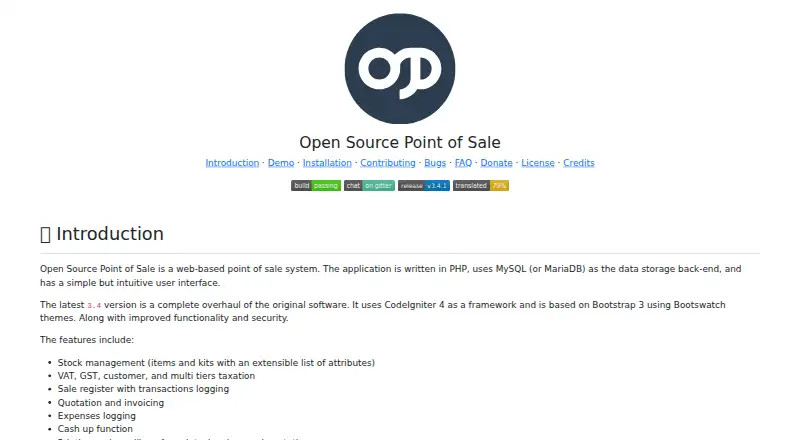
What Open Source Point of Sale is
Open Source Point of Sale is a free web-based point-of-sale system written in PHP, with MySQL or MariaDB as its data store. It manages stock for items and kits using an extensible list of attributes and supports multiple locations. Sales functions include a register with transaction logging, quotations, invoicing, and VAT, GST, customer, and multi-tier taxation. Operations tools include expense logging, cash up, receivings, gift cards, rewards, and restaurant tables. Users can print or email receipts, invoices, and quotations, as well as generate and print barcodes. Multiple users can have permission controls, and reports cover sales, orders, expenses, and inventory status. The listed integrations include MailChimp and SMS messaging. The project describes optional Google reCAPTCHA for login protection and says the software is GDPR ready. Its installation guide lists PHP 8.2 to 8.4, MySQL 5.7 or MariaDB 10.x, and Apache 2.4. Security patches cover versions 3.4.2 and later, not earlier releases. The MIT license includes a requirement to retain the visible footer signature on every page.
Good
- Supports stock management for items and kits.
- Includes a sale register, quotations, and invoicing.
- Supports multiple users with permission controls.
- Reports on sales, orders, expenses, and inventory.
- Can print or email receipts, invoices, and quotations.
Watch out
- Security patches do not cover versions before 3.4.2.
- MIT license requires the visible footer signature on every page.
- Installation guide specifies PHP, database, and Apache requirements.
Who it suits
Open Source Point of Sale suits businesses looking for web-based tools to manage stock, sales, customers, and multiple locations. It may also fit operations that need quotations, invoicing, barcode printing, or restaurant table functions.
Verdict
Open Source Point of Sale combines stock, transaction, tax, and reporting functions in a web-based system. Check the server requirements and keep the required footer signature visible when using it.
Plans and prices
From Open Source Point of Sale's own pricing page, checked 8 Oct 2026.
| Plan | Price | What it gives you |
|---|---|---|
| Open Source Point of Sale | Free | MIT-licensed software; footer signature must remain visible on every page |
The facts
Each one read from Open Source Point of Sale's own pages, with the date it was checked.
Money
- Free plan
- Yeschecked 21 Sep 2026
What it does
- Installation
- The project says it can be set up in different ways and supports the installation methods described in its INSTALL.md file.checked 8 Oct 2026
- Integration
- The features page lists MailChimp integration and messaging by SMS.checked 8 Oct 2026
- Inventory management
- Yeschecked 21 Sep 2026
- License
- The project is licensed under MIT terms with an additional requirement to retain its visible footer signature on every page.checked 8 Oct 2026
- Multi-location support
- Yeschecked 21 Sep 2026
- Operations
- It includes expense logging, cash up, receivings, gift cards, rewards, and restaurant tables.checked 8 Oct 2026
- Product
- Open Source Point of Sale is a web-based point of sale system written in PHP with MySQL or MariaDB as its data store.checked 8 Oct 2026
- Receipts and barcodes
- It can print and email receipts, invoices, and quotations, and generate and print barcodes.checked 8 Oct 2026
- Sales and tax
- Features include a sale register with transaction logging, quotation and invoicing, and VAT, GST, customer, and multi-tier taxation.checked 8 Oct 2026
- Security
- The project lists optional Google reCAPTCHA to protect the login page from brute force attacks and describes the software as GDPR ready.checked 8 Oct 2026
- Security support
- The security policy says versions 3.4.2 and later are supported for security patches, while earlier versions are not.checked 8 Oct 2026
- Stock management
- It supports stock management for items and kits with an extensible list of attributes.checked 8 Oct 2026
- Support
- The security policy says vulnerability reports receive a response within 48 hours and confirmed vulnerabilities are patched within a few days depending on complexity.checked 8 Oct 2026
- System requirements
- The installation guide lists PHP 8.2 to 8.4, MySQL 5.7 or MariaDB 10.x, and Apache 2.4 as supported server software.checked 8 Oct 2026
- Users and reporting
- It supports multiple users with permission control and reporting on sales, orders, expenses, and inventory status.checked 8 Oct 2026
Where it runs
- Platforms
- The installation guide says Docker deployment is available on Linux, Mac, and Windows, with WSL2 required for Windows.checked 8 Oct 2026
The full review of Open Source Point of Sale
Open Source Point of Sale is a self-hosted checkout and operations system built on PHP with MySQL or MariaDB. It is best suited to retailers and restaurants comfortable managing their own server. The broad feature set costs nothing, but server upkeep and a required visible footer signature are meaningful compromises.
Overview
Beyond checkout, the system brings inventory, receivings, expenses, cash-up, gift cards, customer rewards, and restaurant tables into one web-based application. Support for multiple locations and users with permission controls makes it relevant to businesses with more than one counter or staff role. That breadth is a strong proposition at no software cost, provided the business can take responsibility for installation and maintenance.
The software is licensed under MIT terms, with an additional requirement to retain its visible footer signature on every page. That may be acceptable for internal use, but it limits branding control wherever customers encounter the interface. Optional Google reCAPTCHA protects the login page against brute-force attacks, and the project describes the software as GDPR ready.
Key features
Sales, stock, and tax
The register logs transactions and supports quotations and invoicing. Stock management covers both individual items and kits, with an extensible list of attributes. VAT, GST, customer, and multi-tier taxation provide flexibility for different tax setups; businesses should still make sure the supported rules match their own requirements.
Store operations and customer-facing tasks
Expense logging, cash-up, and receivings address routine back-office work, while gift cards and rewards add customer loyalty tools. Restaurant tables extend the system beyond conventional retail. It can print or email receipts, invoices, and quotations, and generate and print barcodes. Barcode scanning is supported, though hardware support is through third parties, so businesses should confirm their equipment arrangements before relying on a particular setup.
Users, reporting, and integrations
Multiple users can be managed with permissions, and reports cover sales, orders, expenses, and inventory status. The features page also names MailChimp integration and SMS messaging. These capabilities make the product more than a cash register, although the stated feature set does not establish how any particular business's processes will map to it.
Pricing
Open Source Point of Sale costs nothing. The free plan is the MIT-licensed software itself, with no paid tier or quota described. Its important condition is not a seat or transaction cap: the visible footer signature must remain on every page. That trade-off may suit operators prioritizing cost and control over branding, but it is a poor fit for businesses requiring a fully branded interface.
Free does not mean managed hosting. The system is web-based and uses PHP with MySQL or MariaDB, so the business must arrange a supported server and take responsibility for keeping it running. The installation guide lists PHP 8.2 to 8.4, MySQL 5.7 or MariaDB 10.x, and Apache 2.4 as supported server software.
Platforms
The product supports Linux, macOS, and Windows, as well as web access and self-hosting. Its server requirements make it a practical choice for teams able to manage compatible hosting; those seeking a hosted service rather than server administration should look elsewhere.
Who it's for
This is a strong candidate for retailers or restaurants that want inventory, transactions, tax handling, reporting, and day-to-day operations in a single no-cost system, especially when multiple locations or user permissions matter. It is less suitable for businesses that want a vendor-managed server, need complete control over page branding, or cannot accommodate third-party hardware support.
Installation can be set up in different ways, with methods described in the project's INSTALL.md. Security maintenance also matters: versions 3.4.2 and later receive security patches, while earlier versions do not. The security policy says vulnerability reports receive a response within 48 hours and confirmed issues are patched within a few days, depending on complexity. Staying on a supported version is therefore important for any business running the system.
Pros and cons
- Pros: No software charge, with stock, sales, tax, reporting, expenses, and receivings in one system; useful breadth for retail and restaurant operations.
- Pros: Multiple locations, user permissions, barcode generation and scanning, and customer rewards support more involved store workflows.
- Cons: Self-hosting requires compatible PHP and database server software, plus ongoing server responsibility.
- Cons: The visible footer signature must remain on every page, restricting branding control.
- Cons: Hardware support comes through third parties, so equipment fit needs consideration.
Alternatives
For another free, self-hosted option, RetailPOS is worth comparing: it is Apache 2.0 licensed and spans Android, iOS, Linux, macOS, web, and Windows as well as self-hosting. Loyverse is a freemium choice with a free POS plan and a 31-day sales history; choose its Unlimited sales history plan at $5 a month if retaining more than that history is important.
Posnic POS offers a free Community Edition and publishes its desktop application source under AGPL-3.0-only. uniCenta oPOS is another freemium option, with a BASE subscription at £72 a year. Erply is a paid alternative whose Growth Plan costs $1,000 a month and includes three stores and unlimited users. NCR Voyix POS is a paid option for grocery, convenience and fuel, department, and specialty retail; pricing requires contacting NCR Voyix. The paid Oracle Retail Xstore Point-of-Service Engage and Oracle Retail Xstore Point-of-Service are additional options to consider; Oracle invites retailers to request a demo for the latter.
Compare more choices in Retail POS Software and Point-of-Sale Software.
Verdict
Choose Open Source Point of Sale if you want a broad retail or restaurant toolkit without a software fee and can manage its server. Its main advantage is the range of stock, checkout, tax, and operational functions in one system; its main drawback is the combination of hosting responsibility and a footer signature you cannot remove. Look elsewhere if either constraint conflicts with your technical resources or branding needs.
Getting started
- Open the Open Source Point of Sale website
- Select an installation method described in INSTALL.md
- Prepare PHP 8.2–8.4 with MySQL 5.7 or MariaDB 10.x
- Use Apache 2.4 as the supported web server
- Deploy the web application on a supported platform or self-hosted system
Limits worth knowing
The software is free under MIT terms, but every page must retain its visible footer signature. Security support is provided for versions 3.4.2 and later; earlier versions are not covered.
Questions
Is Open Source Point of Sale free?
Yes. Its listed plan is free, with a free plan.
Which platforms are supported?
The listed platforms are Linux, macOS, self-hosted, web, and Windows.
What databases can it use?
It uses MySQL or MariaDB as its data store.
Does it support barcodes and hardware?
It supports barcode scanning and can generate and print barcodes. Hardware support is provided through third parties.
What licence applies?
The project uses MIT terms with an additional requirement to keep its visible footer signature on every page.
Alternatives to Open Source Point of Sale
- 1
Loyverse
Free planAndroidiOSWebAPI9.0Free plan - 2
GoFrugal Retail
AndroidiOSWebAPI8.6 - 3
Helcim
Free planAndroidiOSWebAPI8.6From $0.40 a month - 4

Posnic POS
Free planOpen sourceAndroidiOSWebAPI8.6From ₹4,999 a year - 5
GoDaddy POS
Free planAndroidiOSWebAPI8.5From $28.99 a month - 6
Imonggo
Free planAndroidiOSWebAPI8.4From $30 a month