
Omniscient AI
Omniscient AI provides source-linked fact-checking through an API, a WordPress plugin, and a Chrome extension.
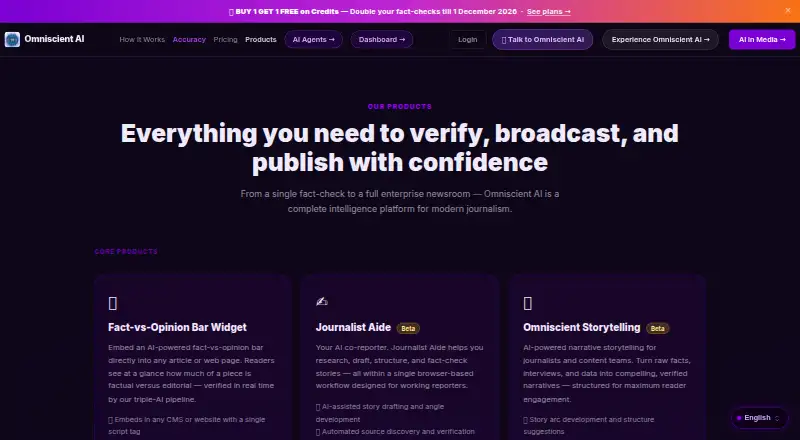
What Omniscient AI is
Omniscient AI provides source-linked fact-checking through an API, a WordPress plugin, and a Chrome extension. An API request returns a consensus Trust Score, model verdicts, and source citations in structured JSON; it runs GPT-4o Mini, Perplexity Sonar Pro, and Gemini 2.5 Flash together. The developer page says a consensus result is returned in under 3 seconds. The WordPress plugin can add a Fact-vs-Opinion bar and automatic article analysis using the user's API key. The Chrome extension checks a webpage or selected text and displays results with supporting sources. Documentation also describes webhook delivery and an OBS browser source. Enterprise API v1 accepts claims up to 8,000 characters and lists ten supported languages: English, Hindi, Spanish, French, German, Portuguese, Arabic, Chinese, Japanese, and Korean. Submitted claims are not used to train models, and API requests use Bearer-token authentication; keys can be revoked from the dashboard. The service offers five free checks after Google sign-in. Metered billing is free with a $0 /mo base, then $0.005 per fact-check request. Other listed plans are $399 a month, $1,000 a month, and $10,000 a year.
Good
- API responses include a consensus score, model verdicts, and citations.
- Chrome extension checks webpages or selected text.
- WordPress plugin offers article analysis and a Fact-vs-Opinion bar.
- Submitted claims are not used to train models.
Watch out
- Free checks require Google sign-in.
- The API pricing FAQ recommends human review for high-stakes decisions.
- Metered requests cost $0.005 each after the $0 /mo base.
Who it suits
Omniscient AI suits publishers and teams that need claim checks with source citations in editorial or web workflows. Its API and integrations also serve developers building fact-checking into other tools.
Verdict
Omniscient AI combines source-linked checks with API, WordPress, and Chrome options. Its Trust Scores are described as triage support, so high-stakes decisions still call for human review.
Plans and prices
From Omniscient AI's own pricing page, checked 5 Oct 2026.
| Plan | Price | What it gives you |
|---|---|---|
| Metered | Free | 60 requests/min · pay-per-use · 3 AI models · live citations · REST API + SDK · community support · results cached 30 days · $0 /mo base, then $0.005 per fact-check request |
| Always-On Pro | $399 a month | Unlimited requests · 300 requests/min · 99.5% uptime SLA · priority queue · email + Slack support · results cached 90 days · Billed monthly · cancel any time |
| Agency | $1,000 a month | Unlimited requests · 1,000 requests/min · team access · multiple API keys · dedicated Slack support · white-label response option · Billed monthly · cancel any time |
| Enterprise | $10,000 a month | 5,000,000+ requests included · dedicated infrastructure · custom SLA up to 99.99% · 24/7 phone + engineer support · GDPR/data residency options · Custom pricing; from $10,000/mo · billed annually |
The facts
Each one read from Omniscient AI's own pages, with the date it was checked.
What it does
- API limits
- The Enterprise API v1 accepts claims up to 8,000 characters and lists English, Hindi, Spanish, French, German, Portuguese, Arabic, Chinese, Japanese, and Korean as supported languages.checked 5 Oct 2026
- API output
- A fact-check API request returns a consensus Trust Score, model verdicts, and source citations in a structured JSON response.checked 5 Oct 2026
- Chrome extension
- The Chrome extension checks a web page or selected text and shows multi-model fact-check results with supporting sources in Chrome.checked 5 Oct 2026
- Data processing
- The API pricing page says requests are processed on Omniscient's infrastructure, which calls upstream AI models over encrypted connections.checked 5 Oct 2026
- Data use
- The API pricing page says submitted claims are not used to train any model.checked 5 Oct 2026
- Decision support
- The API pricing FAQ describes Trust Scores as a triage tool and recommends human review for high-stakes decisions.checked 5 Oct 2026
- Models
- The API runs GPT-4o Mini, Perplexity Sonar Pro, and Gemini 2.5 Flash simultaneously for each request.checked 5 Oct 2026
- Other integrations
- The developer documentation describes webhook delivery, an OBS browser source, and a WordPress plugin integration.checked 5 Oct 2026
- Purpose
- Omniscient AI offers source-linked fact-checking for publishers through an API, a WordPress plugin, and a Chrome extension.checked 5 Oct 2026
- Security
- The developer documentation requires Bearer-token authentication for API requests and says API keys can be revoked from the dashboard.checked 5 Oct 2026
- Speed
- The developer page says a single API request returns a consensus fact-check in under 3 seconds.checked 5 Oct 2026
- WordPress
- The WordPress plugin adds a Fact-vs-Opinion bar and automatic analysis options to published articles, using the user's API key.checked 5 Oct 2026
Money
- Free checks
- The try page offers five free checks after Google sign-in and says a promotional code can unlock additional checks without a card.checked 5 Oct 2026
The company
- Maker and address
- The privacy policy identifies Tanmaya Sharma as the proprietor and gives a registered address in Model Town, Delhi, India.checked 5 Oct 2026
The full review of Omniscient AI
Omniscient AI is a source-linked fact-checking service for publishers and developers, delivered through an API, WordPress plugin, and Chrome extension. It suits teams that need rapid, attributable checks inside editorial or browsing workflows. Its multi-model consensus is useful for triage, while consequential decisions still require a human to assess the evidence.
Overview
Each API request runs GPT-4o Mini, Perplexity Sonar Pro, and Gemini 2.5 Flash simultaneously. The structured JSON response includes a consensus Trust Score, individual model verdicts, and citation links. A request is described as returning its consensus check in under three seconds, making the service a practical signal for publishing queues, moderation, and other time-sensitive processes.
Checks can use web sources and cover text, URLs, webpages, articles, images, printed material, and audio claims. Enterprise API v1 accepts claims up to 8,000 characters in English, Hindi, Spanish, French, German, Portuguese, Arabic, Chinese, Japanese, and Korean. Submitted claims are not used to train models; requests are processed on Omniscient's infrastructure, which calls upstream models over encrypted connections.
Key features
One result, several model views
Three simultaneous models can reveal disagreement that a single verdict would conceal. Citation links make the output inspectable rather than merely numerical. That is valuable for editors who need a fast starting point, but the Trust Score remains a triage aid and cannot replace reviewing the underlying evidence for high-stakes work.
Editorial and browser workflows
The WordPress plugin adds a Fact-vs-Opinion bar to published articles and can analyze posts automatically with the user's API key. It is the strongest fit for WordPress-led publications that want checks in their existing process. The Chrome extension checks a full page or selected text and displays multi-model results with supporting sources, which is more convenient for researchers and readers than moving claims into a separate tool.
Developer documentation also covers webhook delivery, an OBS browser source, and WordPress integration. Bearer-token authentication is required for API calls, and keys can be revoked from the dashboard, giving administrators a direct way to retire credentials.
Pricing
The free entry point is the Metered plan: free, then $0.005 per fact-check request. It provides 60 requests per minute, three AI models, live citations, REST API plus SDK access, community support, and results cached for 30 days. Google sign-in unlocks five free checks on the try page, while a promotional code can add checks without a card. This is suitable for prototypes and light usage, but pay-per-use costs rise with volume and there is no included request allowance.
Always-On Pro costs $399 a month, billed monthly with cancellation any time. It adds unlimited requests, 300 requests per minute, a 99.5% uptime SLA, priority queueing, email and Slack support, and 90-day result caching. It fits a production publisher that needs predictable capacity; smaller teams may find the jump from metered billing difficult to justify.
Agency is $1,000 a month, billed monthly and cancellable any time. Unlimited requests, 1,000 requests per minute, team access, multiple API keys, dedicated Slack support, and a white-label response option target agencies serving several clients.
Enterprise uses custom pricing from $10,000 per month, billed annually at $10,000 a year as listed. It includes 5,000,000 or more requests, dedicated infrastructure, a custom SLA up to 99.99%, 24/7 phone and engineer support, and GDPR or data-residency options. This is an infrastructure purchase for large organizations, not a casual upgrade.
Platforms
Omniscient AI is available through its API, web service, and browser extension, with WordPress and other documented integrations. The API is the right route for custom pipelines; WordPress and Chrome cover ready-made editorial and research use without building an interface.
Who it's for
Choose it for publishers, agencies, and developers that need cited, multi-model checks embedded in content systems. It is less suitable when you need a final autonomous ruling, a low fixed monthly price at modest volume, or a consumer-first mobile experience.
Pros and cons
- Pros: Three-model consensus can expose divergent judgments; structured JSON and citations support reviewable workflows; WordPress, Chrome, REST, SDK, webhooks, and OBS options broaden integration; multilingual Enterprise claims support international publishing; claims are excluded from model training.
- Cons: Trust Scores are explicitly for triage, so human verification remains necessary; the Metered plan has no included request quota and charges per check; Pro, Agency, and Enterprise pricing is aimed at organizations; Enterprise claims are capped at 8,000 characters.
Alternatives
VerumVerify is a better choice for Android or iOS users who want a freemium mobile experience, weekly free checks, and a basic credibility score.
FactGuard suits readers who prefer three free checks per day, private on-device mode, and an iOS or web app rather than a publisher API.
Crowdee is worth considering for self-hosted deployments or image verification with a free daily allowance.
FAXTR fits API users seeking a free monthly call quota and a low-volume claims-search endpoint.
Trusul is a simpler web option for limited daily text and URL analyses with a low-cost starter tier.
Avancer Document Fact-Checker is the alternative when one free scan and image, audio, and document checks are the priority.
Eustace suits project-based users who want 25 verifications to spend over time plus document ledgers and Markdown reports.
Factward is a browser-and-API alternative with two daily free verifications, URL and PDF checks, and shareable reports.
For a broader category comparison, see AI Fact-Checking Tools.
Verdict
Omniscient AI is a strong choice for editorial and development teams that value fast, cited output and need API, WordPress, or Chrome delivery. Choose it for integration flexibility and multi-model visibility; look elsewhere if you want inexpensive consumer use or an automated final answer without human review.
Alternatives to Omniscient AI
- 1

FactGuard
Free planiOSWebAPI7.6From $36.99 a year - 2

VerumVerify
Free planAndroidiOSWeb7.3From $12.99 a month - 3

Factward
Free planWebAPIExtension7.2From $9 a month - 4

Crowdee
Free planWebAPISelf-hosted6.8Free plan - 5
FAXTR
Free planWebAPI6.7From $49 a month - 6

Avancer Document Fact-Checker
Free planWebAPISelf-hosted6.6From $12.99 a month