FAXTR
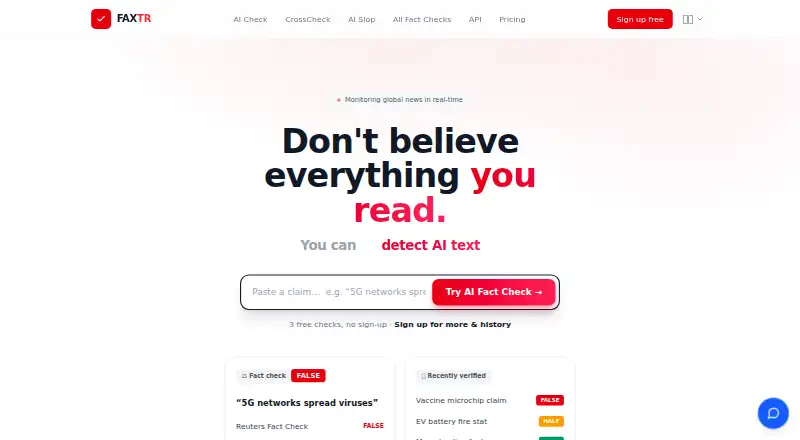
FAXTR is a fact-check platform for reviewing claims, headlines, articles, article URLs, and text generated by large language models.
What FAXTR is
FAXTR is a fact-check platform for reviewing claims, headlines, articles, article URLs, and text generated by large language models. It aggregates verdicts from more than 100 fact-checking organizations across more than 50 countries, rather than making its own final decision about whether a claim is true or false. Its website allows three checks without sign-up; signing up provides more checks and history. FAXTR says it gathers data from the Google Fact Check Tools API and Google News RSS, fetching each automatically three times daily. For integrations, its REST API returns JSON at https://api.faxtr.com/v1, and includes a /v1/guard endpoint for scanning LLM responses for misinformation. Verification endpoints are in private beta and require access. FAXTR Verified gives publishers records of source organization and receipt details, source-text and debunk matches, and a published SHA-256 fingerprint of article text. A publisher can integrate it with one server-rendered link per article, without JavaScript or a runtime dependency on FAXTR.
Good
- Three checks are available without sign-up
- Aggregates verdicts from over 100 organizations
- API includes an LLM misinformation guard endpoint
- Publisher badge needs no JavaScript
Watch out
- Verification endpoints require private beta access
- Starter costs $49 a month
- Free website checks are limited to three without sign-up
Who it suits
FAXTR may suit readers checking claims and publishers that want to show verification records. Its API use cases include LLM guardrails, editorial workflows, and social or user-generated-content platforms.
Verdict
FAXTR brings together existing fact-check verdicts for people and software to assess, rather than issuing its own truth judgment. The free checks offer a starting point, while API verification access is still private beta.
Plans and prices
From FAXTR's own pricing page, checked 1 Oct 2026.
| Plan | Price | What it gives you |
|---|---|---|
| Free | Free | 1,000 API calls/month · 10 requests/minute · /v1/claims search · community support · monthly |
| Starter | $49 a month | 25,000 API calls/month · 60 requests/minute · all search endpoints · /v1/verify single-claim check · email support · monthly |
| Business | $299 a month | 250,000 API calls/month · 300 requests/minute · all endpoints including /v1/guard · webhook delivery · 99.9% SLA · priority support · monthly |
| Enterprise | Priced on request | Unlimited calls · custom rate limits · dedicated infrastructure · custom verification models · on-prem deployment option · dedicated success manager |
The facts
Each one read from FAXTR's own pages, with the date it was checked.
What it does
- API
- The FAXTR API is a REST service with JSON responses and a base URL of https://api.faxtr.com/v1.checked 1 Oct 2026
- API status
- FAXTR states that its verification endpoints are in private beta and require access.checked 1 Oct 2026
- Badge integration
- Publishers integrate FAXTR Verified with one server-rendered link per article, without JavaScript or a runtime dependency on FAXTR.checked 1 Oct 2026
- Coverage
- FAXTR aggregates fact-checking data from organizations across more than 50 countries.checked 1 Oct 2026
- Data sources
- FAXTR uses the Google Fact Check Tools API and Google News RSS, both auto-fetched three times daily for its data collection.checked 1 Oct 2026
- LLM guardrails
- The API includes a /v1/guard endpoint for scanning LLM responses for misinformation.checked 1 Oct 2026
- Method
- FAXTR says it does not independently decide whether a claim is true or false, but aggregates verdicts so users can make the judgment.checked 1 Oct 2026
- Publisher badge
- FAXTR Verified records state the source organization, receipt details, source-text match, debunk matches, and a published SHA-256 fingerprint of the article body.checked 1 Oct 2026
- Purpose
- FAXTR is a global fact-check platform for verifying claims, detecting AI-generated fake news, and checking news against more than 100 fact-checking organizations.checked 1 Oct 2026
- Security practice
- FAXTR instructs API users to pass keys in the Authorization header and never expose keys client-side.checked 1 Oct 2026
- Support
- The pricing page lists community support for Free, email support for Starter, priority support for Business, and dedicated support for Enterprise.checked 1 Oct 2026
- Use cases
- FAXTR describes API use cases including LLM guardrails, editorial workflows, and social or user-generated-content platforms.checked 1 Oct 2026
Money
- Free usage
- The website provides three free checks without sign-up and lets users sign up for more checks and history.checked 1 Oct 2026
The company
- Headquarters
- 16 East 34th Street, New York, NY 10016checked 28 Sep 2026
The full review of FAXTR
FAXTR is a fact-checking service that brings together verdicts from organizations across more than 50 countries. It suits readers and teams who want to compare existing assessments, especially publishers and developers building verification into their workflows. Its free checks are useful for a first look, but its API verification endpoints remain in private beta.
Overview
FAXTR checks claims, headlines, articles, article URLs, and LLM-generated text against fact-checking data from more than 100 organizations. It aggregates verdicts rather than issuing its own true-or-false judgment, so the service is best treated as a way to find relevant assessments—not as a final arbiter of accuracy.
The website offers three checks without sign-up; creating an account enables more checks and history. FAXTR says its collection draws on the Google Fact Check Tools API and Google News RSS, which are automatically fetched three times daily. That makes it a practical starting point for finding published fact checks, though the service’s stated method is assisted verification rather than an independent ruling.
Key features
FAXTR supports claim detection and citation links across web content. Developers can use its REST API, which returns JSON from https://api.faxtr.com/v1. The /v1/guard endpoint is designed to scan LLM responses for misinformation; FAXTR also describes editorial workflows and social or user-generated-content platforms as API use cases. Verification endpoints are in private beta and require access, so teams should not assume they can integrate them immediately.
FAXTR Verified gives publishers a way to attach provenance information to an article. Its record includes the source organization, receipt details, a source-text match, debunk matches, and a published SHA-256 fingerprint of the article body. Integration uses one server-rendered link per article, with no JavaScript or runtime dependency on FAXTR. That lightweight approach is a clear fit for publishers who want to expose verification records without adding a client-side service dependency.
API users are instructed to send keys in the Authorization header and never expose them client-side. That is an important implementation constraint for any product team planning a browser-based integration.
Pricing
FAXTR has a free plan and paid plans billed monthly. Free allows 1,000 API calls per month, 10 requests per minute, claim search through /v1/claims, and community support. It is suited to low-volume exploration or simple claim-search integrations, but it does not include the broader endpoint access of Starter.
Starter costs $49 a month and includes 25,000 API calls per month, 60 requests per minute, all search endpoints, single-claim checks through /v1/verify, and email support. It is the more relevant tier for teams that need verification rather than search alone, subject to obtaining private-beta access.
Business costs $299 a month and raises the allowance to 250,000 API calls per month and 300 requests per minute. It includes all endpoints, including /v1/guard, webhook delivery, a 99.9% SLA, and priority support. Those additions make it the tier aimed at higher-throughput services that need LLM response scanning and a stated service commitment.
Enterprise has custom pricing and includes unlimited calls, custom rate limits, dedicated infrastructure, custom verification models, an on-prem deployment option, and a dedicated success manager. It is for organizations with deployment or capacity requirements beyond the fixed tiers. The free plan is useful for a modest API workload, but its rate limit and claim-search-only access make it a limited substitute for paid verification access.
Platforms
FAXTR is available on the web and through an API. Its API is the relevant route for product integrations; the verification endpoints’ private-beta status is a material limitation for developers evaluating it as an immediately deployable service.
Who it's for
FAXTR is best suited to readers who want to locate existing fact-check verdicts, publishers who want to expose verification records alongside articles, and developers exploring fact-checking in editorial, LLM, or user-content workflows. It is less suitable for anyone expecting FAXTR itself to make a definitive truth judgment or for teams that need open API verification access today.
Pros and cons
- Pros: Aggregates assessments from organizations across more than 50 countries, giving readers a broader route to existing fact checks.
- Pros: Three checks are available without sign-up, making it possible to try the web service before creating an account.
- Pros: FAXTR Verified provides article-level provenance records and can be integrated with a server-rendered link rather than a JavaScript dependency.
- Cons: FAXTR aggregates other organizations’ verdicts instead of deciding whether claims are true or false, so users must make the final judgment.
- Cons: API verification endpoints are in private beta and require access, limiting immediate usefulness for developers.
- Cons: Free API access is capped at 1,000 calls monthly, 10 requests per minute, and claim search, which is restrictive for more demanding integrations.
Alternatives
For a broader directory of options, see AI Fact-Checking Tools.
Choose VerumVerify instead if mobile access matters: it supports Android and iOS as well as the web, and its free tier includes three fact-checks per week, a basic credibility score, a global news feed, and community results.
FactGuard is a better fit for frequent casual checks: its free plan allows three fact-checks per day and includes quick checks, private on-device mode, and Fact Feed access, across API, iOS, and web.
Pick Crowdee when image verification is the priority. Its free offer provides one image verification per IP every 24 hours, for uploads up to 10 MB, with a verdict, confidence score, and supporting indicators.
Omniscient AI may suit developers who prefer usage-based pricing: its metered plan has a $0 monthly base and charges $0.005 per fact-check request, with 60 requests per minute, three AI models, live citations, and a REST API plus SDK.
Trusul is an alternative for web-based text and URL analysis, with limited daily analyses and saved history on its free plan.
Consider Avancer Document Fact-Checker if image, audio, or document checks matter; its free plan includes one scan and requires no credit card.
Eustace is a web option for project-based work: its free plan provides 25 claim verifications, unlimited projects and documents, a full ledger, overrides, and Markdown reports.
Factward is worth considering for browser-extension access and URL or PDF checks; its free plan includes two verifications per day, up to 10,000 characters, five claims per check, shareable reports, and an embeddable badge.
Verdict
Choose FAXTR if your priority is finding existing fact-check verdicts across a broad set of organizations, or if you are a publisher drawn to its lightweight verification badge. Its central strength is aggregation and provenance, not independent truth adjudication. Developers should look elsewhere if they need API verification access immediately, while casual users should compare its three no-sign-up checks with alternatives offering recurring free allowances.
Getting started
- Open the FAXTR website for checks or account access
- Run up to three checks without signing up
- Create an account for more checks and history
- Choose a Free, Starter, Business, or Enterprise plan
- Request access to the private-beta verification endpoints
- Integrate the REST API at https://api.faxtr.com/v1
- Send API keys in the Authorization header and keep them off client-side code
Limits worth knowing
The Free plan includes 1,000 API calls per month, a 10-requests-per-minute rate, claim search, and community support. Website visitors get three checks without sign-up; additional checks and history require registration.
Questions
Is FAXTR free?
Yes. The Free plan costs nothing, and the website provides three checks without sign-up.
Which platforms does FAXTR support?
FAXTR is available through the web and an API.
Does FAXTR decide if a claim is true?
No. It aggregates verdicts from fact-checking organizations and leaves the judgment to users.
What does the API provide?
It is a REST service with JSON responses at https://api.faxtr.com/v1. Verification endpoints are in private beta, and /v1/guard scans LLM responses for misinformation.
What is FAXTR Verified?
It records source and receipt details, source-text and debunk matches, and a published SHA-256 article-body fingerprint. Publishers add it with one server-rendered link per article.
Alternatives to FAXTR
- 1

FactGuard
Free planiOSWebAPI7.6From $36.99 a year - 2

VerumVerify
Free planAndroidiOSWeb7.3From $12.99 a month - 3

Factward
Free planWebAPIExtension7.2From $9 a month - 4

Crowdee
Free planWebAPISelf-hosted6.8Free plan - 5

Omniscient AI
Free planWebAPIExtension6.7From $399 a month - 6

Avancer Document Fact-Checker
Free planWebAPISelf-hosted6.6From $12.99 a month