Nearcade
Nearcade is an open-source, self-hosted platform for sharing local co-op games over the internet.
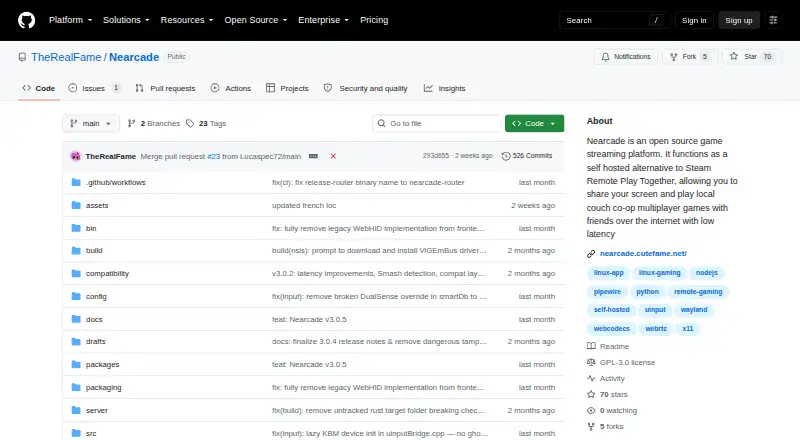
What Nearcade is
Nearcade is an open-source, self-hosted platform for sharing local co-op games over the internet. A host runs the game, while friends join from desktop or mobile web browsers without downloading a client. Streaming uses WebCodecs or WebRTC and peer-to-peer connections. Hosts can choose gamepad input, raw keyboard and mouse, or keyboard and mouse mapped to a virtual gamepad; mobile viewers get touch controls and a virtual joystick. Sessions can use private Cloudflare or Zrok tunnels, or appear in the public Nearcade Arcade lobby. Arcade sessions are limited to 80 minutes and require a verified tunneling provider such as Cloudflared or Zrok. The Rust router blocks audio and video until the host validates the viewer’s session PIN. On Linux, game audio is routed through a virtual capture sink to keep desktop audio and voice chats off the stream. Hosting requires Node.js 18 or newer and Python 3. Linux also needs PipeWire and the uinput module, while Windows gamepad support needs ViGEmBus. Linux is listed as production-stable; Windows and macOS are experimental, and macOS has no gamepad support. Nearcade is published under GPL-3.0.
Good
- Viewers join in a browser without downloads
- Mobile interface includes touch controls
- Hosts can choose among three input modes
- PIN validation gates audio and video
- Private tunnels or public lobby are available
Watch out
- Public Arcade sessions are limited to 80 minutes
- Linux hosting requires PipeWire and uinput
- Windows and macOS are experimental
- macOS has no gamepad support
Who it suits
Nearcade suits people who want to host local co-op games for friends using their own setup. It is aimed especially at private sharing, with browser-based access for desktop and mobile viewers.
Verdict
Nearcade combines browser viewing, multiple input options, and self-hosted session choices for local co-op play. Check the platform maturity and host requirements before choosing where to run it.
The facts
Each one read from Nearcade's own pages, with the date it was checked.
What it does
- Arcade limit
- Public Arcade sessions are limited to 80 minutes and require a verified tunneling provider such as Cloudflared or Zrok.checked 7 Oct 2026
- Audio
- On Linux, Nearcade routes game audio through a virtual sink so personal desktop audio and voice chats stay off the stream.checked 7 Oct 2026
- Audio routing
- On Linux, Nearcade routes game audio to a virtual capture sink to keep desktop audio and voice chats off the stream.checked 7 Oct 2026
- Connections
- It uses peer-to-peer connections and native operating system audio and input routing to keep input delay low.checked 7 Oct 2026
- Hosting options
- Hosts can use private Cloudflare or Zrok tunnels, or list sessions in the public Nearcade Arcade lobby.checked 7 Oct 2026
- Host requirements
- The host requires Node.js 18 or newer and Python 3; Linux also requires PipeWire and the uinput module, while Windows gamepad support requires ViGEmBus.checked 7 Oct 2026
- Input controls
- Hosts can assign viewers gamepad, raw keyboard and mouse, or emulated keyboard and mouse input, and lock player slots.checked 7 Oct 2026
- Input modes
- Hosts can allow gamepad, raw keyboard and mouse, or keyboard and mouse emulated as a virtual gamepad.checked 7 Oct 2026
- Integrations
- Nearcade bundles Cloudflared and Zrok for tunneling and uses Trystero over BitTorrent trackers for signaling.checked 7 Oct 2026
- Intended users
- The project describes its main focus as private setups for sharing local couch co-op games with friends.checked 7 Oct 2026
- Joining sessions
- Viewers join in a desktop or mobile web browser without downloading anything, and the mobile interface includes touch controls and a virtual joystick.checked 7 Oct 2026
- License
- The Nearcade repository is published under the GPL-3.0 license.checked 7 Oct 2026
- Mobile controls
- The mobile viewer interface includes touch controls and a virtual joystick.checked 7 Oct 2026
- PIN protection
- The Rust router blocks video and audio streams until the host app validates the viewer's Session PIN.checked 7 Oct 2026
- Purpose
- Nearcade is an open-source, self-hosted platform for playing local co-op games over the internet with friends.checked 7 Oct 2026
- Streaming
- It streams using WebCodecs or WebRTC and uses peer-to-peer connections to keep input delay low.checked 7 Oct 2026
- Support
- The repository links setup guides, host usage instructions, API and setup documentation, and VPS server setup instructions.checked 7 Oct 2026
- Viewer access
- Viewers join through a desktop or mobile web browser without downloading anything to play.checked 7 Oct 2026
- Viewer access control
- The Rust router blocks video and audio streams until the host validates the viewer's session PIN.checked 7 Oct 2026
- What it does
- Nearcade is an open-source, self-hosted platform for playing local co-op games over the internet with friends.checked 7 Oct 2026
Where it runs
- Linux requirements
- Linux hosting requires PipeWire and the uinput kernel module; the app does not work with PulseAudio.checked 7 Oct 2026
- Platform limits
- The project lists Linux as production stability, Windows and macOS as experimental, and macOS as having no gamepad support.checked 7 Oct 2026
- Platform maturity
- The project lists Linux as production stability and Windows and macOS as experimental; macOS has no gamepad or multi-controller support.checked 7 Oct 2026
- Windows requirements
- Windows gamepad support requires manually installing the ViGEmBus driver.checked 7 Oct 2026
Alternatives to Nearcade
- 1

RomM
Free planOpen sourceAndroidiOSWebAPI8.5From $6.49 a month - 2
OxyROMon
Free planOpen sourceWebAPILinuxmacOS7.4Free plan - 3
WolvenKit
Free planOpen sourceLinuxSelf-hostedWindows7.3Free plan - 4

Igir
Free planLinuxmacOSSelf-hostedWindows6.6Free plan - 5
verifydump
Free planLinuxmacOSWindows6.6Free plan - 6
Gaseous
Free planWebLinuxSelf-hostedWindows6.3Free plan