mori
mori is a free, open-source proxy for working with production databases while keeping production write-protected.
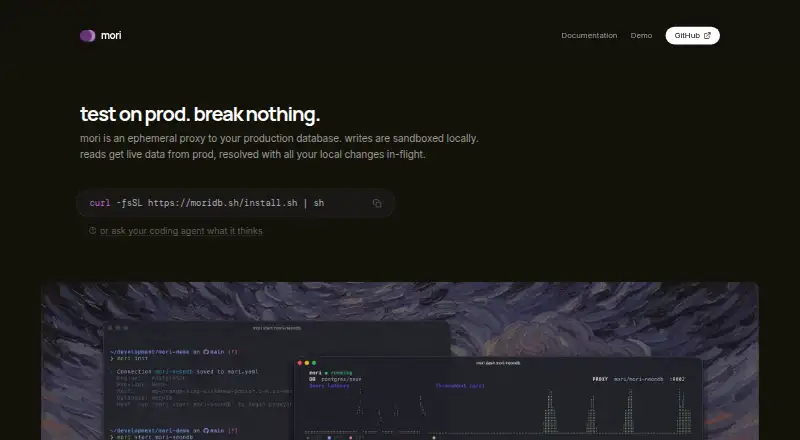
What mori is
mori is a free, open-source proxy for working with production databases while keeping production write-protected. Reads use live production data, while writes and schema changes go to a local Shadow database; mori merges those local changes into read results. This supports querying, migration testing, and data changes in a production-like view before resetting or removing the instance. The project lists PostgreSQL, CockroachDB, MySQL, MariaDB, Microsoft SQL Server, SQLite, DuckDB, Redis, and Firestore. It can detect credentials for providers including AWS RDS, GCP Cloud SQL, Supabase, Neon, and PlanetScale, or accept a connection string. SSH tunnels, GCP Cloud SQL Proxy, and AWS SSM can reach databases behind private networks. A terminal dashboard shows connections, query routing, local changes, schema divergence, logs, latency, and QPS. Its built-in Model Context Protocol server lets AI agents read production data, write to Shadow, verify results, and reset. mori runs on Linux and macOS, uses the MIT license, and provides a shell installer.
Good
- Keeps production write-protected
- Combines production reads with local changes
- Supports migration testing and reset
- Includes a terminal dashboard
- Supports several database engines
Watch out
- Listed for Linux and macOS only
- Writes go to a local Shadow database
Who it suits
mori suits developers or database teams who want to test queries and migrations against production-like reads without writing to production. It may also suit workflows that involve supported AI agents or private-network database access.
Verdict
mori centers on isolating database changes while retaining live production reads. Its engine support, provider authentication, and private-network options are useful to check against your environment.
The facts
Each one read from mori's own pages, with the date it was checked.
What it does
- Additional auth providers
- The repository also lists Azure, Vercel Postgres, MongoDB Atlas, DigitalOcean, Railway, Upstash, Cloudflare, and Firebase.checked 9 Oct 2026
- AI agent integration
- Mori includes a built-in Model Context Protocol server that lets AI agents read production data, write to Shadow, verify results, and reset.checked 9 Oct 2026
- AI integration
- The repository says mori includes a built-in Model Context Protocol server for AI agents to read production data, write to Shadow, verify results, and reset.checked 4 Oct 2026
- Authentication
- The homepage says mori uses existing provider credentials and can auto-detect credentials for AWS RDS, GCP Cloud SQL, Supabase, Neon, and PlanetScale, or use a supplied connection string.checked 4 Oct 2026
- Copy-on-write isolation
- Mori tracks local changes so reads can combine production data with local modifications.checked 9 Oct 2026
- Dashboard
- The homepage lists a terminal user interface dashboard, and the repository says it shows active connections, query routing, local change counts, schema divergence, logs, latency metrics, and QPS.checked 4 Oct 2026
- Database engines
- The repository lists PostgreSQL, CockroachDB, MySQL, MariaDB, MS SQL Server, SQLite, DuckDB, Redis, and Firestore as supported engines.checked 9 Oct 2026
- Install
- The homepage provides a shell command that downloads and runs the installer: curl -fsSL https://moridb.sh/install.sh | sh.checked 4 Oct 2026
- Installation
- The official site provides a shell installation command and describes Mori as a command-line tool.checked 9 Oct 2026
- Isolation
- The repository says writes go to a local Shadow database while reads come from production and merge with local changes; it describes production as write-protected.checked 4 Oct 2026
- License
- The public repository is licensed under MIT.checked 9 Oct 2026
- Migration testing
- The maker lists migration testing as a feature, and says users can apply migrations in a sandbox and reset or kill the instance afterward.checked 9 Oct 2026
- Network access
- Mori supports SSH tunnels, GCP Cloud SQL Proxy, and AWS SSM for reaching databases behind private networks.checked 9 Oct 2026
- Product
- mori is an ephemeral proxy to a production database: writes are sandboxed locally and reads use live production data with local changes applied.checked 4 Oct 2026
- Production protection
- Mori says production is write-protected while writes and schema changes are routed to the local shadow database.checked 9 Oct 2026
- Provider authentication
- The maker says Mori detects credentials for providers including AWS RDS, GCP Cloud SQL, Supabase, Neon, and PlanetScale, or accepts a connection string.checked 9 Oct 2026
- Provider integrations
- The repository lists direct connections and integrations for GCP Cloud SQL, AWS RDS, Neon, Supabase, Azure, PlanetScale, Vercel Postgres, MongoDB Atlas, DigitalOcean, Railway, Upstash, Cloudflare, and Firebase.checked 4 Oct 2026
- Purpose
- Mori is an ephemeral proxy to a production database: writes are sandboxed locally while reads use live production data merged with local changes.checked 9 Oct 2026
- Security and trust
- The homepage says mori authenticates with existing provider credentials; the repository says production is write-protected, and the pages opened did not state a security certification or compliance standard.checked 4 Oct 2026
- Support contact
- The official site lists [email protected] as an email contact.checked 9 Oct 2026
- Terminal dashboard
- The maker lists a terminal dashboard; the repository says it shows connections, routing, local change counts, schema divergence, query logs, and latency metrics.checked 9 Oct 2026
- Tunneling
- The repository says mori supports SSH tunnels, GCP Cloud SQL Proxy, and AWS SSM to reach databases behind private networks.checked 4 Oct 2026
- Use case
- The maker presents mori as a way to run queries, apply migrations, and modify data against production-like reads, then reset or remove the instance.checked 4 Oct 2026
The company
- Maker location
- The official site says Mori was built in Los Angeles, California.checked 9 Oct 2026
Alternatives to mori
- 1

Atlas
Free planOpen sourceWebAPILinuxmacOS8.3From $39 a month - 2

DataKitchen TestGen
Free planOpen sourceWebAPILinuxmacOS8.1From $100 a month - 3

Soda
Free planWebAPILinuxSelf-hosted7.5From $750 a month - 4
Avidemux
Free planOpen sourceWebLinuxmacOSWindows7.3Free plan - 5
pgroll
Free planOpen sourceLinuxmacOSSelf-hostedWindows7.3Free plan - 6

Bytebase Enterprise
Free planWebAPISelf-hosted6.8From $20 a month