MLflow Tracing
MLflow Tracing records inputs, outputs and metadata from steps in LLM application and agent requests, helping teams investigate bugs and unexpected behavior.
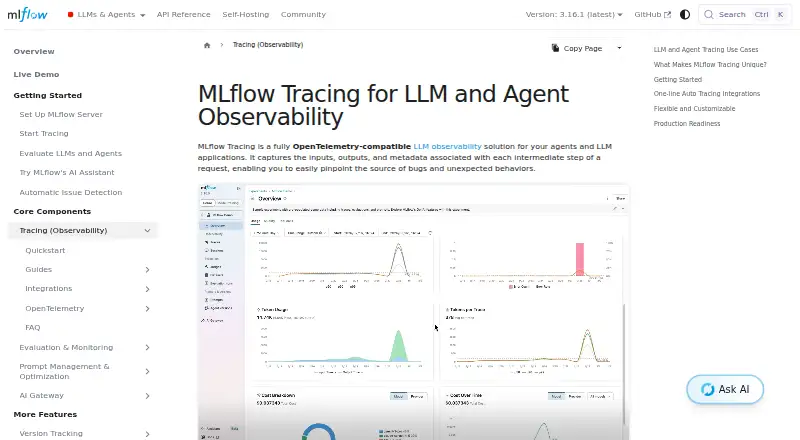
What MLflow Tracing is
MLflow Tracing records inputs, outputs and metadata from steps in LLM application and agent requests, helping teams investigate bugs and unexpected behavior. Trace details include span trees, per-span latency, tool calls, exceptions, token counts, cost breakdowns, feedback and ground-truth annotations. Tracing can be added automatically through integrations for more than 40 LLM and agent libraries and frameworks, or manually through Python and TypeScript SDKs. Listed integrations include OpenTelemetry, OpenAI, Anthropic, LangChain, LangGraph, LlamaIndex, DSPy and Vercel AI. The tool is OpenTelemetry-compatible and supports GenAI Semantic Conventions for trace export and ingestion. Its free, open-source plan stores trace data on the user's own infrastructure. The production package, mlflow-tracing, is documented as having a 95% smaller footprint than the full mlflow package. Production guidance recommends asynchronous logging and sampling, and custom span processors can mask sensitive data before traces reach the backend. The TypeScript SDK is for Node.js backend environments, not frontend browsers or Edge Runtime. OpenTelemetry ingestion requires MLflow 3.6.0 or later and a SQL-based backend store.
Good
- Free and open source.
- Trace views include latency, exceptions and cost breakdowns.
- Automatic tracing covers more than 40 libraries and frameworks.
- Supports OpenTelemetry and GenAI Semantic Conventions.
- Custom span processors can mask sensitive data client-side.
Watch out
- Trace data is hosted on your own infrastructure.
- TypeScript SDK does not support browser or Edge Runtime environments.
- OTLP ingestion requires MLflow 3.6.0 or later and a SQL backend.
- Production setup guidance recommends asynchronous logging and sampling.
Who it suits
MLflow Tracing suits teams building LLM applications or agents that need visibility into request steps, tool calls, latency or token costs. It supports both automatic integrations and manual instrumentation, with trace data hosted on their infrastructure.
Verdict
MLflow Tracing gives teams detailed views of LLM and agent execution, including tool activity and cost measures. Check the SDK environment and backend requirements against your deployment before adopting it.
Plans and prices
From MLflow Tracing's own pricing page, checked 30 Sep 2026.
| Plan | Price | What it gives you |
|---|---|---|
| MLflow Tracing | Free | Open source · trace data hosted on your own infrastructure |
The facts
Each one read from MLflow Tracing's own pages, with the date it was checked.
What it does
- Automatic instrumentation
- MLflow offers one-line automatic tracing integrations for supported LLM and agent libraries, including OpenAI, LangChain, and DSPy.checked 21 Oct 2026
- Automatic tracing
- The integrations page lists automatic tracing for more than 40 LLM and AI agent libraries and frameworks.checked 30 Sep 2026
- Dataset creation
- Production traces can be used to build evaluation datasets that retain details about components such as retrievers and tools.checked 21 Oct 2026
- Developer support
- The repository directs users to documentation, GitHub issues, a mailing list, and Slack for help and project discussions.checked 21 Oct 2026
- Documentation
- MLflow documentation has separate sections for LLM and agent development, tracing, and evaluation, and for traditional machine-learning workflows.checked 21 Oct 2026
- Evaluation
- MLflow connects trace inspection with evaluation results to help assess application quality.checked 21 Oct 2026
- Human feedback
- Users can attach feedback to traces with metadata such as the user and timestamp.checked 21 Oct 2026
- Integrations
- The integrations directory organizes automatic tracing support across frameworks, coding agents, and model providers.checked 21 Oct 2026
- Licence
- The public MLflow repository identifies its licence as Apache-2.0.checked 21 Oct 2026
- Lightweight SDK
- The production tracing package, `mlflow-tracing`, is documented as having a 95% smaller footprint than the full `mlflow` package.checked 30 Sep 2026
- Manual instrumentation
- Python developers can instrument custom functions with the `@mlflow.trace` decorator or create spans directly.checked 21 Oct 2026
- OpenTelemetry
- MLflow Tracing is compatible with OpenTelemetry and supports GenAI semantic conventions for trace export and ingestion.checked 21 Oct 2026
- OTLP ingestion limit
- OpenTelemetry trace ingestion requires MLflow 3.6.0 or later and a SQL-based backend store.checked 30 Sep 2026
- Pricing
- The MLflow Tracing page describes the open-source product as free and says trace data can be hosted on the user's infrastructure.checked 21 Oct 2026
- Production monitoring
- Tracing records latency, token usage, and quality metrics to help monitor deployed LLM applications and agents.checked 21 Oct 2026
- Production package
- The product documentation recommends the `mlflow-tracing` package for production deployments and says it has a 95% smaller footprint than the full MLflow package.checked 21 Oct 2026
- Production use
- The documentation describes tracing as production-ready and recommends asynchronous logging and sampling for production deployments.checked 30 Sep 2026
- Purpose
- MLflow Tracing captures inputs, outputs, and metadata from each step of LLM application and agent requests to help diagnose bugs and unexpected behavior.checked 30 Sep 2026
- Rating on G2
- No product rating or review count for MLflow Tracing is stated on the opened G2 MLflow marketplace page.checked 21 Oct 2026
Where it runs
- Browser limitation
- The TypeScript SDK works in Node.js backend environments and is not compatible with frontend browser or Edge Runtime environments.checked 30 Sep 2026
The company
- Company founded
- Databricks says it was founded in 2013 by the creators of Apache Spark, Delta Lake, MLflow, and Unity Catalog.checked 21 Oct 2026
- Company headquarters
- Databricks says it is headquartered in San Francisco.checked 21 Oct 2026
- Maker
- The MLflow project is developed at Databricks, according to TrustRadius.checked 21 Oct 2026
- Maker and community
- The MLflow site describes the project as backed by the Linux Foundation and committed to open source for more than five years.checked 30 Sep 2026
Alternatives to MLflow Tracing
- 1

W&B Weave
Free planOpen sourceiOSWebAPILinux8.7From $60 a month - 2

Opik
Free planOpen sourceWebAPILinuxmacOS8.4From $19 a month - 3

Langfuse
Free planOpen sourceWebAPILinuxSelf-hosted8.2From $29 a month - 4

LangWatch
Free planOpen sourceWebAPILinuxmacOS8.2From €29 a month - 5

Agenta
Free planOpen sourceWebAPISelf-hosted8.0From $29 a month - 6

LangSmith
Free planWebAPILinuxmacOS8.0$39 usage-based