MLflow Prompt Optimization
MLflow Prompt Optimization automates prompt refinement by evaluating prompts on data, finding failure patterns, and generating revised variants through repea…
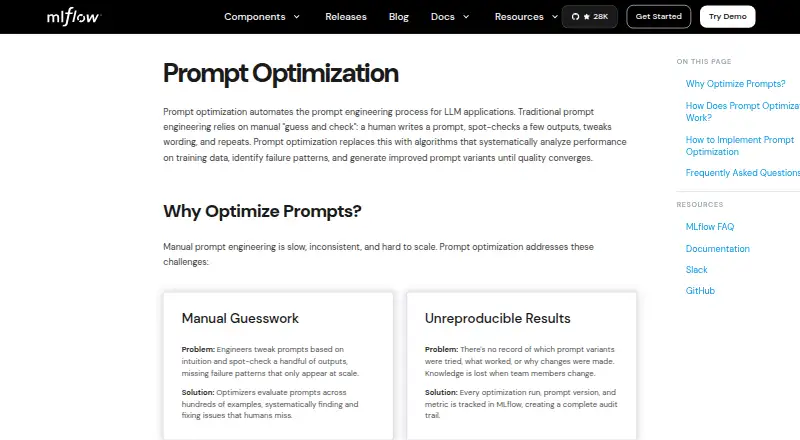
What MLflow Prompt Optimization is
MLflow Prompt Optimization automates prompt refinement by evaluating prompts on data, finding failure patterns, and generating revised variants through repeated optimization. The `mlflow.genai.optimize_prompts` API offers a common interface for algorithms including GEPA and Metaprompting. Users provide training data and scorers, and may define custom scorers and aggregation functions. Optimized prompts can be saved as Prompt Registry versions, while runs, metrics, and traces can be tracked for comparison and rollback. The workflow supports LangChain, LangGraph, OpenAI Agent, Pydantic AI, CrewAI, AutoGen, and custom frameworks, and the product page says it works with any LLM provider. The Apache 2.0-licensed software has a free open-source option that can be self-hosted or managed through cloud providers. The self-hosted option lists community support. Documentation recommends GEPA for work with clear evaluation metrics where quality is critical, such as medical and financial agents. Optimization cost depends on the reflection model and maximum metric calls. MLflow documents basic HTTP authentication for tracking-server resources, including prompts, and security middleware from version 3.5.0 for several network risks.
Good
- Free Apache 2.0-licensed open-source option.
- Supports GEPA and Metaprompting.
- Works with any LLM provider, according to its product page.
- Tracks runs, metrics, and traces for comparison and rollback.
- Allows custom scorers and aggregation functions.
Watch out
- Optimization cost depends on the reflection model and metric-call limit.
- Self-hosted support is community-based.
- GEPA is recommended for datasets of 100 or more records.
Who it suits
MLflow Prompt Optimization suits teams with training data and evaluation criteria who want to automate prompt iteration. GEPA may fit tasks with clear metrics where output quality is critical.
Verdict
MLflow Prompt Optimization provides an API-driven workflow for evaluating and iterating on prompts, with tracking and framework integrations. Teams should factor in optimization costs and the dataset guidance for GEPA.
Plans and prices
From MLflow Prompt Optimization's own pricing page, checked 4 Oct 2026.
| Plan | Price | What it gives you |
|---|---|---|
| MLflow Prompt Optimization (open source) | Free | Apache 2.0 licensed · self-hosted or managed through cloud providers · optimization cost depends on the reflection model and metric-call limit |
The facts
Each one read from MLflow Prompt Optimization's own pages, with the date it was checked.
What it does
- Algorithms
- The documentation lists GEPA and Metaprompting as supported optimization algorithms.checked 4 Oct 2026
- Data guidance
- The product page's example recommends 50–100 labeled training examples; the documentation says GEPA is best suited to a dataset of 100 or more records.checked 4 Oct 2026
- Evaluation
- Users can supply scorers and training data, and can define custom scorers and aggregation functions.checked 4 Oct 2026
- Framework integrations
- The optimization workflow works with LangChain, LangGraph, OpenAI Agent, Pydantic AI, CrewAI, AutoGen, or custom frameworks.checked 4 Oct 2026
- License and governance
- MLflow is licensed under Apache 2.0 and is backed by the Linux Foundation.checked 4 Oct 2026
- Network security
- MLflow 3.5.0 and later includes tracking-server security middleware for DNS rebinding, CORS, clickjacking, and security headers.checked 4 Oct 2026
- Optimization API
- The `mlflow.genai.optimize_prompts` API provides a common interface for prompt optimization algorithms.checked 4 Oct 2026
- Prompt versioning
- Optimized prompts can be saved as new Prompt Registry versions, and runs, metrics, and traces can be tracked for comparison and rollback.checked 4 Oct 2026
- Provider support
- The product page says the workflow works with any LLM provider.checked 4 Oct 2026
- Purpose
- Automates prompt engineering by evaluating prompts on data, identifying failure patterns, and iteratively generating improved variants.checked 4 Oct 2026
- Security controls
- MLflow documents basic HTTP authentication with permissions for tracking-server resources, including prompts.checked 4 Oct 2026
- Support
- The self-hosted open-source option lists community support.checked 4 Oct 2026
- Use case fit
- The documentation recommends GEPA for tasks with clear evaluation metrics and where quality is critical, citing medical and financial agents as examples.checked 4 Oct 2026
Money
- Optimization cost
- The documentation says GEPA optimization cost depends on the reflection model and the maximum number of metric calls.checked 4 Oct 2026
The full review of MLflow Prompt Optimization
MLflow Prompt Optimization is an API-driven prompt improvement workflow for teams that evaluate LLM applications against their own data. It is best suited to developers already working with MLflow or supported agent frameworks; the trade-off is that optimization cost and dataset size need to be part of the plan.
Overview
The workflow evaluates prompts, looks for failure patterns, then generates variants to improve them. Its common mlflow.genai.optimize_prompts API supports GEPA and Metaprompting, while user-supplied training data and scorers let teams define what “better” means for their application.
Prompt improvements can be saved as new Prompt Registry versions, with runs, metrics, and traces tracked for comparison and rollback. That makes the feature more useful for iterative application development than for one-off prompt drafting. It works with any LLM provider, according to the product page, and supports multiple frameworks or custom ones.
Key features
Evaluation and optimization
Teams can provide training data, scorers, and aggregation functions, including custom evaluation logic. GEPA is recommended for work with clear metrics and high quality requirements, such as medical or financial agents. The product example suggests 50–100 labeled examples, while the documentation says GEPA is best suited to 100 or more records; teams with smaller datasets may find that guidance a practical constraint.
GEPA’s cost depends on the reflection model and maximum metric-call count. That flexibility can suit teams willing to tune optimization runs, but it means a free software license should not be mistaken for cost-free model usage.
Versioning and integrations
Saving optimized prompts as registry versions and tracking runs, metrics, and traces gives teams a basis for comparing iterations and rolling back. Integrations cover LangChain, LangGraph, OpenAI Agent, Pydantic AI, CrewAI, AutoGen, and custom frameworks, making the workflow a stronger fit for an existing development stack than for users seeking a standalone visual prompt editor.
Security and governance
MLflow documents basic HTTP authentication with permissions for tracking-server resources, including prompts. From version 3.5.0, its tracking-server middleware also addresses DNS rebinding, CORS, clickjacking, and security headers. The Apache 2.0 license and Linux Foundation backing may appeal to organizations prioritizing open-source governance; the self-hosted option lists community support.
Pricing
MLflow Prompt Optimization (open source): free. The plan is Apache 2.0 licensed and can be self-hosted or managed through cloud providers. It is the natural fit for developers and teams prepared to operate an open-source workflow. There are no paid tiers described for this product; the important cost caveat is that GEPA optimization consumes model calls, with cost shaped by the reflection model and metric-call limit.
Platforms
MLflow Prompt Optimization is available through API, self-hosted, and web platforms. API access, prompt variables, prompt testing, and automated optimization are supported. The combination favors engineering teams building prompt workflows into an application rather than people looking for a device-native app.
Who it's for
Choose it if you need repeatable prompt optimization against labeled data, have evaluation criteria you can express as scorers, and want prompt versions and run history within an MLflow-centered workflow. It is especially appropriate when quality is critical and a sufficiently large evaluation dataset is available. Look elsewhere if you need a turnkey prompt editor, have little evaluation data, or cannot budget for model calls during optimization.
Pros and cons
- Pros: A shared optimization API supports GEPA and Metaprompting, so teams can work through one interface rather than separate algorithm-specific workflows.
- Pros: Registry versions, tracked runs, metrics, and traces support comparison and rollback during prompt iteration.
- Pros: Broad framework integration and provider support leave room to use the workflow with varied agent stacks.
- Cons: GEPA guidance points to datasets of at least 100 records, a meaningful hurdle for teams without labeled examples.
- Cons: Optimization cost varies with model choice and metric-call limits, so usage needs oversight even though the software plan is free.
- Cons: Self-hosted open-source support is community support, which may not suit organizations requiring a dedicated support arrangement.
Alternatives
For a wider browse, see AI Prompt Generators. Consider Agenta instead if you want a freemium API, self-hosted, and web option with a free Hobby plan capped at 2 team members, 5,000 agent runs and 20 evaluations per month, and one-week trace retention.
ProofHound is another freemium API, self-hosted, and web option; its Free plan is organized per organization and includes 3 projects, 1 member, 3 concurrent LLM calls, 5GB retained project storage, and 200MB per dataset upload. Choose PromptLayer if a per-month free plan with 5 users, 2.5k requests, one workspace, 250 evaluation cell executions, and 10MB dataset limit better fits your team’s usage pattern.
PromptEval may suit a lighter API-and-web evaluation workflow: its free plan allows 3 web evaluations and 10 API lint runs monthly, stores up to 5 prompts, and caps prompts at 8,000 characters. Promptitude is a freemium API-and-web alternative with a free allowance for 2 users, 5 prompts, 2 assistants, 1 flow, 1 tool, 100 generations, and 200 tool calls per month.
Pick Promptic if its API-and-web free plan fits: one user, one AI application, 200K monthly Promptic Credits, 14-day retention, and bring-your-own model keys. Promptotype is a web-only alternative with a free prompt engineering playground, test queries with expected results, and code generation from playground input. PromptWizard is another free option spanning API, Linux, macOS, Windows, and self-hosted platforms.
Verdict
MLflow Prompt Optimization is a strong choice for developers who can evaluate prompts with labeled data and want optimization, version tracking, and rollback in a framework-flexible workflow. Its open-source price is compelling, but the decisive reason to look elsewhere is the combination of dataset demands and model-call costs if your evaluation process is small or tightly budgeted.
Alternatives to MLflow Prompt Optimization
- 1
Vellum
Free planOpen sourceAndroidiOSWebAPI8.7From $30 a month - 2

Agenta
Free planOpen sourceWebAPISelf-hosted8.0From $29 a month - 3
Latitude
Free planOpen sourceWebAPILinuxSelf-hosted7.7From $99 a month - 4
VantagePrompt
Free planWeb7.3From $3 a month - 5

PromptLayer
Free planWebAPISelf-hosted7.0From $49 a month - 6
PromptWizard
Free planAPILinuxmacOSSelf-hosted6.8Free plan