Mirus Report Writer
Mirus Report Writer is a reporting product for restaurant businesses, backed by the Mirus data warehouse.
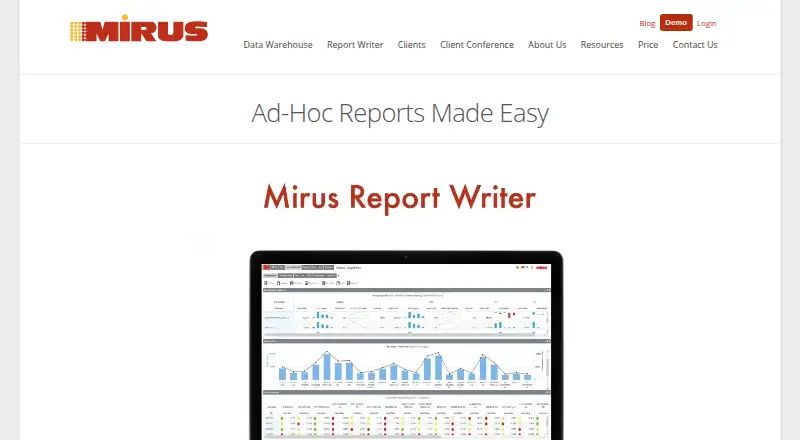
What Mirus Report Writer is
Mirus Report Writer is a reporting product for restaurant businesses, backed by the Mirus data warehouse. It is designed to help multi-unit restaurants access and analyze data, and Mirus says operations, finance, marketing, and IT teams have used the platform. Users can build reports, dashboards, alerts, and graphs through drag-and-drop tools without coding skills; Mirus says clients can create and customize an unlimited number of reports. The product can automate delivery of reports, alerts, and PDFs, with secure sharing from one central solution. Listed integrations include 7shifts, ADP, Aloha, Brink, Excel, HotSchedules, Micros, Restaurant365, Toast, and XPIENT. It is available on web, Android, and iOS. Mobile apps include report lists, views, charts, and controls, but reports must be enabled for mobile and shared with a user or group to appear. Pricing is on request. Listed one-time charges include $9,500 for initial implementation with a Prime POS system, or $12,500 for another POS system; other source integrations and additional POS integrations also have listed one-time fees. Mirus offers client support by email and phone on weekdays during stated business hours.
Good
- Drag-and-drop report building requires no coding skills.
- Supports automated delivery of reports, alerts, and PDFs.
- Mirus says clients can customize unlimited reports.
- Available on web, Android, and iOS.
- Lists integrations with restaurant and business systems.
Watch out
- No free plan.
- Pricing is on request.
- Mobile reports must be enabled and shared with users.
- Initial POS implementation has listed one-time fees.
Who it suits
Mirus Report Writer suits multi-unit restaurant businesses seeking centralized reporting and data analysis. Its mobile apps may help teams that need report access on Android or Apple devices, provided reports are enabled and shared appropriately.
Verdict
Mirus Report Writer offers restaurant-focused reporting, customization, automation, and mobile access. Pricing is on request, and mobile visibility depends on reports being enabled and shared with each user or group.
Plans and prices
From Mirus Report Writer's own pricing page, checked 5 Oct 2026.
| Plan | Price | What it gives you |
|---|---|---|
| Other source system integration | $1,300, paid once | One-time integration fee; price varies by system and data source · $1,300 - $2,500 |
| Additional POS integration | $4,500, paid once | One-time integration fee; price varies by POS type · $4,500 for an additional Prime POS; $8,500 for another POS system. |
| Initial POS implementation | $9,500, paid once | Creates a custom data warehouse with one POS system · $9,500 for a Prime POS system; $12,500 for another POS system. |
| Mirus Enterprise Unlimited | — | Unlimited data sources · users · reports · dashboards · alerts · access · Per unit per month; minimum fee for companies with fewer than 20 units; volume discounts from 100 units. |
The facts
Each one read from Mirus Report Writer's own pages, with the date it was checked.
What it does
- Automation
- The product can automate delivery of reports, alerts, and PDFs.checked 5 Oct 2026
- Custom reports
- Mirus says clients can create and customize an unlimited number of reports.checked 5 Oct 2026
- Integrations
- Mirus lists integrations including 7shifts, ADP, Aloha, Brink, Excel, HotSchedules, Micros, Restaurant365, Toast, and XPIENT.checked 5 Oct 2026
- Intended customers
- Mirus says its platform is for multi-unit restaurants and has been used by operations, finance, marketing, and IT teams.checked 5 Oct 2026
- Mobile access limit
- Reports must be enabled for mobile, and must be shared with a user or their group for that user to see them in the app.checked 5 Oct 2026
- Purpose
- Mirus Report Writer is designed for restaurant businesses to access and analyze data through a reporting solution backed by the Mirus data warehouse.checked 5 Oct 2026
- Report building
- Users can build reports, dashboards, alerts, and graphs with a drag-and-drop interface and without coding skills.checked 5 Oct 2026
- Security
- Mirus describes mobile release 8.12 as including stronger data access controls and offers biometric login after a user saves their password.checked 5 Oct 2026
- Sharing
- Reports can be shared securely from one central solution.checked 5 Oct 2026
- Support
- Mirus lists client support by email and phone and gives business hours as Monday–Friday, 8:30 AM–5:30 PM CST.checked 5 Oct 2026
- Updates
- Mirus says its developers routinely update the reporting engine at no additional cost.checked 5 Oct 2026
The company
- Founded
- 1999checked 28 Sep 2026
- Headquarters
- Houston, Texas, United Stateschecked 28 Sep 2026
- Headquarters and history
- Mirus says its team is headquartered in Houston, Texas, and its product began in 1998.checked 5 Oct 2026
Where it runs
- Mobile apps
- Mirus offers mobile apps for Android and Apple devices, with report lists, report views, charts, and mobile report controls.checked 5 Oct 2026
The full review of Mirus Report Writer
Mirus Report Writer is restaurant reporting software built around Mirus’s data warehouse. It is best suited to multi-unit operators whose teams need to combine restaurant-system data into tailored reports. Its broad reporting toolkit is appealing, but custom pricing and implementation fees make it a less obvious fit for a single location looking for a low-cost, self-serve option.
Overview
Mirus brings restaurant data into a central reporting environment for operations, finance, marketing, and IT teams. Its capabilities span multi-location reporting, labor analytics, food-cost analysis, customer behavior analysis, and forecasting. That breadth makes it relevant to operators who need a view across several parts of the business, rather than only a narrow set of sales reports.
The product began in 1998, and Mirus was founded in 1999. The company is headquartered in Houston, Texas. Mirus says its developers routinely update the reporting engine at no additional cost, which is useful for businesses that want continued maintenance without a separate engine-update charge.
Key features
Build reports without coding
A drag-and-drop interface lets users create reports, dashboards, alerts, and graphs without coding. Mirus says clients can create and customize an unlimited number of reports, giving teams room to adapt reporting to different roles and locations. That flexibility is a stronger fit for organizations with varied reporting needs than for buyers who only need a few standard views.
Automate and share reporting
Reports, alerts, and PDFs can be delivered automatically, while secure sharing centralizes access. Automation can reduce the work of distributing recurring information, but teams still need to decide who should receive it and maintain the appropriate sharing setup.
Connect restaurant systems
Mirus lists integrations with 7shifts, ADP, Aloha, Brink, Excel, HotSchedules, Micros, Restaurant365, Toast, and XPIENT. POS data connectors support bringing restaurant-system data into the warehouse. The named integrations provide a useful starting point for operators using those systems, though the separate POS and other-source integration fees can materially affect the cost of getting started.
Mobile reporting
The Android and Apple apps provide report lists, report views, charts, and mobile report controls. Access is conditional: a report must be enabled for mobile and shared with a user or that user’s group before it appears in the app. Mirus describes mobile release 8.12 as adding stronger data-access controls; biometric login is available after a user saves their password. These controls give administrators a way to limit visibility, but mobile access is not automatic for every report.
Pricing
Mirus uses paid, custom pricing, with no free plan. Its published one-time fees make implementation costs clearer than the ongoing subscription, which is quoted on request.
| Plan or fee | Price | What it covers |
|---|---|---|
| Other source system integration | $1,300, paid once | $1,300–$2,500 one-time, varying by system and data source. |
| Additional POS integration | $4,500, paid once | $4,500 for an additional Prime POS; $8,500 for another POS system. One-time fee varies by POS type. |
| Initial POS implementation | $9,500, paid once | $9,500 for a Prime POS system or $12,500 for another POS system; creates a custom data warehouse with one POS system. |
| Mirus Enterprise Unlimited | Custom pricing | Per-unit monthly billing, with a minimum fee for companies below 20 units and volume discounts from 100 units. Includes unlimited data sources, users, reports, dashboards, alerts, and access. |
Enterprise Unlimited is the natural plan for operators that need broad access across units and reporting functions; unlimited users and reports avoid the caps that could constrain a growing team. The minimum fee below 20 units may make it less economical for smaller operators, while volume discounts begin at 100 units. The one-time integration and implementation charges are important to budget alongside the recurring per-unit fee. No free tier offers a lower-commitment way to try the product.
Platforms
Mirus Report Writer supports web, Android, and iOS. The mobile apps extend reporting to Apple and Android devices, subject to reports being enabled for mobile and shared with the relevant users or groups.
Who it's for
Mirus is aimed at multi-unit restaurants, especially those whose operations, finance, marketing, or IT teams need customized reporting across systems and locations. Its analytics coverage and automation suit businesses coordinating recurring reporting across functions. A smaller restaurant with limited reporting needs may find the custom subscription and setup costs harder to justify.
Pros and cons
- Pros: No-code report, dashboard, alert, and graph building supports teams without dedicated coding skills.
- Pros: Unlimited report creation, automated delivery, and secure sharing support varied and recurring reporting needs.
- Pros: Restaurant-focused integrations and analytics cover POS data, labor, food costs, customer behavior, forecasting, and multiple locations.
- Pros: Mirus says engine updates come at no additional cost, and mobile access offers stronger controls and biometric login.
- Cons: Enterprise pricing is custom, and the minimum fee for companies with fewer than 20 units can weigh against smaller operators.
- Cons: One-time POS implementation and integration fees can reach $12,500 for initial setup and $8,500 for an additional POS system.
- Cons: Mobile users only see reports enabled for mobile and shared with them or their group, so administrators must configure access deliberately.
Alternatives
Restaurant Analytics Software is a useful starting point for comparing tools in the same category.
- Avero is worth considering for operators who want a free plan: its Starter tier is free for any number of users and locations, with unlimited usage and free POS integration for most common POS systems.
- Dishboard is another paid option available on Android, iOS, and web.
- PAR Ordering is a paid Android, iOS, and web option for readers considering a restaurant software alternative.
- RestoStack may suit buyers comparing paid restaurant software with per-order or per-location pricing, including a commission-based option with no monthly fee.
- iammi offers a free trial and supports Android, iOS, and web, making it an option for readers who prioritize trying a paid product before committing.
- Lineup.ai may be a better fit when labor forecasting is the priority: its Forecasts Only plan is $79 a month per location and includes automated AI-generated forecasts and a custom labor allowance budget.
- Meuze is another paid option with a free trial for readers who want to compare subscription software before choosing.
- Nory is a paid Android, iOS, and web alternative for readers comparing restaurant software with custom pricing.
Verdict
Mirus Report Writer is a strong candidate for multi-unit restaurant groups that need tailored reporting, automated distribution, and analysis across restaurant systems. Its main reason to choose it is the combination of extensive report customization and restaurant-focused analytics; its main reason to look elsewhere is the custom recurring price plus potentially substantial one-time setup fees. Smaller operators seeking a free or straightforward entry point should compare alternatives before committing.