MerchantWords
MerchantWords provides Amazon keyword research tools, search-volume estimates, competitive analysis and related e-commerce optimization services.
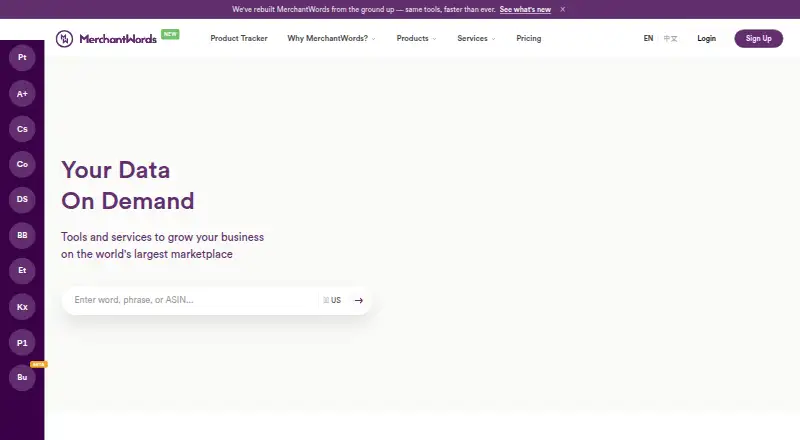
What MerchantWords is
MerchantWords provides Amazon keyword research tools, search-volume estimates, competitive analysis and related e-commerce optimization services. Classic Search shows estimated monthly volume, 12-month seasonality, related terms, and keyword depth and strength across Amazon marketplaces. ASIN Plus finds keywords a product ranks for from its ASIN, while Product Tracker follows Amazon keyword rankings daily. Other tools include Collections, Emerging Trends, Keyword Explorer, Keyword Multiplier, Page 1 Products and Bulk Search. MerchantWords says its keyword data comes from Amazon's autocomplete search bar, but describes its figures as estimates and does not guarantee absolute accuracy. Collections can be exported as CSV files for listings and ad campaigns. Data access is offered through web, REST API and MCP; the MCP page lists Claude Desktop, Claude Code, Cursor, VS Code Copilot and compatible agent frameworks. A free API demo provides real data for fixed demo terms without an account. Search intent data is not included.
Good
- Shows estimated search volume and seasonality trends.
- Finds ranking keywords from a product ASIN.
- Tracks Amazon keyword rankings daily.
- Offers REST and MCP data access.
- Free API demo requires no account.
Watch out
- Search and keyword data are estimates, not guaranteed exact.
- Search intent data is not included.
Who it suits
MerchantWords suits Amazon sellers seeking search-volume estimates, related keyword ideas, competitor keyword information or listing research. Teams that need programmatic access can consider its REST and MCP data options, while accounting for estimated data and the absence of search intent metrics.
Verdict
MerchantWords covers Amazon keyword discovery, ASIN research and ranking tracking, with web and API access. Its figures are estimates, so users should account for that caveat when relying on search metrics.
Plans and prices
From MerchantWords's own pricing page, checked 8 Oct 2026.
| Plan | Price | What it gives you |
|---|---|---|
| Demo (API) | Free | Public demo key · real data on a fixed set of demo terms · REST API and MCP · $0 no account needed |
| Silver | $35 a month | 500 searches · 1 user · 10 collections · United States · $35/mo |
| Starter (API) | $79 a month | 5 requests/min · 50 results per search · all endpoints · email support · $79 /month |
| Gold | $79 a month | 1,000 searches · 2 users · 100 collections · North America · $79/mo |
| Platinum | $149 a month | Unlimited searches · 3–5 users · 1,000 collections · Global (all countries) · $149/mo |
| Pro (API) | $499 a month | 10 requests/min · 200 results per search · bulk 200 per call · 50K bulk quota/month · priority support · $499 /month |
| Enterprise | $749 a month | Unlimited searches · 20 concurrent users · 10,000 collections · all features · custom integrations · dedicated support · $749/mo |
| Enterprise (API) | $1,499 a month | 30 requests/min · 1,000 results per search · bulk 1,000 per call · 500K bulk quota/month · data license available · $1,499 /month |
The facts
Each one read from MerchantWords's own pages, with the date it was checked.
What it does
- API and AI integrations
- MerchantWords offers data access through REST and MCP, and its MCP page lists Claude Desktop, Claude Code, Cursor, VS Code Copilot, and MCP-compatible agent frameworks.checked 8 Oct 2026
- Data caveat
- MerchantWords describes its search-volume and keyword data as estimates and says it does not guarantee absolute accuracy.checked 8 Oct 2026
- Data source
- MerchantWords says its keyword data comes directly from the Amazon autocomplete search bar.checked 8 Oct 2026
- Exports
- Collections can be exported as CSV files for use in listings and ad campaigns.checked 8 Oct 2026
- Keyword research
- Classic Search shows estimated monthly search volume, 12-month seasonality trends, related keywords, keyword depth and strength across Amazon marketplaces.checked 8 Oct 2026
- Privacy
- MerchantWords says it does not sell personal data and says full credit card numbers are handled exclusively by Stripe and never stored on its servers.checked 8 Oct 2026
- Product tracking
- Product Tracker tracks Amazon keyword rankings daily and shows how listings move over time.checked 8 Oct 2026
- Purpose
- MerchantWords provides Amazon keyword research tools, search-volume estimates, competitive analysis, and related e-commerce optimization services.checked 8 Oct 2026
- Research tools
- The product suite includes Collections, Emerging Trends, Keyword Explorer, Keyword Multiplier, Page 1 Products, and Bulk Search.checked 8 Oct 2026
- Reverse ASIN
- ASIN Plus lets users enter a product ASIN to find the keywords it ranks for.checked 8 Oct 2026
- Security
- MerchantWords says it uses encryption in transit (TLS) and at rest to help protect personal information.checked 8 Oct 2026
- Support
- The product pages advertise 24/7 customer support, while the API Starter plan includes email support and the Pro API plan includes priority support.checked 8 Oct 2026
- Usage limits
- The listed Silver plan includes 500 searches, while Gold includes 1,000 and Platinum and Enterprise list unlimited searches.checked 8 Oct 2026
The company
- Company history
- MerchantWords says it was founded in 2012 by George Lawrence to help Amazon sellers discover and rank for relevant keywords.checked 8 Oct 2026
- Founded
- 2012checked 28 Sep 2026
The full review of MerchantWords
Overview
MerchantWords is an Amazon-focused keyword research and listing analysis service for sellers who need search estimates, competitor keyword discovery and ranking trends. Its mix of marketplace research and API access suits both individual sellers and teams building data into their own workflows, though the right plan depends heavily on market coverage and search volume.
Key features
Classic Search combines estimated monthly search volume with 12-month seasonality, related terms, and measures of keyword depth and strength across Amazon marketplaces. MerchantWords says its data comes from Amazon’s autocomplete bar; the metrics are still estimates, and the company does not guarantee absolute accuracy. They can guide keyword selection, but should not be treated as exact demand figures.
ASIN Plus works in the reverse direction: enter a product ASIN to find the terms it ranks for. Product Tracker follows keyword rankings daily, making it useful for seeing how a listing moves over time rather than relying on a one-off snapshot. The suite also includes Collections, Emerging Trends, Keyword Explorer, Keyword Multiplier, Page 1 Products and Bulk Search. Collections can be exported to CSV for listing and advertising work.
REST and MCP access make MerchantWords relevant beyond its web interface. Its MCP page names Claude Desktop, Claude Code, Cursor, VS Code Copilot and compatible agent frameworks. Security measures include TLS encryption in transit and encryption at rest. MerchantWords says it does not sell personal data and that Stripe handles full card numbers, which are not stored on its servers.
Pricing
There is a free Demo (API) with a public demo key, real data on a fixed set of demo terms, and REST API and MCP access; no account is needed. It is a way to inspect the API workflow, not a substitute for unrestricted research.
For web research, Silver is $35/mo and includes 500 searches, one user, 10 collections and United States coverage. It is the entry point for a solo seller focused on that marketplace, but its search cap and geography limit broader research. Gold is $79/mo for 1,000 searches, two users, 100 collections and North America coverage. That adds room for a small team and a wider region, while still imposing a monthly search limit.
Platinum costs $149/mo and includes unlimited searches, three to five users, 1,000 collections and global coverage. It is the stronger fit for sellers researching multiple countries or running frequent searches. Enterprise is $749/mo, with unlimited searches, 20 concurrent users, 10,000 collections, all features, custom integrations and dedicated support; that scale and support are aimed at larger operations, not a typical solo seller.
API plans are separate from those web tiers. Starter (API) is $79/month for 5 requests per minute, 50 results per search, all endpoints and email support. Pro (API) is $499/month for 10 requests per minute, 200 results per search, bulk calls of 200, a 50K monthly bulk quota and priority support. Enterprise (API) is $1,499/month for 30 requests per minute, 1,000 results per search, bulk calls of 1,000 and a 500K monthly bulk quota; a data license is available. Choose by throughput and bulk needs, not by assuming web search allowances transfer to the API.
Platforms
MerchantWords is available on the web and through an API. MCP access connects its data to named coding and AI tools, but the core product is oriented around Amazon commerce rather than a general-purpose keyword platform.
Who it's for
It is best suited to Amazon sellers who need marketplace-specific keyword estimates, reverse-ASIN research or ongoing rank tracking, especially those with a reason to export or integrate data. Sellers who need exact search counts should look elsewhere or use the estimates as directional signals. There is no search-intent data, so it is less suited to workflows that depend on classifying why users search.
Pros and cons
- Pros: Reverse-ASIN discovery and daily ranking tracking address competitor research and ongoing listing movement, not just keyword suggestions.
- Pros: Market coverage scales from the United States to global research, and API/MCP options support teams that want to use the data outside the web product.
- Cons: Search-volume and keyword figures are estimates without an accuracy guarantee, so they are not dependable as exact demand counts.
- Cons: The lowest paid plan is limited to one user, 500 searches and the United States; broader coverage and higher capacity require more expensive tiers.
- Cons: There is no search-intent data, leaving that analysis to another tool or workflow.
Alternatives
Compare more keyword research tools if MerchantWords’ Amazon focus is too narrow. Helium 10 is another freemium option, with Android, iOS, web and browser-extension access; consider it if those platforms matter. CanIRank offers web access, a free plan and a free trial, and is an alternative for readers considering a different keyword research service. EHunt has a free account and paid plans starting at $9.99 per month, making it worth considering when a lower entry price matters. QuestionDB has a free tier of five searches per month and a $9.99 Solo plan for 100 monthly searches; choose it if that search allowance fits better. Twinword Ideas provides free web plans with daily search and suggestion allowances, an alternative for readers seeking a free keyword-idea workflow. eRank has a free plan with daily keyword lookups and listing audits, and is another option for a capped free workflow. Keyword Discovery offers a free web and API plan with daily search and analysis allowances, useful to consider if those limits suit the work. Keyword Revealer is another web-based freemium alternative.
Verdict
Choose MerchantWords if Amazon keyword discovery, reverse-ASIN research and daily rank tracking are central to your selling workflow, or if you need its data through REST or MCP. Its clearest strengths are Amazon-specific research and scalable access; its estimated metrics, lack of search intent and rising cost for broader coverage are good reasons to look elsewhere when exact counts, intent analysis or a low-cost global plan matter more.
Alternatives to MerchantWords
- 1

Helium 10
Free planAndroidiOSWebExtension7.5Free plan - 2

sellerboard
AndroidiOSWebExtension7.1From $19 a month - 3
Jungle Scout
AndroidiOSWebAPI6.8From $348 a year - 4
SellerApp
Free planWebAPIExtension6.8From $99 a month - 5

ManageByStats
Free planWebExtension6.7From $59.97 a month - 6

AMZScout
WebExtension6.6From $399.99 a year