Mayday
Mayday is a web-based month-end platform for finance teams using Xero, QuickBooks Online, or Intuit Enterprise Suite.
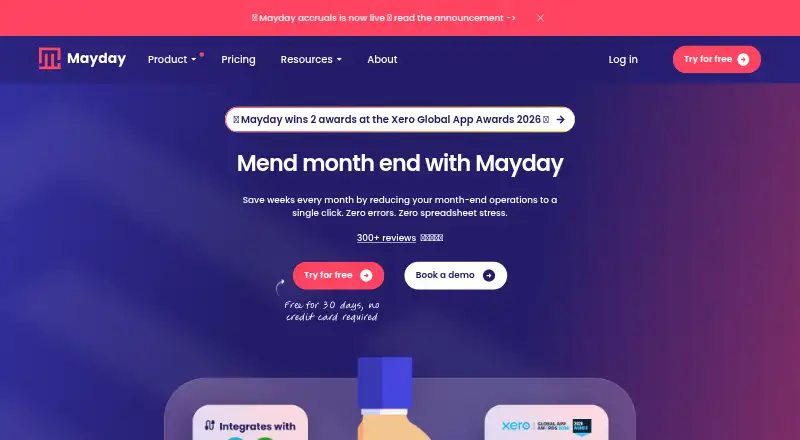
What Mayday is
Mayday is a web-based month-end platform for finance teams using Xero, QuickBooks Online, or Intuit Enterprise Suite. It helps teams identify missing or incorrect entries, calculate adjustments for review and approval, and post approved journals to Xero or QuickBooks. Its products include Flux, Prepayments, Accruals, Deferred Revenue, Balancer, Mayday HQ, BRAG, and Recharger. The platform supports approval workflows, audit trails, multi-entity close, recurring templates, and API-based ERP connectivity.
Mayday AIR uses accounting principles and business context to suggest actions. The maker says it does not train AIR on private customer data without permission. Mayday offers a free Basic plan and a 30-day trial that does not require payment card details. Basic includes three same-currency intercompany balances and unlimited users; paid plans cover functions such as variance analysis, accruals, prepayments, deferred revenue, and intercompany balances. QuickBooks Online users have some product restrictions, including unavailable BRAG and Mayday HQ features. Mayday was founded in 2021, is headquartered in the United Kingdom, and identifies its company as Mayday Holdings Limited.
Good
- Finds missing or incorrect entries and prepares adjustments for review.
- Posts approved journals to Xero or QuickBooks.
- Supports multi-entity close, recurring templates, approvals, and audit trails.
- Offers a free Basic plan and a 30-day trial without card details.
- Mayday AIR suggests actions using accounting principles and business context.
Watch out
- BRAG and Mayday HQ are unavailable for QuickBooks Online.
- Basic includes only three same-currency intercompany balances.
- Some QuickBooks Online functions in other products have limitations.
Who it suits
Mayday suits finance teams closing the month in Xero, QuickBooks Online, or Intuit Enterprise Suite, especially large and multi-entity businesses. Accountancy firms can also consider its Bureau plans, while teams needing review and approval workflows can use those features as part of the close process.
Verdict
Choose Mayday if your finance team uses a supported accounting platform and wants a month-end workflow for reviewing adjustments and posting journals. Its free Basic plan may suit teams with a small number of same-currency intercompany balances. QuickBooks Online users who need BRAG, Mayday HQ, or affected product functions should account for those restrictions.
Plans and prices
From Mayday's own pricing page, checked 14 Oct 2026.
| Plan | Price | What it gives you |
|---|---|---|
| Basic | Free | Free intercompany plan · unlimited users |
| Passive | £10 a month | Unlimited intercompany balances · FX adjustments · Interest · Downloadable reports · Read-only Mayday HQ access · Unlimited users · £10/mo |
| Accrued Revenue | £10 a month | Price scales with number of entities · Ad-hoc and recurring revenue accruals · AIR predictions · £10/mo |
| Active | £10 a month | AR/AP matching · Unlimited recharge rules · Unlimited BRAG transactions · Unlimited Mayday HQ access · Unlimited users · £10/mo |
| Advanced | £10 a month | Everything from Active · Bespoke rule creation service · 2-hour tailored onboarding · Dedicated account manager · £10/mo |
| Accrued Costs | £10 a month | Price scales with number of entities · Ad-hoc and recurring cost accruals · AIR predictions · £10/mo |
| Recharger Lite | £10 a month | Few inter-departmental transactions · 3 recharge rules shown · £10/mo |
| Flux | £12.50 a month | P&L comparisons · AI commentary · approval audit trail · unlimited users · billed annually for 1 entity |
| Accruals | £30 a month | Recurring and ad-hoc accruals · AI suggestions · one-click posting · unlimited users · billed annually for 1 entity |
| Deferred revenue | £30 a month | Revenue schedules · one-click posting · audit trail · unlimited users · billed annually for 1 entity |
| Prepayments | £30 a month | Prepayment schedules · one-click posting · audit trail · unlimited users · billed annually for 1 entity |
| Intercompany Active | £34 a month | Balancer · Recharger · BRAG · HQ · unlimited users · billed annually for 2 entities |
| Tailored quote | Priced on request | Complex groups · accounting firms · bespoke setup · security reviews · ERP migrations |
The facts
Each one read from Mayday's own pages, with the date it was checked.
What it does
- Accruals
- Accruals manages recurring and ad-hoc cost or revenue accruals and can suggest new accruals and reversals from ledger data.checked 14 Oct 2026
- AI
- Mayday AIR uses accounting principles and business context to suggest actions, and the maker says it is not trained on private customer data without permission.checked 7 Oct 2026
- AI data policy
- Mayday says its AIR engine is trained on synthetic data and explicitly consented data, not private customer data without permission.checked 14 Oct 2026
- API permissions
- Mayday’s connection guide says Xero users need Standard plus Reports or Adviser access because those roles determine the APIs Mayday can authorize.checked 14 Oct 2026
- Audience
- Mayday describes its users as large and multi-entity businesses and also offers Bureau plans for accountancy firms.checked 7 Oct 2026
- Authentication
- Mayday supports SSO and MFA through the connected Xero and Intuit accounts.checked 14 Oct 2026
- Balancer
- Balancer compares mapped intercompany loan, receivable and payable accounts, highlights discrepancies and calculates FX or interest adjustments.checked 14 Oct 2026
- BRAG
- BRAG is a browser extension that reconciles cross-entity transactions from inside Xero’s bank-reconciliation interface.checked 14 Oct 2026
- Close workflow
- It identifies missing or incorrect entries, calculates adjustments for review and approval, then posts approved journals to Xero or QuickBooks.checked 7 Oct 2026
- Compliance
- The maker states it complies with UK/EU GDPR requirements and aligns privacy practices with the Australian Privacy Principles.checked 7 Oct 2026
- Data hosting
- Mayday says its service runs on AWS and its data storage and processing occur in AWS's London region.checked 7 Oct 2026
- Deferred Revenue
- Deferred Revenue creates, reviews and posts revenue-recognition schedules from invoices, journals and bank transactions.checked 14 Oct 2026
- Documentation and support
- The Help Centre provides setup articles, quick-start guides and an offer of a free one-to-one onboarding call through in-app chat or email.checked 14 Oct 2026
- Flux
- Flux compares monthly P&L movements and drafts AI commentary for review, approval and editing.checked 14 Oct 2026
- Integrations
- Mayday connects with Xero, QuickBooks Online and Intuit Enterprise Suite; product pages describe one-click posting back to the accounting systems.checked 14 Oct 2026
- Legal name
- Mayday’s product footer identifies the operating company as Mayday Holdings Limited.checked 14 Oct 2026
- Limit: Xero configuration
- One Xero reviewer says some use cases require configuring Xero tracking categories to achieve the desired result.checked 14 Oct 2026
- Mayday HQ
- Mayday HQ keeps chart-of-accounts codes, tracking categories and contacts aligned across entities and can post fixes to Xero.checked 14 Oct 2026
- Notable news: award
- Xero announced Mayday as the 2026 Global People’s Choice Award winner and 2026 New Zealand Practice App of the Year.checked 14 Oct 2026
Where it runs
- App listing age
- The Xero App Store listing says Mayday was added in 2022 and is available in multiple countries including the United Kingdom, United States, Australia and Canada.checked 14 Oct 2026
The company
- Company location
- LinkedIn lists the headquarters and primary location as London, England.checked 14 Oct 2026
- Company size
- LinkedIn lists Mayday as a privately held software-development company with 11–50 employees.checked 14 Oct 2026
- Founded
- LinkedIn gives Mayday’s founding year as 2021.checked 14 Oct 2026
- Headquarters
- United Kingdomchecked 28 Sep 2026
The full review of Mayday
Mayday is a month-end close platform for finance teams working in Xero, QuickBooks Online or Intuit Enterprise Suite. It is best suited to larger, multi-entity businesses and accountancy firms that need structured adjustment review and journal posting. Its modular approach can address specific close tasks, but QuickBooks Online users face meaningful product restrictions.
Overview
Mayday links error checks, adjustment calculations, approval and journal posting in a single close workflow. It identifies missing or incorrect entries, prepares adjustments for review, and posts approved journals to Xero or QuickBooks. That connected process is useful for teams looking to control the path from identifying a problem to recording its correction; it is less compelling if the accounting platform or workflow falls outside Mayday’s supported scope.
The product suite includes Flux, Prepayments, Accruals, Deferred Revenue, Balancer, Mayday HQ, BRAG and Recharger. Mayday AIR suggests actions using accounting principles and business context. The maker says it does not use private customer data to train AIR without permission. Security measures include encryption in transit and at rest, role-based access controls, 24/7 infrastructure monitoring, and SSO and MFA via Xero and Intuit. Mayday runs on AWS, with storage and processing in its London region, and says it complies with UK/EU GDPR requirements and aligns privacy practices with the Australian Privacy Principles.
Key features
Review, approvals and posting
Mayday’s central strength is the sequence from identifying suspect entries to calculating adjustments, getting approval and posting journals. Approval workflows, audit trails and recurring templates support a more controlled close, while multi-entity close is relevant to businesses managing accounts across entities. These capabilities suit finance teams that need repeatable review rather than a tool limited to basic task tracking.
Modular close tools
The separate modules cover variance analysis, accruals, prepayments, deferred revenue, intercompany balances and recharges. Flux includes P&L variance analysis, AI commentary, review and approval, and an audit trail. Accrued Costs and Accrued Revenue offer ad-hoc and recurring accruals with AIR predictions; their prices scale with the number of entities. Prepayments and Deferred Revenue provide schedules and one-click posting to Xero or QBO, with entity-based pricing. The value of this modularity depends on choosing the right module and checking platform limitations before purchase.
Intercompany and recharges
Basic is capped at three same-currency intercompany balances. Passive raises that to unlimited balances and adds FX adjustments, interest and downloadable reports. Recharger Lite is aimed at teams with few inter-departmental transactions and shows three recharge rules; Active includes unlimited recharge rules, AR/AP matching, unlimited BRAG transactions and Mayday HQ access. These tiers draw a practical line between a small, simple intercompany need and a more involved finance operation.
Pricing
Mayday uses a freemium, modular pricing model. Basic costs £0 per month and includes three same-currency intercompany balances, unlimited users and live-chat support. It is a useful starting point for a small team with modest intercompany needs, but the balance cap makes it unsuitable as those operations grow.
Flux, Accrued Costs, Advanced, Prepayments, Recharger Lite, Active, Deferred Revenue, Passive and Accrued Revenue are each shown at £10 per month. Entity-based pricing applies to Accrued Costs, Prepayments, Deferred Revenue and Accrued Revenue, so the displayed monthly figure is not the full cost for every multi-entity buyer. Advanced includes everything from Active, bespoke rule creation, two-hour tailored onboarding and a dedicated account manager. The plan descriptions use different module names and scopes, so buyers should confirm the package contents they need before choosing.
Mayday’s pricing note also gives paid pricing from £12.50/mo (annual). That is the stated annual-term entry point; compare it with the module prices and entity-based terms when budgeting. A 30-day free trial does not require payment card details. In-app support chat receives a personal response within hours, often within minutes, according to the pricing FAQ.
Platforms
Mayday is a web platform that integrates with Xero and QuickBooks Online; Intuit Enterprise Suite is also named as a supported accounting platform. QuickBooks Online has important exceptions: BRAG and Mayday HQ are unavailable, and some Balancer, Recharger, Deferred Revenue and Prepayments functions are limited. A QBO team should verify its required functions before committing to a workflow built around those products.
Mayday says its service is hosted on AWS in the London region. SSO and MFA are provided via Xero and Intuit, alongside encryption, role-based access and infrastructure monitoring.
Who it's for
Mayday is a strong fit for finance teams already using a supported accounting platform that need a structured month-end process, especially larger businesses managing several entities. Accountancy firms are also in scope through Bureau plans. Basic can suit smaller teams testing a narrow intercompany workflow, while the paid modules target teams that need specific schedules, analysis or recharge processes. It is a weaker fit for QuickBooks Online users whose work depends on BRAG, Mayday HQ or affected product functions.
Pros and cons
Pros
- Connected adjustment workflow: Finding issues, calculating adjustments, approving them and posting journals are linked in one process.
- Modular coverage: Teams can select tools for particular close needs, from variance analysis to revenue schedules and recharges.
- Low-cost entry point: Basic is free, and the trial lasts 30 days without requiring card details.
- Useful controls for larger teams: Approval workflows, audit trails, multi-entity close and unlimited users on several plans support a more structured operation.
- Defined security and hosting approach: Mayday describes encryption, access controls, monitoring and London-region AWS hosting.
Cons
- Free plan is narrow: Three same-currency balances limit Basic’s usefulness for growing or more complex intercompany operations.
- Platform restrictions matter: QBO users lose access to BRAG and Mayday HQ and face limits on some other module functions.
- Costs can vary with entity count: Four modules scale their price by the number of entities, complicating budgets for multi-entity customers.
- Module choice requires care: The suite’s task-specific plans mean buyers need to match the package to their workflow rather than assume every function is bundled.
Alternatives
Financial Close Software is a broader category to compare if Mayday’s accounting-platform focus or module structure does not match your close process. For a narrower intercompany comparison, see Intercompany Accounting Software.
novacly may suit teams seeking a free beta with full platform access, unlimited usage and multi-entity support. OneStream is a paid platform with a wider range of listed deployment and device platforms; request a demo to discuss pricing. Nordavix offers a free founding-firms beta with unlimited companies, team seats and modules.
FIS Data Integrity Manager is a paid web alternative without a free plan. Double is another paid option, with a free trial and an annual flat-rate plan for internal finance teams; contact sales for pricing. Eagl and Stacks Financial Close are paid web alternatives.
Verdict
Choose Mayday if your finance team uses Xero, QuickBooks Online or Intuit Enterprise Suite and needs a controlled month-end workflow for reviewing adjustments and posting journals. Its modular coverage, approvals and multi-entity capabilities make it most persuasive for larger businesses and accountancy firms with defined close processes. Look elsewhere if you need unrestricted QuickBooks Online functionality, or if your intercompany needs already exceed Basic’s three same-currency balance cap and the paid modules do not fit your budget.
Getting started
- Visit the Mayday website.
- Choose the free Basic plan or review the listed paid plans.
- Start the 30-day free trial without entering payment card details.
- Use Mayday with Xero, QuickBooks Online, or Intuit Enterprise Suite.
Limits worth knowing
Basic covers three intercompany balances in the same currency. QuickBooks Online does not support BRAG or Mayday HQ, and some Balancer, Recharger, Deferred Revenue, and Prepayments functions have limitations.
Questions
Does Mayday have a free plan?
Yes. Basic is listed at £0/mo and includes three same-currency intercompany balances, unlimited users, and live chat support.
How much does Mayday cost?
Several listed plans are priced at £10/mo.
Is there a free trial?
Yes. Mayday offers a 30-day trial without requiring payment card details.
Which accounting platforms does Mayday support?
Mayday integrates with Xero and QuickBooks Online, and also lists Intuit Enterprise Suite as a supported accounting platform.
What restrictions apply to QuickBooks Online?
BRAG and Mayday HQ are unavailable for QuickBooks Online. Some Balancer, Recharger, Deferred Revenue, and Prepayments functions also have limitations.
What does Mayday AIR do?
It uses accounting principles and business context to suggest actions. The maker says it does not train AIR on private customer data without permission.