MailTub
MailTub is a free, open-source service for creating temporary email inboxes that you host yourself.
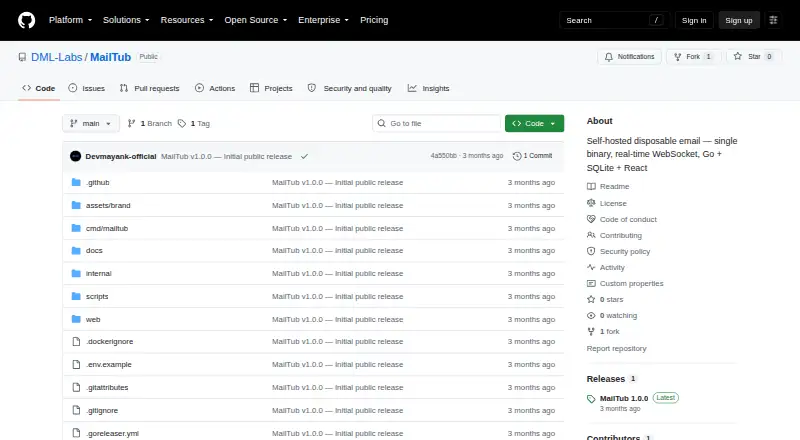
What MailTub is
MailTub is a free, open-source service for creating temporary email inboxes that you host yourself. New messages arrive through WebSocket updates rather than periodic checks. Each session can hold up to five inboxes, with expiry choices of 1 hour, 6 hours, 24 hours, or 7 days. MailTub accepts MIME attachments, allows configurable size caps, and lets users export inboxes as an .eml ZIP or structured JSON. It runs as a Go binary with SQLite and an embedded React interface, or can be deployed with Docker. The web interface offers dark, light, and system themes and can be installed as a progressive web app on mobile and desktop. A REST API, SMTP receiving, scriptable CLI, and Prometheus-compatible metrics endpoint are also available. To receive real email, you need a domain with an MX record pointing to the server, port 25 access or redirection, and a matching MAILTUB_DOMAIN setting. Mailbox creation is limited to 20 per IP per hour.
Good
- New mail arrives through WebSocket updates.
- Sessions can hold up to five inboxes.
- Inbox contents can be exported as ZIP or JSON.
- Web interface supports three themes.
- Deployment is available through Docker or a Go binary.
Watch out
- Receiving real email requires domain and server configuration.
- Mailbox creation is limited to 20 per IP per hour.
- Each session is limited to five simultaneous inboxes.
Who it suits
MailTub suits people who want temporary inboxes on infrastructure they control and can configure. It may also suit developers who need API, CLI, SMTP, or WebSocket access.
Verdict
MailTub combines temporary inboxes with self-hosted deployment and developer-facing interfaces. Plan for domain and port configuration if you need to receive real email.
The facts
Each one read from MailTub's own pages, with the date it was checked.
What it does
- API access
- The API is open by default unless an API key is configured; the health endpoint remains public.checked 30 Sep 2026
- API and CLI
- MailTub provides a REST API and a scriptable CLI for creating, listing, reading, watching, and sending mail.checked 30 Sep 2026
- Attachments
- MailTub parses MIME attachments and supports configurable per-attachment and total attachment size caps.checked 30 Sep 2026
- Deployment
- MailTub runs as a single Go binary with SQLite and an embedded React interface, and also provides Docker deployment.checked 30 Sep 2026
- Email size limits
- Defaults include a 25 MiB SMTP message limit, a 25 MiB per-attachment cap, and a 50 MiB total attachment cap per email.checked 30 Sep 2026
- Exports
- Users can download an inbox as an .eml ZIP or structured JSON.checked 30 Sep 2026
- Inbox limits
- A session can have up to five simultaneous inboxes, with mailbox expiry choices of 1 hour, 6 hours, 24 hours, or 7 days.checked 30 Sep 2026
- Integrations
- It provides a REST API, SMTP receiving, WebSocket updates, and a Prometheus-compatible metrics endpoint.checked 30 Sep 2026
- License
- The repository identifies the project as Apache 2.0 licensed.checked 30 Sep 2026
- Mailbox limits
- A session can have up to five simultaneous inboxes, with expiry options of 1 hour, 6 hours, 24 hours, or 7 days.checked 30 Sep 2026
- Optional caching
- Mailbox caching can optionally use a Redis or Upstash URL.checked 30 Sep 2026
- Purpose
- MailTub is a self-hosted disposable email service that creates temporary inboxes.checked 30 Sep 2026
- Rate limit
- Mailbox creation is limited to 20 per IP per hour.checked 30 Sep 2026
- Rate limiting
- MailTub limits mailbox creation to 20 per IP per hour.checked 30 Sep 2026
- Real-time email
- New emails appear through WebSocket push, which the project says delivers them in milliseconds without polling.checked 30 Sep 2026
- Real-time inboxes
- New emails appear through WebSocket push, without polling.checked 30 Sep 2026
- Receiving mail requirements
- Receiving real email requires a domain with an MX record pointing to the server, port 25 access or redirection, and a matching MAILTUB_DOMAIN setting.checked 30 Sep 2026
- Security
- The admin panel stores its password as a bcrypt hash and uses HMAC-SHA256 signed session cookies with a 24-hour lifetime.checked 30 Sep 2026
- Support
- The project asks users to report security vulnerabilities to [email protected].checked 30 Sep 2026
- Support and security contact
- The project asks users to report vulnerabilities to [email protected].checked 30 Sep 2026
- User interface
- The web interface supports dark, light, or system themes, and can be installed as a progressive web app on mobile and desktop.checked 30 Sep 2026
The full review of MailTub
MailTub is a self-hosted disposable-email service for users who want to run their own temporary inboxes. It suits developers, testers, and operators able to configure domains and mail delivery, while casual users may find hosted alternatives more convenient. Its live updates, automation tools, and open deployment model are compelling when you control the infrastructure.
Overview
MailTub is free, open-source software under the Apache 2.0 license. Deployment is available as a single Go binary with SQLite and an embedded React interface, or through Docker. You operate the service yourself rather than subscribing to a hosted mailbox, gaining deployment control at the cost of server administration.
Receiving real email requires a domain with an MX record directed to the server, access to port 25 or a redirection, and a matching MAILTUB_DOMAIN setting. That setup requirement makes MailTub less suitable for someone who needs an immediate throwaway address without managing mail infrastructure.
Key features
Live inboxes and expiry controls
Incoming messages are delivered through WebSocket push instead of polling, so the interface can update promptly. A session supports up to five simultaneous inboxes, with expiry choices of 1 hour, 6 hours, 24 hours, or 7 days. These durations cover short testing cycles and week-long temporary use, but the five-inbox ceiling limits larger parallel jobs.
Attachments, exports, and automation
MailTub parses MIME attachments and lets users export an inbox as an .eml ZIP or structured JSON. Its REST API and scriptable CLI support creating, listing, reading, watching, and sending mail, making it more useful in automated test pipelines than a browser-only disposable mailbox.
Deployment and operations
The web interface offers dark, light, and system themes and can be installed as a progressive web app on mobile or desktop. SMTP receiving, WebSocket updates, and a Prometheus-compatible metrics endpoint provide the interfaces operators need to integrate and monitor a deployment. Optional mailbox caching can use a Redis or Upstash URL.
Security and limits
The admin password is stored as a bcrypt hash, while session cookies use HMAC-SHA256 signatures and last 24 hours. API access is open by default unless you configure an API key; the health endpoint remains public, so deployment hardening matters. Mailbox creation is limited to 20 per IP per hour. Default limits allow 25 MiB SMTP messages, 25 MiB per attachment, and 50 MiB in total attachments per email, with those caps configurable.
Pricing
MailTub is free because it is open-source software, with no paid tiers, seat charges, or subscription renewal. Your practical cost is the infrastructure needed to run it and the work of configuring mail delivery. That model suits developers and operators who already have a server and domain; it offers less convenience than a hosted service for occasional personal use.
Platforms
MailTub supports Android, iOS, Linux, macOS, Windows, and web access, alongside API, CLI, and self-hosted deployment options. The progressive web app makes the interface installable on mobile and desktop without requiring a separate native client.
Who it's for
Choose MailTub for software testing, development workflows, or private disposable-mail infrastructure when you can manage DNS, SMTP reachability, and server security. It is also a strong fit for teams that need WebSocket events, exports, metrics, or scripted mailbox control. Look elsewhere if you want a ready-to-use address with no domain, port, or operational responsibilities.
Pros and cons
- Pros: free Apache 2.0 software; self-hosted control; WebSocket delivery without polling; REST API and CLI automation; inbox exports; configurable attachment limits; broad client and deployment support.
- Cons: real mail requires MX, port 25 access or redirection, and domain configuration; five simultaneous inboxes per session; mailbox creation limited to 20 per IP per hour; API is open by default unless secured with a key; operating and securing the server is your responsibility.
Alternatives
Disposable Email Services is the broader category guide for comparing temporary-mail products. Pick SecureTempMail instead if you prefer a freemium hosted service with API and extension access; its Premium plan costs $39 a year and adds up to 30-day retention, private domains, attachment downloads, no ads, and inbox history and search.
EmailOnDeck suits users wanting a free, ad-supported option with one email at a time and private emails. Temp-Mail.org offers free domains and 1–2 hour message storage, with a 10.00 USD monthly premium tier. MailDrop is a hosted API/web choice with a free 300-requests-per-day allowance and one mailbox per 24 hours, plus paid higher quotas. Mohmal provides web inboxes with a lifetime-free plan and optional paid upgrades.
TempMailPortal provides free Android and web access with messages expiring within up to 24 hours. 1secemail is a free web-only temporary email service. Emailnator offers no-signup public inboxes, deletion after 24 hours, and up to 100 addresses at once.
Verdict
MailTub is a strong recommendation for developers and operators who want open-source, self-hosted disposable mail with real-time events and automation interfaces. Choose it when control and integration matter more than turnkey access; choose a hosted alternative when configuring DNS, SMTP ports, and ongoing server security is not worth the effort.
Alternatives to MailTub
- 1

EmailOnDeck
Free planAndroidiOSWebAPI8.1Free plan - 2

Guerrilla Mail
Free planOpen sourceAndroidWebAPIExtension8.1From $9.99 a year - 3

Mailinator
Free planAndroidWebAPIExtension7.8From $79 a month - 4

SecureTempMail
Free planWebAPIExtensionLinux7.8From $39 a year - 5
Mohmal
Free planWeb7.5From $35.99 a year - 6

MailDrop
Free planWebAPI7.4From $5 a month