MagicBPM
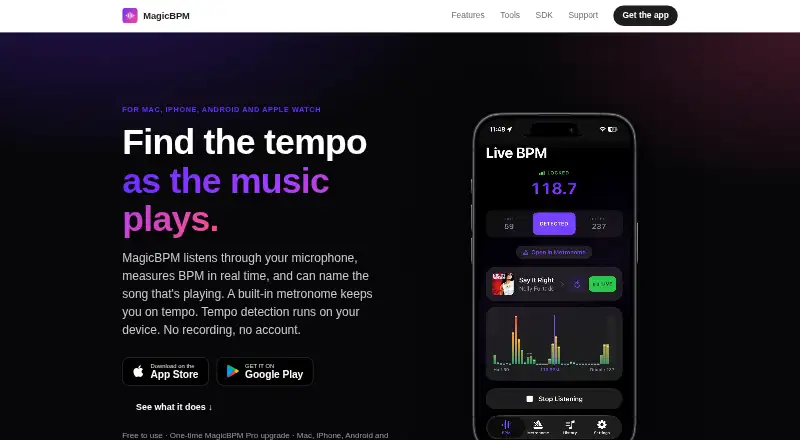
MagicBPM listens through a microphone to measure music tempo in real time, and includes a metronome and song identification.
What MagicBPM is
MagicBPM listens through a microphone to measure music tempo in real time, and includes a metronome and song identification. Its BPM readout updates as music plays and shows a confidence indicator as the reading settles. A scrolling tempogram displays tempo changes over time. The metronome supports tempos up to 300 BPM, eight time signatures, accented downbeats, and eighth-note, triplet, and sixteenth-note subdivisions. MagicBPM can listen while music plays aloud from Spotify, Apple Music, YouTube, Deezer, and other services; detected-song history can link to several music services. Tempo analysis happens on-device, and microphone audio is not recorded or uploaded. Song identification sends an acoustic fingerprint to Apple’s Shazam service, requires an internet connection, and is switched off on CarPlay and Bluetooth hands-free routes. The app does not import audio files: users can measure sound captured by the microphone or tap the beat. The core app is free, with ads on iPhone and Android; its Mac app is ad-free.
Good
- Displays live BPM with a confidence indicator.
- Metronome supports up to 300 BPM.
- Shows tempo changes in a scrolling tempogram.
- Tempo analysis stays on-device.
- Supports tapping the beat.
Watch out
- Does not import audio files.
- Song identification requires internet access.
- Song identification is off on CarPlay and Bluetooth hands-free routes.
- Free iPhone and Android apps show ads.
Who it suits
MagicBPM suits musicians or listeners who want to measure tempo from sound, tap a beat, or use a metronome. Its platform support includes Mac, iPhone, iPad, Android phones, and an Apple Watch metronome.
Verdict
MagicBPM combines microphone-based tempo detection with metronome controls and song identification. Note that audio files cannot be imported and song identification has connection and route limitations.
Plans and prices
From MagicBPM's own pricing page, checked 30 Sep 2001.
| Plan | Price | What it gives you |
|---|---|---|
| Free | Free | Core app free · iPhone and Android apps show ads · Mac app is ad-free |
| MagicBPM Pro | — | Automatic song identification · song history · 12 additional metronome sounds · removes ads on iPhone and Android · One-time purchase; price not stated on the opened page |
The facts
Each one read from MagicBPM's own pages, with the date it was checked.
What it does
- Ads and data
- The privacy policy says the free app uses Google AdMob, does not run its own servers, and does not use analytics or crash-reporting tools.checked 30 Sep 2001
- Audio-file limit
- The app does not import audio files; it measures sound captured by the microphone or lets users tap the beat.checked 30 Sep 2001
- Developer
- Google Play identifies the developer as DMYTRO OSIPA and lists a San Jose, California address.checked 30 Sep 2001
- Identification limit
- Song identification requires an internet connection and is switched off on CarPlay and Bluetooth hands-free routes.checked 30 Sep 2001
- Live detection
- The BPM readout updates as music plays and includes a confidence indicator for when the reading settles.checked 30 Sep 2001
- Metronome
- The metronome supports tempos up to 300 BPM, eight time signatures, accented downbeats, and eighth-note, triplet, and sixteenth-note subdivisions.checked 30 Sep 2001
- Music services
- The app can listen while Spotify, Apple Music, YouTube, Deezer, and other music services play aloud; detected-song history can link to Apple Music, Spotify, YouTube Music, Amazon Music, Deezer, TIDAL, or SoundCloud.checked 30 Sep 2001
- Privacy
- Tempo analysis happens on-device and microphone audio is not recorded or uploaded; song identification sends an acoustic fingerprint to Apple’s Shazam service.checked 30 Sep 2001
- Purpose
- MagicBPM listens through a microphone and measures music tempo in real time, with a built-in metronome and song identification.checked 30 Sep 2001
- SDK
- A licensable SDK provides on-device, offline tempo detection for iOS and Android, and the maker invites developers to contact it about licensing and pricing.checked 30 Sep 2001
- SDK scope
- The maker says the SDK is tuned for steady rhythmic material and that general-purpose libraries are stronger for broad multi-genre offline analysis such as jazz, classical, and solo acoustic music.checked 30 Sep 2001
- Support
- The maker accepts questions, bug reports, feature ideas, and purchase inquiries by email and says it reads every message.checked 30 Sep 2001
- Tempo visualization
- A scrolling tempogram displays tempo changes over time.checked 30 Sep 2001
Where it runs
- Device support
- The app supports Mac, iPhone, iPad, Android phones, and an Apple Watch metronome; listed minimums are macOS 15, iOS 18, iPadOS 18, watchOS 11, and Android 9.checked 30 Sep 2001
The full review of MagicBPM
Overview
MagicBPM is a microphone-based tempo detector with a metronome and song identification, available across Apple and Android devices. It suits musicians who want to find the tempo of music playing aloud and then practice against a matching beat. Its strongest case is the combination of live BPM readings and flexible metronome controls; its main constraint is that it cannot analyze imported audio files.
The tempo readout updates as music plays and includes a confidence indicator for when a reading settles. A scrolling tempogram gives a view of tempo changes over time, which is more useful for music that shifts pace than a single BPM number alone. Users can also tap the beat to enter a tempo manually.
Tempo analysis runs on-device, and microphone audio is not recorded or uploaded. Song identification is separate: it requires internet access and sends an acoustic fingerprint to Apple’s Shazam service. Identification is disabled on CarPlay and Bluetooth hands-free routes. The free app uses Google AdMob; its privacy policy says it does not run its own servers or use analytics or crash-reporting tools.
Key features
- Live tempo detection: The changing BPM reading and confidence indicator help users distinguish a settled result from one still finding the beat.
- Metronome: It supports up to 300 BPM, eight time signatures, accented downbeats, and eighth-note, triplet, and sixteenth-note subdivisions. That range makes it useful for varied practice rhythms, though custom time signatures are not supported.
- Tempo visualization: The scrolling tempogram shows tempo changes over time, adding context when a piece does not hold one steady pace.
- Music services and identification: MagicBPM can listen while Spotify, Apple Music, YouTube, Deezer, and other services play aloud. Identified-song history can link to Apple Music, Spotify, YouTube Music, Amazon Music, Deezer, TIDAL, or SoundCloud.
- Audio input: It measures sound through the microphone or accepts a tapped beat, but does not import audio files. Anyone who needs to analyze a saved recording directly should choose another workflow.
Pricing
Free — free. The core app is free. The iPhone and Android apps show ads, while the Mac app is ad-free. This is the straightforward choice for tempo detection and metronome use without paying, but it does not include the Pro-only features.
MagicBPM Pro — custom pricing. It is a one-time purchase, with automatic song identification, song history, 12 additional metronome sounds, and ad removal on iPhone and Android. Pro is the fit for users who want identification and saved history or prefer an ad-free mobile app.
Platforms
MagicBPM supports macOS, iOS, Android, and web. Device support includes Mac, iPhone, iPad, Android phones, and an Apple Watch metronome. Minimum versions are macOS 15, iOS 18, iPadOS 18, watchOS 11, and Android 9, so older devices may not qualify. The listed platform coverage includes web, though watchOS is also supported for the metronome.
Who it's for
Choose MagicBPM if you want to identify the tempo of music playing aloud, use the result for practice, and have metronome subdivisions and accents in the same app. Its on-device tempo analysis is also a strong fit for people who do not want microphone audio uploaded. It is a poor fit for direct analysis of audio files, or for song identification when offline or listening through CarPlay or Bluetooth hands-free.
Developers can ask about a licensable SDK for on-device, offline tempo detection on iOS and Android. The maker says it is tuned for steady rhythmic material and that general-purpose libraries are stronger for broad multi-genre offline analysis, including jazz, classical, and solo acoustic music.
Pros and cons
- Pros: Live BPM readings include a confidence indicator, helping users judge when the result settles.
- Pros: The metronome combines a 300 BPM ceiling with eight time signatures and three subdivision types.
- Pros: Tempo analysis is on-device, with no microphone audio recording or upload.
- Pros: The core app is free, and Mac use is ad-free.
- Cons: Audio files cannot be imported, so the app cannot directly analyze a stored track.
- Cons: Song identification needs an internet connection and is disabled on CarPlay and Bluetooth hands-free routes.
- Cons: Custom time signatures are not supported.
Alternatives
For a broader starting point, browse Metronome Apps. Metronome Beats is another freemium option, with a free ad-supported app and an iOS Pro one-time purchase at 8.99 USD; its free plan contains in-app purchases.
True Metronome offers a free tier and a free trial, with its free plan covering 20–400 BPM and all time signatures. Bounce Metronome Pro is an option for Linux, macOS, and Windows users.
PolyMetronome has a free Simple Mode and a yearly Pro plan. The Metronome by Soundbrenner offers free core features on Android, iOS, and macOS, with a Plus plan.
Metronome Time is a free option for Android, iOS, and web. Easy Metronome is another freemium choice on iOS, Android, and macOS, while Yames is free and supports macOS, Windows, and Linux.
Verdict
MagicBPM is a good choice for musicians who want to measure music playing nearby and move straight into metronome practice, especially if on-device tempo analysis matters. Its live reading, confidence cue, tempo visualization, and capable metronome make a focused package.
Getting started
- Open the MagicBPM website at https://magicbpm.com/.
- Choose an available version for Android, iOS, macOS, or the web.
- Check that your device meets the listed minimum: macOS 15, iOS 18, iPadOS 18, watchOS 11, or Android 9, as applicable.
- Use the free core app, or choose MagicBPM Pro for automatic song identification, song history, additional metronome sounds, and ad removal on iPhone and Android.
- Allow sound to be captured by the microphone for live tempo detection, or tap the beat instead.
Limits worth knowing
The free core app has ads on iPhone and Android, while the Mac app is ad-free.
Questions
Is MagicBPM free?
Yes. The core app is free. The iPhone and Android apps show ads, and the Mac app is ad-free.
What does MagicBPM Pro include?
Pro adds automatic song identification, song history, 12 additional metronome sounds, and ad removal on iPhone and Android. It is a one-time purchase, with the price not stated.
Which devices does MagicBPM support?
It lists Android, iOS, macOS, and web. Device support includes Mac, iPhone, iPad, Android phones, and an Apple Watch metronome, with minimum OS versions listed for each.
Does MagicBPM import music files?
No. It measures sound captured by the microphone or lets users tap the beat.
How does MagicBPM handle microphone audio?
Tempo analysis happens on-device, and microphone audio is not recorded or uploaded. Song identification sends an acoustic fingerprint to Apple’s Shazam service.
Alternatives to MagicBPM
- 1

True Metronome
Free planAndroidiOSWebmacOS8.0$0.99, paid once - 2
Bounce Metronome Pro
Free planLinuxmacOSWindows7.4$9.99, paid once - 3
Metronome Beats
Free planAndroidiOSWebmacOS7.3$8.99, paid once - 4
Tempo by Frozen Ape
Free planAndroidiOS7.0$1.49, paid once - 5
Pro Metronome
Free planAndroidiOS6.9From $0.33 a month - 6
PolyMetronome
Free planAndroidiOSWeb6.7Free plan