Lumastery
Lumastery is a web app for homeschool lessons and adaptive practice in math and reading, alongside on-screen science lessons.
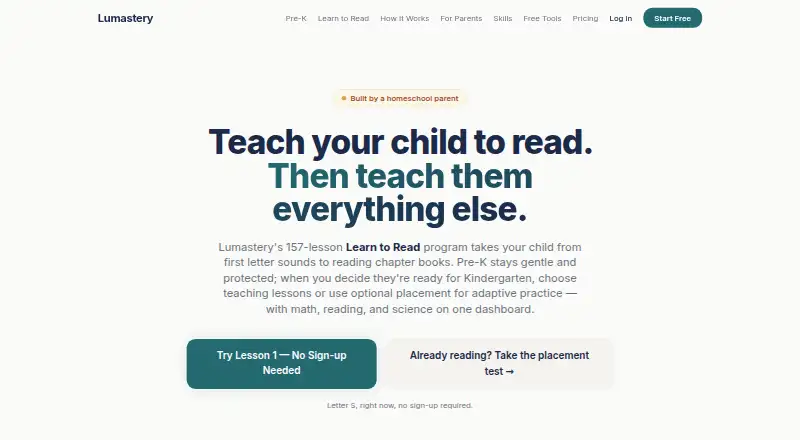
What Lumastery is
Lumastery is a web app for homeschool lessons and adaptive practice in math and reading, alongside on-screen science lessons. It is designed for families teaching children at different ages and learning levels. Practice changes difficulty in response to a child's recent answers and can return to foundational skills. A skill reaches mastery at 85% across the last 10 attempts. Spaced review revisits skills over time, except arithmetic-chain skills. The listed curriculum includes 238 math lessons, including Algebra I and Geometry, 157 structured reading lessons, and 117 on-screen K–8 science lessons. Science is not lab work; literature has three pilot chapters, writing assignments are a parent-graded pilot, and world languages are not offered. Families on the Family plan can choose traditional or conceptual math for each child. A free plan is described for one child and one daily session. The Family plan is listed at $19.99 per month or $199 per year, but checkout and billing are closed. The public beta has ended, new registrations are not accepted, and the app is unavailable to families during the wind-down.
Good
- Adaptive practice responds to recent answers
- Mastery uses 85% across the last 10 attempts
- Math instruction can be chosen per child
- Curriculum lists math, reading, and science lessons
Watch out
- Public beta has ended and new registrations are closed
- App is unavailable to families during wind-down
- Science lessons are on-screen, not lab work
- World languages are not offered
Who it suits
Lumastery is designed for homeschool families managing children across different ages and learning levels. It is not currently available to families, and new registrations are closed.
Verdict
Lumastery describes adaptive homeschool lessons with a broad listed math, reading, and science curriculum. It is currently unavailable, so families cannot register or use the app during its wind-down.
Plans and prices
From Lumastery's own pricing page, checked 15 Oct 2026.
| Plan | Price | What it gives you |
|---|---|---|
| Free | Free | 1 child · 1 daily session · full adaptive engine · math, reading, grammar, spelling, vocabulary and science · Kindergarten+ placement · $0/mo |
| Family | $19.99 a month | Up to 4 children · unlimited sessions · weekly emailed reports · spaced review · prerequisite map · per-child traditional or conceptual math · checkout not live · $19.99/mo; or $199/yr · Founding Family rate, locked in forever |
The facts
Each one read from Lumastery's own pages, with the date it was checked.
What it does
- Adaptive learning
- Practice difficulty adjusts based on a child's recent responses, and the system can step back to reinforce foundational skills.checked 7 Oct 2026
- Adaptive placement
- Kindergarten and older learners can take a short adaptive placement quiz that adjusts difficulty to identify a starting skill level.checked 15 Oct 2026
- AI use
- Terms disclose that artificial intelligence generates and adapts exercises and may occasionally produce errors.checked 15 Oct 2026
- API and SDKs
- The published terms and product pages provide no public API, SDK or developer-extension documentation.checked 15 Oct 2026
- Children's privacy
- The privacy policy says Lumastery complies with COPPA, requires parental consent before collecting child data, and does not knowingly collect personal information from children under 13 without verifiable parental consent.checked 7 Oct 2026
- Content verification
- Lumastery reports reading 924 teaching lessons, re-solving about 5,000 lesson questions, auditing 392 generators and hand-checking about 3,800 generated exercises.checked 15 Oct 2026
- Current availability
- The public beta has ended; new registrations are closed and the app is unavailable during wind-down.checked 15 Oct 2026
- Curriculum scope
- The pricing page lists 238 math lessons including Algebra I and Geometry, 157 structured reading lessons, and 117 on-screen K–8 science lessons.checked 7 Oct 2026
- Daily dashboard
- The dashboard surfaces a child’s current math and reading lesson and practice, with phonics lessons when needed.checked 15 Oct 2026
- Data handling
- The privacy policy names Supabase, Stripe, Anthropic, and Vercel as service providers, and says Anthropic receives skill metadata but no child personal data.checked 7 Oct 2026
- Data rights
- Parents can review, export and delete a child’s data from account settings, with deletion described as permanent.checked 15 Oct 2026
- Independent context: homeschool software
- A Reddit homeschool discussion describes existing homeschool apps as feeling clunky, generic and poorly tailored to homeschool families.checked 15 Oct 2026
- Independent context: tracker limits
- A Reddit commenter says a digital homeschool planner can help organized families but may not solve consistency problems for people who struggle to keep using it.checked 15 Oct 2026
- Intended audience
- The product is designed for homeschool families managing children at different ages and learning levels.checked 7 Oct 2026
- Licence
- Terms grant only a limited, non-exclusive, non-transferable personal educational licence and say Lumastery owns the software, curriculum and branding.checked 15 Oct 2026
- Limit: beta status
- Terms describe Lumastery as being in unpaid beta, with only the one-child, one-session free account available.checked 15 Oct 2026
- Limit: curriculum breadth
- The maker explicitly says science is not a lab course, writing is a pilot, literature has only three chapters and world languages are absent.checked 15 Oct 2026
- Limit: paid access
- The Family plan is announced but checkout is not live, so the paid features cannot currently be purchased.checked 15 Oct 2026
- Limit: service warranty
- Terms provide the service as-is and disclaim guarantees that it will be uninterrupted or error-free.checked 15 Oct 2026
- Literature
- Literature is identified as a three-chapter pilot.checked 15 Oct 2026
- Mastery and review
- A skill is marked mastered at 85% across the last 10 attempts, and spaced review revisits skills over time; arithmetic-chain skills are not spaced-reviewed.checked 7 Oct 2026
- Mastery rule
- Pricing states mastery is calculated as 0.85 accuracy over the last 10 attempts rather than a single correct response.checked 15 Oct 2026
Money
- Family plan status
- Family is listed at $19.99 per month or $199 per year, but billing and checkout are not open and the plan cannot currently be bought or trialed.checked 7 Oct 2026
- Independent context: planning pain
- Replies in the same Reddit discussion identify lesson planning and staying organized as recurring homeschool pain points.checked 15 Oct 2026
The full review of Lumastery
Lumastery is built for homeschool parents teaching children at different ages and levels, combining adaptive practice with a sizable core-subject curriculum.
Overview
Lumastery changes practice difficulty according to a child’s recent answers and can step back to reinforce prerequisite skills. Mastery is defined as 85% accuracy across the last 10 attempts, while spaced review brings skills back over time. Arithmetic-chain skills are excluded from spaced review, so retention support is not uniform across all mathematics.
The scope is substantial for a homeschool core: 238 math lessons, including Algebra I and Geometry, 157 structured reading lessons, and 117 on-screen K–8 science lessons. Science is screen-based rather than laboratory work. Literature currently amounts to three pilot chapters, writing is a parent-graded pilot, and there is no world-language offering.
The public beta has ended, registrations are closed, and the app is unavailable during its wind-down. That makes its otherwise promising curriculum a future possibility rather than a practical choice today.
Key features
Adaptive practice and mastery
Response-based difficulty and prerequisite stepping are useful for children who need lessons to adjust instead of following a fixed sequence. The explicit 85%-over-10-attempts rule gives parents a concrete completion standard. Spaced review supports longer-term recall, although arithmetic-chain skills receive no such revisiting.
Per-child teaching choices
The Family plan lets parents choose traditional or conceptual math separately for each child. That is a meaningful advantage for households whose learners need different instructional approaches, rather than forcing one method across siblings.
Parent oversight and privacy
Family includes weekly emailed reports, a prerequisite map, and unlimited sessions for up to four children. Lumastery says it requires verifiable parental consent before collecting data from children under 13 and complies with COPPA. It describes TLS, database row-level security, authenticated-parent access controls, and permanent deletion of associated child data when a profile is deleted. Supabase, Stripe, Anthropic, and Vercel are named service providers; Anthropic receives skill metadata but no child personal data.
Pricing
The Free plan costs nothing and covers one child, one daily session, and no credit card. It is suitable for a cautious, limited trial, but the single-session allowance is restrictive for a full homeschool day and omits the Family plan’s broader tools.
Family is priced at $19.99 per month or $199 per year, with a founding-family rate locked in forever. It supports up to four children, unlimited sessions, weekly reports, spaced review, a prerequisite map, and per-child traditional or conceptual math. Paid plans are intended to include a 14-day trial and a 30-day money-back guarantee when billing opens. Checkout is not live, so neither purchase nor trial is currently possible.
Platforms
Lumastery runs on the web. There is no offline access, so families need an internet connection for lessons and practice.
Who it's for
It is aimed at homeschool families coordinating siblings at different ages and learning levels, especially those wanting adaptive math and reading with configurable math pedagogy. The Family structure is most relevant to households with several children. It is a poor fit for lab-centered science, language study, substantial literature or writing instruction, or anyone needing an active service now.
Pros and cons
- Pro: Adaptive difficulty and prerequisite reinforcement can respond to individual gaps instead of treating every learner alike.
- Pro: The listed math, reading, and K–8 science lesson counts provide broad core coverage in one program.
- Pro: Family supports four children with unlimited sessions and child-specific math methods.
- Pro: Clear mastery criteria and spaced review give parents a defined progression and retention routine.
- Con: The service is unavailable while registrations and billing remain closed, preventing families from adopting it now.
- Con: Science is on-screen only, while literature and writing remain small pilots and world languages are absent.
- Con: The free tier allows only one daily session for one child, and arithmetic-chain skills are outside spaced review.
Alternatives
For a broader adaptive-learning directory, browse Adaptive Learning Software.
- MobyMax is the better immediate alternative for families wanting Android, iOS, macOS, Windows, or web access and a freemium model.
- FullRecall suits users seeking a free, cross-platform memorization database with no limit on database items or size.
- Duolingo is preferable when language learning is the priority, with free access and a one-week trial.
- Khan Academy is a stronger choice for free web and mobile academic resources, including a $10-per-student annual Enterprise Starter option for qualifying U.S. schools and districts.
- AttoLearn offers a web-based freemium family option with a free starter tier and plans for up to three children.
- Reading Plus is the alternative for a dedicated paid reading program procured through a school or district representative.
- Zearn Math is the better fit for free teacher-led math classrooms of up to 35 students.
- MATHia is an option for organizations willing to request a demonstration and custom pricing.
Verdict
Choose Lumastery if you want one homeschool framework with adaptive math and reading, configurable math methods for each child, and enough listed core content to span several grades. Its principal drawbacks are decisive: the service cannot currently be registered for or purchased, science lacks lab work, and enrichment subjects are thin. Families needing a working platform today should choose an active alternative instead.
Alternatives to Lumastery
- 1

MobyMax
Free planAndroidiOSWebmacOS8.2From $6.95 a year - 2

Duolingo
Free planAndroidiOSWebmacOS7.7Free plan - 3
Khan Academy
Free planAndroidiOSWeb7.7From $10 a year - 4
MATHia
AndroidiOSWebmacOS7.5 - 5
FullRecall
Free planAndroidiOSWebLinux7.4Free plan - 6

Synap
AndroidiOSWebExtension7.4From £1,200 a year