
Lucasys Tax Provision
Lucasys Tax Provision is web-based software that automates income tax provision workflows for enterprise finance and tax teams.
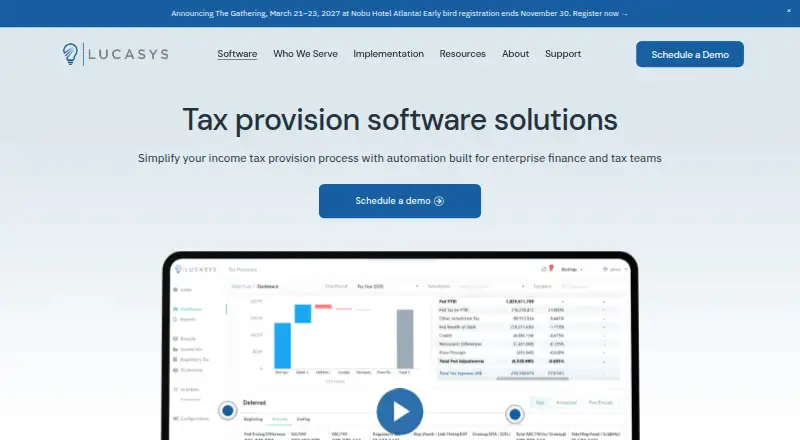
What Lucasys Tax Provision is
Lucasys Tax Provision is web-based software that automates income tax provision workflows for enterprise finance and tax teams. It supports ASC 740 and ASC 980 compliance, including rate-regulated reporting, and calculates current and deferred tax assets and liabilities across entities, schedules and jurisdictions. Teams can examine multiple periods and jurisdictions for rolling cases, unitary calculations and what-if scenarios. Live variance analysis and continuous data validation help with review and audit readiness. The product page describes a secure cloud architecture and native integrations with SAP and Oracle. Lucasys also describes an embedded AI agent for tax expertise, software guidance and data analysis. Its stated security measures include SOC 1 and SOC 2 Type II certifications, access controls, encryption, audit trails and monitoring; Lucasys advertises 99.99% uptime. The implementation framework includes data conversion, built-in validations and point-and-click integrations, and the company says customers can become operational in weeks. Pricing is available on request, and the page invites visitors to schedule a demo.
Good
- Supports ASC 740 and ASC 980 compliance
- Calculates current and deferred tax balances
- Includes live variance analysis and continuous validation
- Native integrations with SAP and Oracle
- Includes multi-period, multi-jurisdiction scenarios
Watch out
- Pricing is available on request
- Available on web only
Who it suits
It is intended for enterprise finance and tax teams, particularly in utilities, energy and other asset-intensive industries. Its regulatory support is relevant to teams preparing rate-regulated reporting.
Verdict
Lucasys Tax Provision addresses enterprise provision work across entities, jurisdictions and reporting standards, with validation and ERP integrations. Teams must request pricing and schedule a demo for more information.
The facts
Each one read from Lucasys Tax Provision's own pages, with the date it was checked.
What it does
- AI features
- Lucasys AI is described as an embedded interactive agentic AI with tax expertise, software support guidance, and data analysis capabilities.checked 3 Oct 2026
- Availability
- Lucasys advertises 99.99% uptime for its platform.checked 2 Oct 2026
- Cloud deployment
- The Tax Provision page describes a secure cloud architecture.checked 3 Oct 2026
- Commercial details
- The product page invites visitors to schedule a demo and does not state a price or trial offer.checked 2 Oct 2026
- Data validation
- Features include live variance analysis and continuous data validation for audit readiness.checked 3 Oct 2026
- Deferred tax
- It calculates deferred tax assets and liabilities across entities, schedules, and jurisdictions.checked 2 Oct 2026
- Deferred taxes
- It calculates deferred tax assets and liabilities across entities, schedules, and jurisdictions.checked 3 Oct 2026
- ERP integrations
- Lucasys describes native integrations with SAP and Oracle.checked 3 Oct 2026
- Implementation
- Lucasys says its implementation process aims to get customers operational in weeks with almost no IT dependency.checked 3 Oct 2026
- Integrations
- The product page identifies native integrations with SAP and Oracle.checked 2 Oct 2026
- Intended customers
- Lucasys positions Tax Provision for large enterprises, especially utilities, energy companies, and other asset-intensive industries.checked 2 Oct 2026
- Intended users
- Lucasys describes Tax Provision as built for enterprise finance and tax teams, with particular regulatory support relevant to utilities and energy companies.checked 3 Oct 2026
- Multi-period analysis
- The product page describes multi-period and multi-jurisdiction analysis for rolling cases, unitary calculations, and what-if scenarios.checked 3 Oct 2026
- Pricing availability
- The product page offers a personalized demo and does not state a Tax Provision price.checked 3 Oct 2026
- Purpose
- Lucasys Tax Provision automates income tax provision workflows for enterprise finance and tax teams.checked 3 Oct 2026
- Security
- Lucasys states that it holds SOC 1 and SOC 2 Type II certifications and uses access controls, encryption, monitoring, and audit trails.checked 3 Oct 2026
- Support
- Lucasys lists support by email at [email protected] and describes direct support from experts familiar with tax and utilities.checked 3 Oct 2026
- Tax standards
- The software supports ASC 740 and ASC 980 compliance, including rate-regulated reporting.checked 3 Oct 2026
- Uptime
- Lucasys states that it provides 99.99% uptime.checked 3 Oct 2026
- Validation and reporting
- The product offers live variance analysis and continuous data validation.checked 2 Oct 2026
The company
- Company location
- Lucasys Inc lists its address as 1595 Peachtree Parkway, Suite 204-190, Cumming, Georgia 30041.checked 2 Oct 2026
- Headquarters
- Cumming, Georgia, United Stateschecked 28 Sep 2026
Where it runs
- Scenarios
- Lucasys describes multi-period, multi-jurisdiction analysis for rolling cases, unitary calculations, and what-if scenarios.checked 2 Oct 2026
The full review of Lucasys Tax Provision
Lucasys Tax Provision is a web-based system for automating current and deferred income-tax provision work in large organizations. It best fits enterprise finance and tax teams in utilities, energy, and other asset-intensive industries that must handle regulated reporting across many entities and jurisdictions. The main trade-off is a powerful, integration-oriented platform that requires a demo and custom quote rather than self-service purchasing.
Overview
The product is built around enterprise provision workflows, covering tax forecasting as well as current and deferred tax calculations. Its support for ASC 740 and ASC 980, including rate-regulated reporting requirements, gives it a clear advantage for utilities and similar businesses whose accounting treatment is more specialized than a standard corporate provision process.
Lucasys positions the service as a secure cloud deployment. It cites SOC 1 and SOC 2 Type II certifications, access controls, encryption, audit trails, monitoring, and 99.99% uptime. Those controls and availability targets are relevant when tax data and reporting processes must remain operational and auditable, although buyers will still need to assess whether the service's controls match their own governance requirements.
Key features
Lucasys calculates deferred tax assets and liabilities across entities, schedules, and jurisdictions. That structure is suited to groups with multiple legal entities or reporting layers, where a single-company worksheet approach becomes difficult to maintain. Current-tax provision and forecasting are also included, so teams can use one environment for present-period reporting and forward-looking analysis.
Multi-period and multi-jurisdiction analysis supports rolling cases, unitary calculations, and what-if scenarios. In practice, this gives tax professionals a way to compare changing assumptions across periods and locations instead of rebuilding each case independently. It is especially relevant when regulatory or operational changes require repeated scenario analysis.
Live variance analysis and continuous data validation provide checks while information changes. That can make discrepancies easier to identify before close or audit review and supports audit readiness as an ongoing process rather than a final-stage exercise.
Native integrations with SAP and Oracle are a practical strength for enterprises already centered on either ERP. Lucasys also describes point-and-click integrations and data conversion within its implementation framework. An embedded interactive agentic AI feature is described as providing tax expertise, software-support guidance, and data-analysis capabilities; organizations should evaluate how that assistance fits their review and control policies.
Pricing
Lucasys Tax Provision uses paid, custom pricing. The product page invites prospective customers to schedule a personalized demo and does not publish a subscription amount, seat allowance, usage quota, renewal term, or trial offer.
That commercial model is appropriate for large deployments where scope, integrations, and implementation need to be negotiated. It is less suitable for smaller teams that need to compare transparent monthly costs or start without a sales process. Lucasys says its implementation framework can bring customers operational in weeks and includes data conversion, built-in validations, and point-and-click integrations, but the actual timeline and services cost depend on the engagement.
Platforms
Tax Provision runs on the web through Lucasys's secure cloud architecture. No separate desktop or mobile application is identified.
Who it's for
This is a strong candidate for large enterprises with dedicated finance and tax teams, particularly utilities, energy companies, and other asset-intensive businesses. The ASC 980 and rate-regulated support, multi-entity calculations, and SAP and Oracle connectivity address requirements that are likely to matter in those environments.
It is a weaker fit for a small business, a single-entity department, or a buyer that needs an immediate free trial and published pricing. Those users may find the enterprise implementation and demo-led process disproportionate to their needs.
Pros and cons
Pros
- Regulated-reporting coverage: ASC 740 and ASC 980 support, including rate-regulated requirements, directly serves utility and energy reporting.
- Broad provision scope: Current and deferred tax, forecasting, and deferred-tax balances across entities, schedules, and jurisdictions cover complex group structures.
- Ongoing controls: Live variance analysis and continuous validation help surface data issues before final reporting.
- Enterprise connectivity: Native SAP and Oracle integrations reduce the case for disconnected ERP exports.
- Operational assurances: SOC 1, SOC 2 Type II, stated security controls, and 99.99% uptime support enterprise governance needs.
Cons
- No published price or trial: Buyers cannot qualify cost or experience the product without contacting Lucasys.
- Enterprise-oriented scope: The implementation and governance model may be excessive for small or single-entity teams.
- Web-only access: Users seeking native mobile or desktop clients will need to work through the browser deployment.
Alternatives
For a broader comparison, see Tax Provision Software.
Flowie is the better choice when a freemium entry point, free trial, API or self-hosted deployment, and a free plan capped at 24 documents per month are more important than enterprise tax-provision specialization.
Choose OneStream when you need a platform spanning Android, iOS, Windows, web, API, or self-hosted environments and are willing to request a demo for pricing.
CSC Corptax is another paid enterprise corporate-tax option with web access and demo-based pricing.
CCH Integrator Indirect Tax is a paid web alternative for organizations focused on indirect-tax work.
Kleos suits buyers seeking paid Android and iOS software with per-user plans, including a 49 EUR per month Core tier and a 65 EUR per month Advanced tier, rather than Lucasys's enterprise provision focus.
PowerPlan Tax Provision is a paid web-based alternative in the same tax-provision category.
Tax Series is worth considering when a proof-of-concept determines a fixed licensing fee and a free trial is useful.
TaxLab Nucleus is another paid web option for tax-provision work.
Verdict
Choose Lucasys Tax Provision if your enterprise needs ASC 740 and ASC 980 coverage, rate-regulated reporting, multi-jurisdiction provision analysis, continuous validation, and SAP or Oracle integration in one cloud service. Look elsewhere if transparent pricing, a free trial, lightweight deployment, or mobile access is a priority. Its value is clearest for complex utility and energy operations that can justify a tailored implementation.
Alternatives to Lucasys Tax Provision
- 1

Flowie
Free planWebAPISelf-hosted7.4From €12 a month - 2

OneStream
AndroidiOSWebAPI7.0 - 3

Vena
WebAPIExtensionmacOS6.7 - 4

Bloomberg Tax
WebAPIWindows6.3 - 5
Tax Series
WebAPI6.3 - 6
CSC Corptax
Web6.0