Look-see
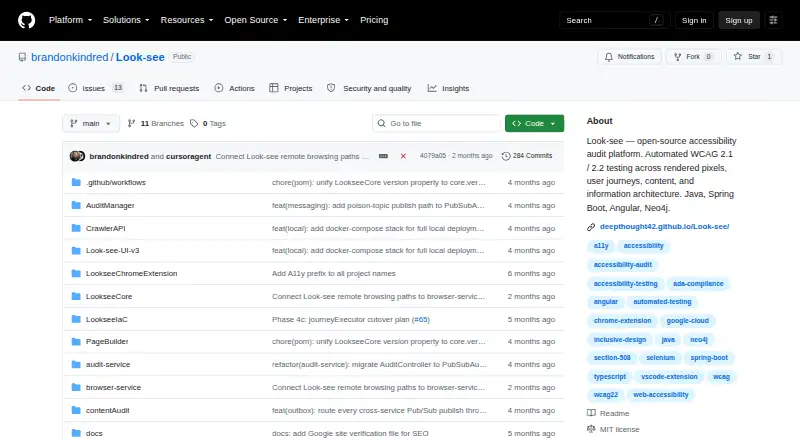
The facts below are what the maker publishes about Look-see, checked and dated. Our editors have not written about it yet.
The facts
Each one read from Look-see's own pages, with the date it was checked.
What it does
- Audit areas
- Audits cover visual design, content, information architecture, and user journeys.checked 12 Oct 2026
- Authentication
- The listed authentication technology is Auth0 using OAuth2 and JWT.checked 12 Oct 2026
- Automated scans
- Yeschecked 23 Sep 2026
- Availability
- The hosted version is described as planned but not live; the project says it is not yet version 1.0 and may have rough edges.checked 12 Oct 2026
- CI/CD integration
- Yeschecked 23 Sep 2026
- Content audits
- Content checks include alt-text presence and quality, readability grade, paragraph structure, and plain language.checked 12 Oct 2026
- Data control
- The project says a self-hosted deployment keeps data in the user's cloud.checked 12 Oct 2026
- Deployment
- Look-see can be deployed to Google Cloud Run using its Terraform package, and the repository describes self-hosting as the supported path.checked 12 Oct 2026
- Hosting and data
- Self-hosting on Google Cloud is the supported path, and the README says data can remain in the user's cloud.checked 12 Oct 2026
- Information architecture
- Information-architecture checks include heading hierarchy, table semantics, form labels, link text, landmarks, and page metadata.checked 12 Oct 2026
- Integrations
- The project uses Google Cloud Pub/Sub, Neo4j, and Pusher WebSockets; its shared library also includes Google Cloud Storage, Vision, and NLP integrations.checked 12 Oct 2026
- Intended users
- The project names accessibility leads and consultants, product and engineering teams, agencies, and open-source maintainers as intended users.checked 12 Oct 2026
- Interfaces
- The project includes an Angular web dashboard, a Chrome extension, and a VS Code extension.checked 12 Oct 2026
- Journey testing
- Look-see uses a real headless browser to explore interactive elements and validate multi-step flows.checked 12 Oct 2026
- License
- The repository states that Look-see is released under the MIT License.checked 12 Oct 2026
- Product
- Look-see is an open-source accessibility audit platform that crawls websites and audits pages and user journeys.checked 12 Oct 2026
- Setup requirements
- The quick start lists Java 17 or later, Maven 3.9 or later, Node.js 18.19 or later, Neo4j 5.x, and optionally Docker and Google Cloud SDK.checked 12 Oct 2026
- Standards
- It grades pages against WCAG 2.1 and 2.2 AA, ADA, Section 508, and EN 301 549.checked 12 Oct 2026
- Support and contribution
- The repository invites pull requests and bug reports, and directs users to open issues for roadmap progress.checked 12 Oct 2026
- User journeys
- Look-see drives a real headless browser through interactive elements and checks journeys such as login, checkout, and search flows.checked 12 Oct 2026
- Visual audits
- Its visual-design service audits rendered pages, including color contrast, typography, image quality, whitespace, and imagery contrast.checked 12 Oct 2026
- Visual checks
- Visual design checks include color contrast, typography, image quality, whitespace, and imagery contrast.checked 12 Oct 2026
- WCAG coverage
- wcag 2.2checked 23 Sep 2026
Where it runs
- Browser extension
- Yeschecked 23 Sep 2026
Alternatives to Look-see
- 1

Axe DevTools
Free planOpen sourceAndroidiOSWebAPI9.4From $40 a month - 2

WAVE
Free planWebAPIExtensionLinux8.4Free plan - 3

Binclusive
AndroidiOSWebAPI8.2From $59 a month - 4

Assistiv Labs
Free planAndroidiOSWebLinux8.2From $19 a month - 5

IBM Equal Access Accessibility Checker
Free planOpen sourceWebAPIExtensionSelf-hosted8.1Free plan - 6

A11yInspect
Free planExtensionLinuxmacOSWindows8.0From $120 a year