
LocalGov Drupal
LocalGov Drupal is an open-source publishing platform built and maintained by councils and suppliers for local government.
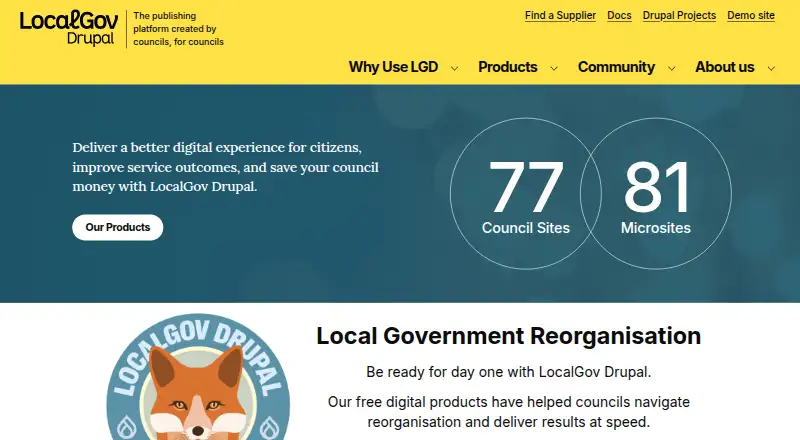
What LocalGov Drupal is
LocalGov Drupal is an open-source publishing platform built and maintained by councils and suppliers for local government. It is designed for councils in the UK and Ireland, with tools for subsites, news, events, alerts, directories, service pages, guides, publications, and election content. Publishing features include flexible page components, patterns, styles, callouts, workflows, revisions, service contacts, and shareable previews. Optional governance tools can manage roles, permissions, moderation, approvals, scheduled publishing, review dates, and revision records. Councils can use Microsites to run distinct websites from one platform; more than 50 are live. The distribution includes a base theme, a sample subtheme, a quick-start installation, modular architecture, automated testing, and coding-standard checks. Drupal REST and JSON:API tools and its module ecosystem can connect it with forms, payments, CRM, case management, identity providers, mapping, and directories. Content and functionality are designed to meet or exceed WCAG 2.1 AA, and multilingual publishing and document management are supported. The software is free, but implementation needs development resources, suitable hosting, and ongoing security updates.
Good
- Tools cover service pages, alerts, events, and elections.
- Optional tools support permissions, approvals, and scheduled publishing.
- Microsites can run distinct sites from one platform.
- Designed to meet or exceed WCAG 2.1 AA.
- Supports multilingual publishing and document management.
Watch out
- Implementation requires development resources.
- Requires suitable hosting and ongoing security updates.
- The intended audience is councils in the UK and Ireland.
Who it suits
LocalGov Drupal is intended for local councils in the UK and Ireland that need publishing, workflow, and multisite capabilities. It suits organizations with development resources for implementation, hosting, and maintenance.
Verdict
LocalGov Drupal combines council-oriented publishing tools with workflow governance and multisite support. Its implementation and ongoing hosting and security needs should be part of the decision.
Plans and prices
From LocalGov Drupal's own pricing page, checked 21 Oct 2026.
| Plan | Price | What it gives you |
|---|---|---|
| LocalGov Drupal CMS | Free | Free open-source CMS · council websites · self-hosted |
| LocalGov Drupal flying solo | £9,999, paid once | Supplier-installed instance · 10-day setup · training · documentation · £9,999 a unit |
| Council subscription | — | Funds roadmap and BAU · optional community participation · Voluntary subscription based on council size, capped at £10,000 per year |
The facts
Each one read from LocalGov Drupal's own pages, with the date it was checked.
What it does
- Accessibility
- The CMS content and functionality are designed to meet or exceed WCAG 2.1 AA, with the administration interface also targeted at that level.checked 21 Oct 2026
- Audience
- The platform is designed for local councils across the UK and Ireland.checked 30 Sep 2026
- CMS feature: alerts
- Alert banners can be displayed across an entire site or selected pages.checked 21 Oct 2026
- CMS feature: directories
- Directories present searchable and filterable lists of similar content.checked 21 Oct 2026
- CMS feature: microsites
- The Microsites product runs multiple sites from one Drupal installation, each with its own domain, users, content and files.checked 21 Oct 2026
- CMS feature: news
- The News functionality provides news article and newsroom content types with search and filtering.checked 21 Oct 2026
- CMS feature: services
- The Services module supplies structured service landing, sub-landing and service pages for council information.checked 21 Oct 2026
- CMS feature: step-by-step
- Step-by-step pages provide guided instructions for completing a process.checked 21 Oct 2026
- CMS feature: themes
- A scalable LocalGov Base theme and example Scarfolk subtheme are supplied for branded customization.checked 21 Oct 2026
- CMS feature: workflows
- Publishing workflows support draft, review and approval processes, with revisions and scheduled publishing available through workflow tools.checked 21 Oct 2026
- Community support
- The project offers technical Slack channels, a weekly Thursday technical drop-in and weekly Merge Tuesdays.checked 30 Sep 2026
- Content features
- The CMS includes subsites, news, events, alert banners, directories, service pages, guides, step-by-step pages, HTML publications and elections.checked 30 Sep 2026
- Council adoption
- The project website says more than 75 councils across the UK and Ireland participate in its community.checked 21 Oct 2026
- Developer support
- The project offers technical Slack channels, weekly technical drop-ins, weekly Merge Tuesdays and fortnightly technical governance meetings.checked 21 Oct 2026
- Development
- The distribution provides a quick-start install, modular architecture, automated testing and automated coding-standards checks.checked 30 Sep 2026
- Documentation
- Documentation covers installation, configuration, theming, content types, developer workflows, hosting, security, testing and contribution.checked 21 Oct 2026
- Extensibility
- Developers can enable additional project or Drupal modules, create custom modules, build custom themes and use the system headlessly.checked 21 Oct 2026
- Government evaluation
- A 2026 GOV.UK evaluation says LocalGov Drupal achieved notable market impact, reaching a reported 14% share of the content-management-system market.checked 21 Oct 2026
- Hosting dependency
- Availability and resilience depend on the council's hosting provider, and the platform itself has no guaranteed availability in the listed service.checked 21 Oct 2026
- Implementation requirement
- Installing and preparing a site requires development resources, appropriate hosting and ongoing security updates.checked 30 Sep 2026
- Installation
- Local installation uses Composer, with DDEV or Lando recommended, and Drupal 11 is supported on the 4.x branch.checked 30 Sep 2026
The company
- Company legal name
- Open Digital Cooperative Ltd manages and governs LocalGov Drupal as a company limited by guarantee, company number 14532300.checked 21 Oct 2026
Money
- Cost claim
- The project estimates rebuild costs 30%–50% lower than proprietary CMS alternatives, typically saving £30,000–£90,000.checked 21 Oct 2026
- Implementation cost
- The project says typical implementations cost £70,000–£150,000, excluding optional additions and supplier-specific work.checked 21 Oct 2026
The full review of LocalGov Drupal
Overview
LocalGov Drupal is an open-source content management platform built for councils in the UK and Ireland. It suits councils with development capacity that want structured public-service publishing and control over their web estate. Its breadth and multisite capabilities are compelling, but this is a platform to implement and maintain, not a ready-hosted website.
Key features
Content and publishing
The CMS covers subsites, service pages, directories, guides, step-by-step content, news, events, alert banners, HTML publications and elections. That range gives council teams a framework for common resident-facing information, rather than limiting them to basic news posts and static pages. Flexible components, patterns, styles and callouts let teams shape pages within a consistent system; service contacts, revisions and shareable preview links help coordinate publication.
Optional workflow tools add roles and permissions, moderation, approval dashboards, scheduled publishing, review dates and revision records. These controls can help councils manage approval and upkeep across teams, though they also make the platform a better fit for organisations prepared to configure and govern a CMS than for those seeking a simple turnkey site.
Accessibility, languages and integrations
Content and functionality are designed to meet or exceed WCAG 2.1 level AA. Multilingual publishing and document management are supported. Drupal’s REST and JSON:API tools, along with its module ecosystem, can connect the platform to forms, payments, CRM, case management, identity providers, mapping and directories. Those options provide room to build around existing services, but depend on implementation work.
Customization and development
A scalable base theme and sample Scarfolk subtheme provide a starting point for visual customization. The distribution includes a quick-start install, modular architecture, automated testing and coding-standards checks. Local installation uses Composer; DDEV or Lando are recommended, and Drupal 11 is supported on the 4.x branch. The installation tooling and development practices will appeal to technical teams, but councils still need development resources, suitable hosting and ongoing security updates.
Microsites
LocalGov Drupal Microsites supports running many distinct websites from one platform, with more than 50 microsites live. That makes it relevant to councils managing several related web properties; councils needing only one small site may not benefit as much from this capability.
Pricing
The LocalGov Drupal CMS plan costs nothing and is open-source GPL2 software freely available to all UK and Irish councils. There are no paid tiers or seat and usage caps in the plan facts. Free software does not remove the practical costs of development, hosting and security maintenance, so councils should weigh those operational needs rather than treating the plan price as the full cost of running a site.
Platforms
LocalGov Drupal is available as a web platform, through an API and as self-hosted software. Its self-hosted model gives councils control over deployment, while placing hosting and ongoing maintenance on the implementation team.
Who it's for
This is best suited to UK and Irish councils with technical capacity, or suppliers able to provide it, that need council-oriented publishing, workflow governance or a network of microsites. Its accessibility design, multilingual publishing and broad content types also suit public-service teams with varied resident information needs. It is a weaker choice for organisations without development support or those that want hosting and implementation handled as part of a turnkey service.
Pros and cons
Pros
- Council-focused publishing: Service pages, guides, alerts, directories and other public-service formats address a broader set of council content needs than a basic page-and-news CMS.
- Governance options: Optional approval, moderation, scheduling and review controls help teams coordinate publishing and content upkeep.
- Multisite and integration scope: Microsites support and Drupal APIs give councils room to manage multiple properties and connect other services.
- Open-source availability: The CMS plan is free to UK and Irish councils, without a paid plan tier to unlock the core platform.
Cons
- Implementation burden: Councils need development resources and appropriate hosting to install and prepare a site.
- Ongoing security responsibility: Security updates remain an operational requirement after launch.
- Configuration is not turnkey: The architecture and integration options are useful to technical teams but may be excessive for a council seeking a managed, ready-to-use website.
Alternatives
Government Website Builders is a directory for comparing options across the category. Choose Jadu Central if you prefer a paid platform with pricing available by request. Town Web may fit councils looking for a paid web offering with Android and iOS platforms as well as web access; its Municipal website plan starts at $99 a month, with the exact price quoted and a nominal one-time build fee that may be spread across the contract.
Council Platform is an alternative with page-view-based monthly licensing: its listed plans include £200 a month for up to 5,000 monthly page views and £400 a month for 5,001 to 15,000. Choose Digital Place if you want an all-inclusive SaaS subscription with feature packs. Isomer is another free web option, while S3WaaS offers a freemium web option.
Contensis for Councils is a paid API and web option; its Starter plan is $920 a month and includes 200GB bandwidth, 50GB storage, 5 concurrent users and 1 project. WPPersona Government Website CMS is a paid web alternative with Starter at $83 a month for up to 5,000, Community at $208 a month for up to 25,000, and Municipal at $499 a month for up to 100,000.
Verdict
Choose LocalGov Drupal if your UK or Irish council has the technical capacity to implement and maintain it and needs structured council publishing, governance options or multisite support. Its free open-source availability and focused feature set are strong reasons to consider it. Look elsewhere if you need a hosted, turnkey service or cannot commit resources to development, hosting and security updates.
Getting started
- Visit the LocalGov Drupal website
- Prepare development resources, suitable hosting, and a security-update process
- Install locally with Composer
- Use DDEV or Lando as the recommended local environment
- Run Drupal 11 on the supported 4.x branch
- Customize the base theme or sample Scarfolk subtheme
Limits worth knowing
The software itself is free under GPL2 and available to UK and Irish councils. Running it requires development resources, appropriate hosting, and ongoing security updates.
Questions
Is LocalGov Drupal free?
Yes. The LocalGov Drupal CMS plan is free and released as open-source GPL2 software for UK and Irish councils.
Who is LocalGov Drupal for?
It is designed for local councils across the UK and Ireland.
Can it manage multiple websites?
Yes. LocalGov Drupal Microsites supports many distinct websites from one platform, and more than 50 microsites are live.
What accessibility standard does it target?
Content and functionality are designed to meet or exceed WCAG 2.1 level AA.
How is it installed?
Local installation uses Composer, with DDEV or Lando recommended. Drupal 11 is supported on the 4.x branch.
What can it integrate with?
Drupal REST, JSON:API, and the module ecosystem can connect forms, payments, CRM, case management, identity providers, mapping, and directories.
Alternatives to LocalGov Drupal
- 1
GovCMS
Open sourceWebAPILinuxSelf-hosted7.1 - 2
Single Digital Presence
Free planOpen sourceWebAPISelf-hosted7.1Free plan - 3
Isomer
Free planOpen sourceWeb7.0Free plan - 4
Public Platform
WebAPI6.9From £200 a month - 5
 6.6From £200 a month
- 6
Loop Municipal Websites
AndroidiOSWeb6.6