Local Deep Research
Local Deep Research is a free AI research assistant that uses multiple language models and search engines to create reports with citations.
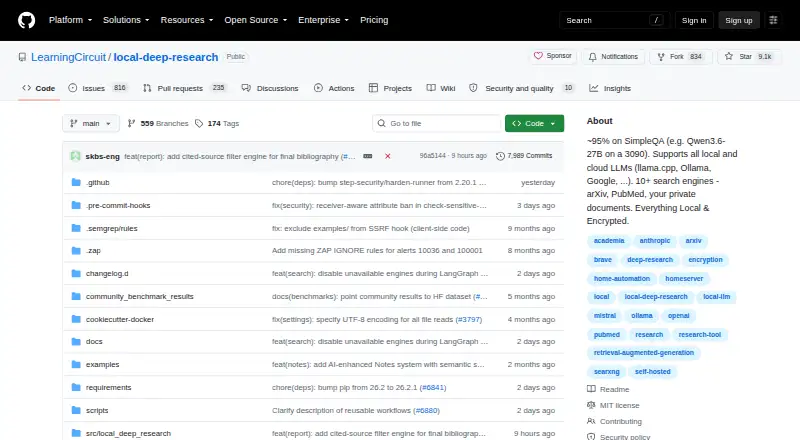
What Local Deep Research is
Local Deep Research is a free AI research assistant that uses multiple language models and search engines to create reports with citations. It offers quick summaries, detailed research, report generation, and document analysis. Sources can be downloaded into an encrypted library, indexed, and searched alongside the live web. Listed search connections include arXiv, PubMed, Semantic Scholar, Wikipedia, SearXNG, GitHub, Elasticsearch, Wayback Machine, The Guardian, and Wikinews. It supports local models through Ollama, LM Studio, and llama.cpp, plus hosted providers and compatible endpoints. Interfaces include a web UI, Python API, authenticated HTTP REST API, and an MCP server for Claude Desktop and Claude Code. Reports export to PDF or Markdown, and scheduled digests can be delivered as Markdown reports or structured summaries. The project describes isolated SQLCipher databases encrypted with AES-256 and says it has no telemetry or tracking. Installation is available through Docker, Docker Compose, or pip on Windows, macOS, and Linux. Egress controls are best-effort, and the local MCP server has no built-in authentication or rate limiting.
Good
- Free and MIT licensed
- Cited reports and document analysis
- Encrypted source library
- Local and hosted model integrations
- PDF and Markdown exports
Watch out
- Egress controls are not an air gap
- MCP server lacks authentication and rate limiting
- No telemetry does not remove configured network requests
Who it suits
It suits researchers who want cited reports, document analysis, local or hosted model choices, and searchable source libraries. Developers can also use its APIs and MCP server.
Verdict
Local Deep Research offers broad research modes, source connectors, model options, APIs, and encrypted local storage without a listed price. Its security boundaries matter: egress protections are best-effort and the local MCP server lacks built-in access controls.
The facts
Each one read from Local Deep Research's own pages, with the date it was checked.
What it does
- API and assistant integration
- It provides authenticated HTTP and Python APIs and an MCP server for Claude Desktop and Claude Code.checked 4 Oct 2026
- Data security
- The project says each user gets an isolated SQLCipher database encrypted with AES-256 using a key derived from their password, and that passwords are not stored.checked 4 Oct 2026
- Deployment
- Installation options include Docker Compose, Docker, pip, and an Unraid template; the installation guide names CPU-only Compose support for all platforms and Windows PowerShell instructions.checked 5 Oct 2026
- Egress limitation
- The project describes egress scopes as best-effort guard rails rather than an air gap or hard security boundary.checked 5 Oct 2026
- Egress limits
- The project describes egress scopes as best-effort guard rails rather than an air gap or hard security boundary.checked 4 Oct 2026
- Exports and subscriptions
- It supports PDF and Markdown exports and scheduled research digests delivered as Markdown reports or structured summaries.checked 4 Oct 2026
- Interfaces
- The project provides a web UI, Python API, authenticated HTTP REST API, and an MCP server for Claude Desktop and Claude Code.checked 5 Oct 2026
- Knowledge base
- It can index downloaded papers and web pages in an encrypted library so users can search those sources alongside the live web.checked 5 Oct 2026
- Knowledge base integrations
- LangChain-compatible retrievers can connect sources including FAISS, Chroma, Pinecone, Weaviate and Elasticsearch.checked 4 Oct 2026
- Knowledge integrations
- LangChain-compatible retrievers are supported, including FAISS, Chroma, Pinecone, Weaviate, and Elasticsearch.checked 5 Oct 2026
- License
- The repository states that Local Deep Research is distributed under the MIT License.checked 5 Oct 2026
- LLM integrations
- Supported model options include Ollama, LM Studio, llama.cpp, OpenAI, Anthropic Claude, Google Gemini, OpenRouter, Requesty, and compatible custom endpoints.checked 5 Oct 2026
- MCP limitation
- The MCP server is intended for local STDIO use and has no built-in authentication or rate limiting.checked 5 Oct 2026
- MCP security limit
- The MCP server is intended for local STDIO use and has no built-in authentication or rate limiting.checked 4 Oct 2026
- Privacy
- The project says it has no telemetry, analytics, tracking, or crash reporting, and that network calls are initiated by the user’s configured search, model, or notification services.checked 5 Oct 2026
- Purpose
- Local Deep Research is an AI-powered research assistant that searches multiple sources and synthesizes cited reports.checked 5 Oct 2026
- Research modes
- It offers quick summaries, detailed research, report generation, and AI analysis of private documents.checked 5 Oct 2026
- Search integrations
- Listed search sources include arXiv, PubMed, Semantic Scholar, Wikipedia, SearXNG, GitHub, Elasticsearch, Tavily, Google via SerpAPI or Programmable Search Engine, and Brave Search.checked 5 Oct 2026
- Security
- The project says each user receives an isolated SQLCipher database encrypted with AES-256, with the key derived from the login password.checked 5 Oct 2026
- Support
- The project directs users to Discord and Reddit for community help and GitHub Issues for bug reports.checked 5 Oct 2026
Alternatives to Local Deep Research
- 1

Perplexity
Free planAndroidiOSWebAPI8.2From $20 a month - 2

Consensus
Free planAndroidiOSWebAPI8.1From $20 a month - 3
Liner
Free planAndroidiOSWebAPI8.1From $14.99 a month - 4

SciSpace
Free planAndroidiOSWebAPI8.1From $96 a year - 5
Gab AI Research Assistant
Free planAndroidiOSWebAPI8.0From $16.67 a month - 6

Fabric
AndroidiOSWebAPI7.9From $8 a month