
Litekart
Litekart is a free, open-source commerce foundation that developers and businesses can self-host to build marketplaces, B2B systems, dealer networks and mult…
What Litekart is
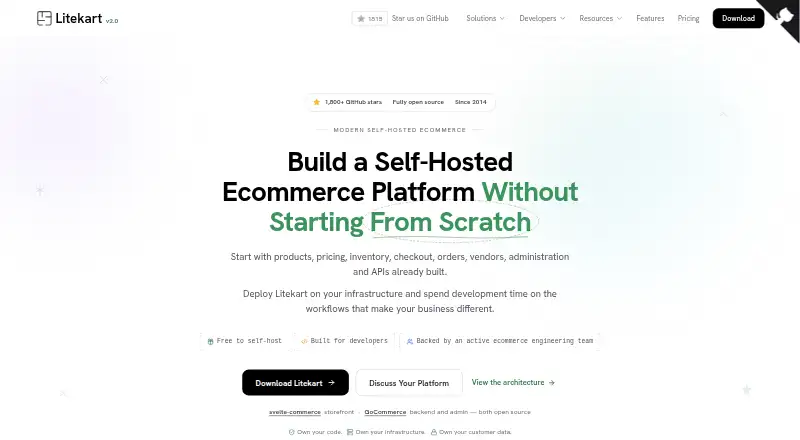
Litekart is a free, open-source commerce foundation that developers and businesses can self-host to build marketplaces, B2B systems, dealer networks and multi-tenant platforms. Its downloadable stack connects a storefront, admin dashboard, vendor portal and API server, with product, customer, pricing, inventory, cart, checkout, order, payment and administration functions. Documented APIs, events and webhooks support its API-first architecture. For multi-vendor use, it includes vendor onboarding, catalogues, commissions, vendor orders and shared administration. B2B tools cover company accounts, buyer roles, tiered and account-specific pricing, minimum orders, approvals, credit limits and quote-to-order conversion. Razorpay, Stripe and PayPal integrations are included, with an abstraction layer for additional gateways. On self-hosted deployments, customers own their data and can export products, customers and orders through APIs and CSV. The free Download and Build plan provides the full source code and features for self-hosting. Android and iOS apps can be built and customized as a paid service; no price is listed for that service.
Good
- Free plan includes full source code and all features
- Includes vendor onboarding, catalogues and commissions
- B2B tools cover account pricing and approval workflows
- Customers own and can export self-hosted data
- Includes Razorpay, Stripe and PayPal integrations
Watch out
- Requires deployment on the customer's infrastructure
- Branded Android and iOS apps are a paid service
- No price is listed for the paid app service
Who it suits
Litekart is for developers and businesses building marketplaces, B2B commerce systems, dealer networks or multi-tenant platforms. It particularly suits teams prepared to self-host and manage their own security and compliance policies.
Verdict
Litekart offers a broad commerce foundation with multi-vendor and B2B capabilities in a free self-hosted download. It is a fit for teams that want control over deployment and data, while mobile app customization requires a separate paid service.
Plans and prices
From Litekart's own pricing page, checked 15 Oct 2026.
| Plan | Price | What it gives you |
|---|---|---|
| Download and Build | Free | Self-hosted storefront and Go backend · all features included · community resources · Free no mandatory platform fees |
| Complete Platform Delivery | Priced on request | Design and build · deployment · ongoing maintenance · optional managed infrastructure · Custom quotation per project |
| Engineering Support | Priced on request | Architecture reviews · deployment assistance · priority support · custom modules · integrations · Custom pricing scoped to requirements |
| White Label | Priced on request | Full rebranding · software updates · standard support · 1% of sales |
The facts
Each one read from Litekart's own pages, with the date it was checked.
Where it runs
- Android app
- Google Play lists a Litekart seller app by MISIKI TECHNOLOGIES LLP, marked for everyone and categorized as Business.checked 15 Oct 2026
- Android data safety
- The Google Play listing says the developer declares no data shared with third parties and no data collected.checked 15 Oct 2026
What it does
- API
- Litekart provides a REST API covering products, customers, orders, payments and shipping, with Postman documentation.checked 15 Oct 2026
- Architecture
- Litekart uses an API-first approach in which the storefront, admin dashboard and vendor portal run on documented APIs with events and webhooks.checked 1 Oct 2026
- B2B
- B2B functionality includes bulk orders, tiered pricing, custom catalogs and wholesale account controls.checked 15 Oct 2026
- Catalog
- The platform supports product variants, attributes, categories, bulk editing, inventory and catalogs exceeding one million products.checked 15 Oct 2026
- Checkout
- Guest checkout, partial-cart checkout, coupons, invoices and payment-gateway integrations are listed as native features.checked 15 Oct 2026
- Documentation depth
- Official docs contain installation, project structure, deployment, admin extensions, storefront hooks, integrations, API reference and a changelog.checked 15 Oct 2026
- Downloadable stack
- The downloadable platform includes the storefront, admin dashboard, vendor portal and API server with products, customers, pricing, inventory, cart, checkout, orders, payments and administration connected.checked 1 Oct 2026
- Extensibility
- Developers can add custom REST routes and extend data models, workflows, events and admin UI without forking the core.checked 15 Oct 2026
- GitHub storefront
- The public Svelte Commerce repository describes Litekart as one of 26 supported commerce backends and shows about 1.8k stars, 337 forks and an MIT license.checked 15 Oct 2026
- Independent integration assessment
- The Svelte Commerce maintainers report Litekart connector coverage of 39 out of 43 storefront services, including cart, checkout, orders and authentication.checked 15 Oct 2026
- Integrations
- Litekart integrates shipping and logistics providers, email and SMS notifications, Google Tag Manager, Meta Pixel and analytics, while APIs and webhooks cover ERP, CRM and OMS integrations.checked 1 Oct 2026
- Legal registration
- TheCompanyCheck identifies MISIKI TECHNOLOGIES LLP as an active LLP incorporated on 16 July 2019 with LLPIN AAP-9397.checked 15 Oct 2026
- License
- The documentation identifies Litekart as open source under the MIT License.checked 15 Oct 2026
- Limit: connector gaps
- The same capability matrix marks some non-Litekart backends as untested or incomplete, showing that connector breadth does not mean every backend has equal coverage.checked 15 Oct 2026
- Limit: infrastructure responsibility
- Self-hosting requires the customer to operate infrastructure, while managed deployment is offered separately as a paid service.checked 15 Oct 2026
- Limit: live verification
- The independent connector documentation says its endpoint coverage was derived from authoritative sources but had not been tested against a live production Litekart instance.checked 15 Oct 2026
The company
- Company founding
- LinkedIn gives 2019 as the founding year for MISIKI TECHNOLOGIES LLP.checked 15 Oct 2026
- Company size
- LinkedIn lists MISIKI TECHNOLOGIES LLP as a 2–10 employee software-development partnership headquartered in Rourkela, Odisha.checked 15 Oct 2026
- Data ownership
- On a self-hosted deployment, the customer owns the data and can export products, customers and orders through APIs and CSV at any time.checked 1 Oct 2026
- Founded
- 2014checked 23 Sep 2026
- Headquarters
- Rourkela, Odisha, Indiachecked 23 Sep 2026
Money
- Free plan
- Yeschecked 20 Sep 2026
The full review of Litekart
Overview
Litekart is an open-source commerce platform for teams building marketplaces, B2B systems, dealer networks or multi-tenant services. It suits developers and businesses prepared to self-host and shape their own commerce experience. Its connected commerce components and broad business rules are compelling; operating the platform and tailoring it remain the customer’s responsibility.
Key features
Connected commerce foundation
The downloadable stack combines a storefront, admin dashboard, vendor portal and API server, with product, customer, pricing, inventory, cart, checkout, order, payment and administration functions. This gives builders a broad starting point without requiring each component to be assembled from unrelated systems. The API-first architecture, documented APIs, events and webhooks also make it suitable for teams integrating external services or building custom interfaces.
Marketplace and B2B operations
Marketplace tools cover seller onboarding, vendor catalogues, commissions, vendor orders and shared administration. Commission rules and automated payouts are included, making the foundation relevant to operators managing multiple sellers rather than a single-store catalogue.
The B2B capabilities go beyond basic bulk ordering: company accounts, buyer roles, account-specific and tiered prices, minimum order rules, approval workflows, credit limits and quote-to-order conversion are supported. That breadth can serve businesses with distinct purchasing policies, though teams still need to implement and operate the platform themselves.
Payments, integrations and data
Razorpay, Stripe and PayPal are included, with an abstraction layer for adding other gateways. Shipping and logistics providers, email and SMS notifications, Google Tag Manager, Meta Pixel and analytics are also supported; APIs and webhooks provide routes to ERP, CRM and OMS integrations.
Integrated payment gateways are PCI-DSS compliant, while passwords use strong one-way hashing. Because deployment is self-hosted, customers set their own security and compliance policies end to end. They own their deployment data and can export products, customers and orders through APIs and CSV. This control is a clear advantage for organizations that want to manage their infrastructure, but it also puts security and operational responsibility on them.
Stores include server-side rendering, automated sitemaps, structured data and clean URLs. Android and iOS apps can be built and branded as a paid service, then published through the customer’s developer accounts; mobile customization is not part of the free download.
Pricing
Download and Build: free. This includes self-hosting on your infrastructure, full source code, all features and community resources. It is the fit for teams able to handle deployment and development; it does not include the convenience of managed hosting or the paid engineering services.
White Label: custom pricing for complete white labeling, software updates and standard support. This suits organizations seeking a branded product with updates and support rather than only the source code.
Engineering Support: custom pricing for architecture reviews, deployment assistance, priority support, custom modules and integrations. It fits teams that need help adapting or operating their implementation.
Complete Platform Delivery: custom pricing for design and build, deployment and ongoing maintenance, with optional managed infrastructure. This is the more hands-off route for organizations that want a delivered platform, though it is not the free self-hosted offer.
There is no free trial; the downloadable plan itself is free. No seat or usage quota is stated for these plans. Mobile app customization is a separate paid service.
Platforms
Litekart supports Android, iOS, web, API and self-hosted deployments. Self-hosting is central to the offer; mobile apps can be delivered as a paid service rather than being included in the free download.
Who it's for
Litekart is best for developers and businesses that need marketplace or B2B building blocks, want control over deployment and data, and have the capacity to build and maintain a self-hosted system. Its vendor management and detailed purchasing rules make it especially relevant to multi-seller or account-based commerce. It is a weaker fit for teams seeking a ready-to-run, managed store without implementation work.
Pros and cons
- Pro: The free download includes the full source and all features, giving capable teams a broad base without a software charge.
- Pro: Vendor operations and B2B purchasing rules cover workflows that a simple storefront may not address.
- Pro: Self-hosting and API/CSV exports give customers control of deployment and data.
- Con: Customers must host and operate the platform, including applying their own security and compliance policies.
- Con: White labeling, engineering help and complete delivery require custom pricing; mobile app customization is separately paid.
Alternatives
MarketplaceKit is worth considering for teams comparing a free self-hosted community edition with a paid Hobby plan; its community edition is described as a lighter version than hosted and has no customer support.
Dokan Multivendor Marketplace offers a free Lite plan with unlimited vendors and WordPress.org support, with a paid annual Starter plan for teams considering that route.
Marketbridge by Hykmah has a free API/web plan capped at one product, 100 records, 100 transactions per month and 1 GB storage, which may suit a smaller, quota-bound starting point.
Mercur offers a free, MIT-licensed, self-hosted marketplace core, with implementation, deployment and maintenance handled by the customer.
Websta is a separate option for teams seeking a free AI-built profile page rather than a commerce platform.
Yo!Kart is a paid self-hosted alternative, with its GoQuick plan priced at $1,999, paid once and a lifetime license.
Digivance Marketplace Platform is a paid alternative with a Starter plan priced at $2,999 a month for up to 100 active vendors.
Sharetribe is a paid option with a free trial; its Build plan is $39 a month and includes 1M usage credits per month, unlimited test users and listings, and test-mode API access.
For broader comparisons, see Online Marketplace Software and Ecommerce platforms.
Verdict
Choose Litekart if you need a flexible marketplace or B2B foundation, can self-host it, and value control over source code and data. Its free, feature-complete download is the main draw; the main reason to look elsewhere is the need for a ready-made managed service or included mobile app customization.
Getting started
- Visit https://litekart.in/
- Choose the free Download and Build plan
- Download the source code and deploy it on your infrastructure
- Use the connected storefront, admin dashboard, vendor portal, and API server
- For branded Android or iOS apps, arrange the paid build service and publish from your developer accounts
Limits worth knowing
The free Download and Build plan is for self-hosting on your infrastructure. Android and iOS app builds are a paid service.
Questions
Is Litekart open source?
Yes. The free Download and Build plan includes the full source code.
What platforms does Litekart support?
Listed platforms are Android, API, iOS, self-hosted, and web.
Can Litekart support a multi-vendor marketplace?
Its foundation includes vendor onboarding, vendor catalogues, commissions, vendor orders, and shared platform administration.
Which payment integrations are included?
Razorpay, Stripe, and PayPal are included, with an abstraction layer for adding other gateways.
Can I get Android and iOS apps?
Apps can be built and customized to a customer's branding as a paid service. They are published from the customer's developer accounts.
Alternatives to Litekart
- 1
EcommerceSoftwarePro
Free planAndroidiOSWeb7.8$999 one-time - 2
Websta
Free planAndroidiOSWeb7.6From €0.69 a month - 3
MarketplaceKit
Free planAndroidiOSWebAPI7.2From $15 a month - 4
Tamaranga
AndroidiOSWebAPI7.1 - 5
My Marketplace Builder
AndroidiOSWeb6.9From $83 a month - 6
PazaryeriSoft Real Estate Listing Software
AndroidiOSWeb6.9$7,990 one-time