LevelBlue MDR
LevelBlue MDR is a managed detection and response service that processes alerts from security tools to identify credible threats and support an organization’…
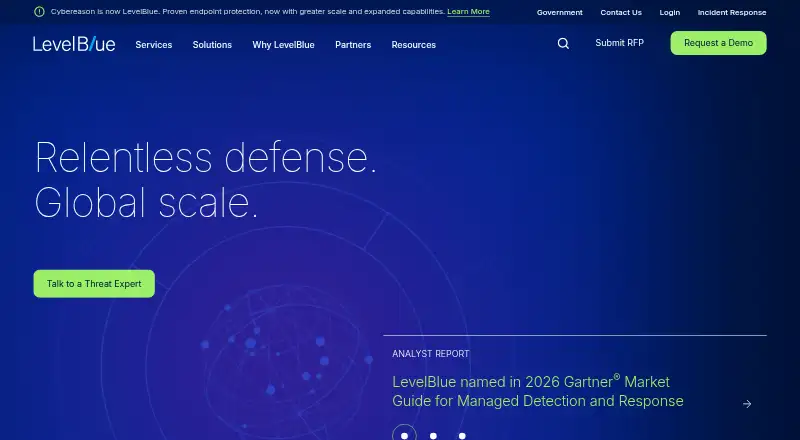
What LevelBlue MDR is
LevelBlue MDR is a managed detection and response service that processes alerts from security tools to identify credible threats and support an organization’s response. It provides global monitoring and response 24/7/365 and works with customers’ existing security infrastructure. Its detection approach looks for behavioral threats beyond indicators of compromise that security technologies may miss. LevelBlue describes AI-enabled, context-based incident investigation, with containment and mitigation following client-driven protocols. The service acts as an extension of the customer’s team. Through LevelBlue Fusion, users can view threats and take action in a web portal and mobile app. MDR can correlate alerts across multiple cloud providers and on-premises systems as one logical environment. LevelBlue says onboarding takes 10 days or less. Its SpiderLabs team includes more than 1,000 security consultants, threat hunters, incident responders, forensic investigators, and researchers. The company lists frameworks and certifications including ISO/IEC 27001, SOC 2 Type II, FedRAMP, PCI DSS, HIPAA, and ISO 27701, while advising customers to confirm product-specific details with sales. Pricing is by request.
Good
- Global monitoring and response runs 24/7/365.
- Uses customers’ existing security infrastructure.
- Correlates alerts across cloud and on-premises environments.
- Response follows client-driven protocols.
Watch out
- Pricing is available on request.
- Product-specific certification details should be confirmed with sales.
Who it suits
LevelBlue MDR is aimed at organizations with regulated, hybrid, or high-risk environments that want managed monitoring and response as an extension of their security team.
Verdict
LevelBlue MDR combines continuous monitoring, threat investigation, and coordinated response across hybrid environments. Organizations should confirm which listed security frameworks apply to the specific product they plan to use.
Plans and prices
From LevelBlue MDR's own pricing page, checked 11 Oct 2026.
| Plan | Price | What it gives you |
|---|---|---|
| LevelBlue Managed Detection and Response | Priced on request | Pricing by request; the site offers a Request Pricing option |
The facts
Each one read from LevelBlue MDR's own pages, with the date it was checked.
What it does
- Coverage
- The service provides global threat monitoring and response 24/7/365.checked 11 Oct 2026
- Existing tools
- LevelBlue says MDR uses customers’ existing security infrastructure and security tools.checked 11 Oct 2026
- Hybrid environments
- LevelBlue says MDR can cover multiple cloud providers and on-premises infrastructure as one logical environment for alert correlation.checked 11 Oct 2026
- Integrations
- The MDR page lists partnerships including Microsoft, CrowdStrike, Splunk, Palo Alto Networks, Zscaler, SentinelOne, Check Point, Ivanti, Azure, Google Cloud, AWS, Cisco, Fortinet, Cybereason, Akamai, and Omnissa.checked 11 Oct 2026
- Intended customers
- LevelBlue describes its services as protecting regulated, hybrid, and high-risk environments and positions MDR as an extension of an organization’s security team.checked 11 Oct 2026
- Investigation and response
- LevelBlue describes AI-enabled, context-based incident investigation and rapid threat containment and mitigation.checked 11 Oct 2026
- Onboarding
- The MDR page says onboarding gets organizations up and running in days, and its FAQ says each client is onboarded in 10 days or less.checked 11 Oct 2026
- Response protocols
- Response actions follow client-driven protocols and are taken as an extension of the customer’s team.checked 11 Oct 2026
- Security and compliance
- LevelBlue lists ISO/IEC 27001, SOC 2 Type II, FedRAMP, GSA, PCI DSS, HIPAA, and ISO 27701 among its key certifications and frameworks, while noting product-specific details should be confirmed with sales.checked 11 Oct 2026
- Security practices
- LevelBlue says data is encrypted in transit and at rest, access is restricted, and its systems undergo 24/7 monitoring.checked 11 Oct 2026
- Service
- LevelBlue MDR processes alerts from security tools to identify credible threats and help organizations respond.checked 11 Oct 2026
- Threat detection
- The service looks beyond indicators of compromise to identify behavioral threats that security technologies may miss.checked 11 Oct 2026
- Threat intelligence
- LevelBlue says its SpiderLabs team includes more than 1,000 security consultants, threat hunters, incident responders, forensic investigators, and researchers.checked 11 Oct 2026
The company
- Headquarters
- Plano, Texas, United Stateschecked 28 Sep 2026
Where it runs
- Platform
- The service uses LevelBlue Fusion, described as a cloud-native enterprise security operations platform with a web portal and mobile app for viewing threats and taking action.checked 11 Oct 2026
The full review of LevelBlue MDR
LevelBlue MDR is a managed detection and response service for organizations that already operate security tools but need specialists to monitor and investigate them continuously. It suits regulated, hybrid, and high-risk environments better than small teams seeking a simple self-serve security app. The central choice is whether 24/7/365 coverage and coordinated, client-directed response justify a sales-led, custom-priced service.
Overview
LevelBlue MDR analyzes alerts from an organization’s existing security infrastructure to separate credible threats from routine noise. Its detection approach goes beyond indicators of compromise, looking for behavioral activity that conventional security technologies can overlook. That makes it a practical way to add specialist capacity without replacing an established security stack.
Global monitoring and response run around the clock. LevelBlue describes investigations as AI-enabled and context-based, followed by rapid containment and mitigation. Response actions follow protocols defined by the client, with the provider operating as an extension of the customer’s team. This is valuable for organizations with clear escalation rules, but less suitable for teams that want the provider to make all response decisions independently.
Key features
Continuous monitoring and threat hunting
Threat hunting is included alongside 24/7 monitoring, so the service is intended to find suspicious behavior rather than wait for a single tool to raise an obvious alarm. That combination is most useful where alerts arrive from several products and internal staff cannot investigate them at all hours.
Investigation and coordinated response
LevelBlue combines context-based investigation with incident response and coordinated containment. Client-driven protocols let a regulated organization align actions with its own approval and operational requirements. The trade-off is that customers must establish those protocols and maintain a working relationship with the external response team.
Fusion portal and hybrid coverage
LevelBlue Fusion is a cloud-native security operations platform with a web portal and mobile app for reviewing threats and taking action. MDR can correlate alerts across multiple cloud providers and on-premises infrastructure as one logical environment. That unified view is a strong fit for hybrid estates that would otherwise force analysts to switch between separate consoles.
Integrations and intelligence
The service lists integrations and partnerships spanning Microsoft, CrowdStrike, Splunk, Palo Alto Networks, Zscaler, SentinelOne, Check Point, Ivanti, Azure, Google Cloud, AWS, Cisco, Fortinet, Cybereason, Akamai, and Omnissa. LevelBlue also points to a SpiderLabs team of more than 1,000 security consultants, threat hunters, incident responders, forensic investigators, and researchers. Together, these capabilities support organizations that need broad telemetry and access to specialist investigation skills.
Onboarding and safeguards
LevelBlue says customers can be operational in days and that each client is onboarded in 10 days or less. Data is encrypted in transit and at rest, access is restricted, and systems are monitored 24/7. LevelBlue cites ISO/IEC 27001, SOC 2 Type II, FedRAMP, GSA, PCI DSS, HIPAA, and ISO 27701 among its certifications and frameworks; organizations should verify which apply to the specific product and service arrangement.
Pricing
| Plan | Price | What it includes |
|---|---|---|
| LevelBlue Managed Detection and Response | Pricing by request | 24/7 monitoring, threat hunting, incident response, coordinated response, and access to the LevelBlue MDR service |
There is no published self-serve price, free plan, or stated trial term. Custom pricing is appropriate for organizations whose scope, telemetry sources, environments, and response requirements vary, but it makes budget comparison difficult. Buyers should request a quote that spells out coverage, onboarding, response authority, and any product-specific compliance commitments.
Platforms
LevelBlue MDR is available on Android, iOS, and the web through the Fusion mobile app and portal. Those clients are for viewing threats and taking action; the underlying service is designed to monitor hybrid cloud and on-premises environments.
Who it's for
This is a strong fit for regulated organizations, companies operating high-risk environments, and enterprises with a mixture of cloud providers and on-premises infrastructure. It also suits security teams that want outside specialists to extend existing tools rather than replace them. Smaller organizations seeking transparent pricing, a short trial, or a standalone endpoint product should look elsewhere.
Pros and cons
Pros
- 24/7/365 global coverage: continuous monitoring and response cover periods an internal team may not staff.
- Behavior-focused detection: threat hunting looks beyond indicators of compromise to identify activity tools can miss.
- Client-directed response: containment follows the customer’s protocols instead of imposing a single operating model.
- Hybrid correlation: cloud and on-premises alerts can be handled as one logical environment.
- Broad ecosystem: the listed integrations support common enterprise security and cloud platforms.
Cons
- Custom pricing only: buyers cannot compare a published rate or test a free tier before engaging sales.
- Protocol responsibility: customers need defined response procedures to get the full benefit of client-directed action.
- Compliance requires confirmation: cited frameworks do not by themselves establish coverage for every product configuration.
Alternatives
Choose Arctic Wolf Managed Detection and Response instead if its 24x7 monitoring, integrated telemetry, Arctic Wolf Agent, and Active Response model better match your operating preference.
Critical Start MDR is another managed detection and response option with pricing by request and a demo-led buying process.
Pick Huntress Managed Detection and Response when per-endpoint pricing is more useful: its Managed EDR plan is listed at $7.99 a month per endpoint for an example of 100 endpoints, on a standard 12-month term with a 50-agent minimum commitment.
Blumira is worth considering for a paid service with a free trial and a Detect plan priced at $12 a month, including cloud and local-network SIEM visibility, pre-tuned detections, and one-year log retention.
Choose Bitdefender Total Security for an individual security suite with a free plan, free trial, and coverage for five devices at $59.99 a year for the first year.
Acronis Cyber Disaster Recovery Cloud is the alternative for disaster-recovery protection billed pay-as-you-go for used cloud storage and compute.
CrowdStrike Falcon Surface provides a demo-led exposure-management alternative, while Binary Defense MDR offers an MDR Plus plan with managed deception, malware disruption, behavioral detections, identity safeguards, configurable telemetry, and EDR.
Verdict
LevelBlue MDR is best for organizations with complex hybrid infrastructure and a security team that needs a continuously available extension staffed for monitoring, threat hunting, and response. Its strongest reason to choose it is the combination of broad existing-tool integration, behavioral investigation, and response governed by your protocols. Look elsewhere if transparent pricing, a free trial, or a simpler product for a small environment matters more than enterprise-scale managed coverage.
Alternatives to LevelBlue MDR
- 1

Blumira
Free planAndroidiOSWebAPI8.2Free plan - 2
Microsoft Defender for Business
AndroidiOSAPImacOS7.5 - 3

Acronis Cyber Disaster Recovery Cloud
AndroidiOSWebLinux6.8 - 4

eSentire MDR
AndroidiOSWebAPI6.6From $17 a month - 5
Google Cloud Secret Manager
Free planWeb6.5From $0.02 a month - 6
Huntress Managed Detection and Response
WebAPILinuxmacOS6.5From $7.99 a month