
KrakenD API Gateway
KrakenD API Gateway is a stateless, distributed gateway for connecting, protecting, combining and transforming APIs and AI workloads.
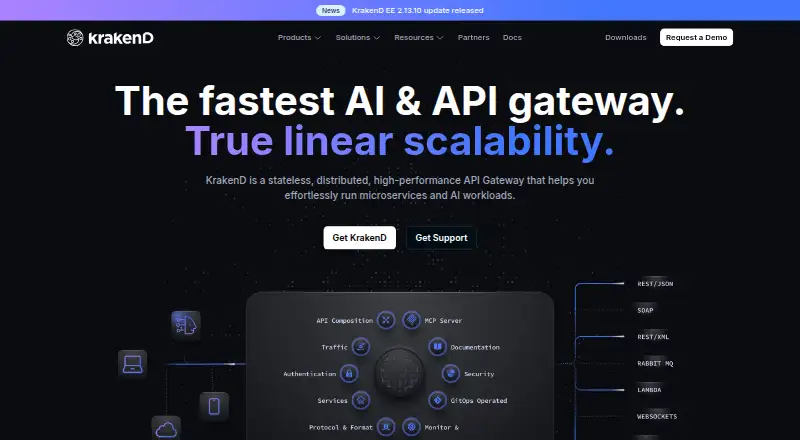
What KrakenD API Gateway is
KrakenD API Gateway is a stateless, distributed gateway for connecting, protecting, combining and transforming APIs and AI workloads. Its composition functions gather information from several APIs or services and return one response shaped for the client. Traffic controls include rate limiting, circuit breaking, IP filtering, bot detection and load balancing. The gateway connects with REST, HTTP, WebSockets, RabbitMQ, SNS, SQS, Kafka, NATS, GraphQL, gRPC, SOAP and Lambda services. Authentication methods include JWT, OAuth2, OpenID Connect, client credentials, API keys, Basic Authentication and mutual TLS. KrakenD describes a zero-trust security approach with token validation and safeguards against common web attacks. It is self-hosted, with Docker, Kubernetes, cloud marketplace virtual machines, Linux packages and generic Linux binaries available. The development Docker image can run on Windows, Mac or Linux, while native operation is stated for Linux and Mac OS. Community Edition is free to use at no cost, with unlimited requests, APIs and AI workloads. Enterprise Edition adds commercial support and service-level agreements. AI Gateway and AI security are Enterprise features.
Good
- Free Community Edition has no license cost
- Unlimited requests, APIs and AI workloads
- Combines multiple APIs into one client response
- Supports broad protocols and authentication methods
- Docker and Kubernetes deployment options
- Includes rate limiting and circuit breaking
Watch out
- Community lacks Enterprise AI Gateway and AI security
- Direct vendor support and SLAs are Enterprise offerings
- Self-hosted deployment is required
- Enterprise pricing requires contacting sales
Who it suits
KrakenD suits teams that need a self-hosted gateway to combine services, manage traffic and secure API access. It is also relevant to organizations connecting varied protocols or AI workloads across Linux, Mac, Windows development environments and hybrid deployments.
Verdict
Pick KrakenD if you need a self-hosted gateway with broad connectivity, traffic controls and unlimited Community usage. Its free edition covers core gateway workloads, while organizations needing Enterprise AI capabilities, direct support or SLAs should review the Enterprise option.
Plans and prices
From KrakenD API Gateway's own pricing page, checked 30 Sep 2026.
| Plan | Price | What it gives you |
|---|---|---|
| Community Edition | Free | Unlimited requests · unlimited APIs and AI workloads · self-hosted · Free to use; no license cost |
| Enterprise Edition | Priced on request | Unlimited requests · unlimited APIs and AI workloads · commercial support and SLAs · Contact sales |
The facts
Each one read from KrakenD API Gateway's own pages, with the date it was checked.
What it does
- API composition
- It can combine data from multiple APIs or services into a single response tailored to client needs.checked 30 Sep 2026
- Authentication
- Listed authentication options include JWT, OAuth2, OpenID Connect, client credentials, and mTLS.checked 30 Sep 2026
- Compliance
- KrakenD states that the company is SOC 2 Type II certified; Enterprise also advertises FIPS compliance.checked 30 Sep 2026
- Connectivity
- The gateway connects to REST, RabbitMQ, SNS, SQS, Kafka, GraphQL, gRPC, SOAP, and Lambda services.checked 30 Sep 2026
- Deployment
- KrakenD is self-hosted and available through Docker and Kubernetes, cloud marketplace virtual machines, Linux packages, and Linux generic binaries.checked 30 Sep 2026
- Enterprise AI features
- The feature comparison lists AI Gateway and AI security capabilities as Enterprise features not included in Community.checked 30 Sep 2026
- Limits
- The maker says plans have unlimited requests, APIs, and AI workloads, while Community feature availability differs from Enterprise in areas including SSO/SAML, audit logging, and direct SLA support.checked 30 Sep 2026
- Purpose
- KrakenD is a stateless, distributed API gateway for connecting, securing, aggregating, and transforming APIs and AI workloads.checked 30 Sep 2026
- Security
- KrakenD describes a zero-trust design with token validation, API key authentication, IP filtering, rate limiting, and protections against common web attack vectors.checked 30 Sep 2026
- Support
- Community support resources include Google Groups, GitHub issue reporting, and Gophers Slack; Enterprise offers direct vendor support and SLAs.checked 30 Sep 2026
- Traffic management
- Traffic controls include rate limiting, circuit breaking, IP filtering, bot detection, and load balancing.checked 30 Sep 2026
The company
- Founded
- 2016checked 28 Sep 2026
- Headquarters
- Barcelona, Spainchecked 28 Sep 2026
Where it runs
- Platform support
- The maker says the development Docker image can be used on Windows, Mac, or Linux, and that KrakenD runs natively on Linux and Mac OS.checked 30 Sep 2026
The full review of KrakenD API Gateway
KrakenD API Gateway is a self-hosted, stateless gateway for joining, protecting, and reshaping API and AI traffic. It is best suited to teams integrating many protocols and services while keeping deployment under their control. Community Edition removes request, API, and AI-workload quotas, but enterprise-only controls and vendor support can change the calculation for larger organizations.
Overview
KrakenD runs as a distributed gateway and can aggregate responses from multiple APIs or services into one client-oriented result. That composition is valuable when an application would otherwise make several upstream calls and reconcile them itself. Teams with only a small number of straightforward endpoints may find the extra gateway layer unnecessary.
Traffic management is broad: rate limiting, circuit breaking, IP filtering, bot detection, and load balancing are all included capabilities. These controls provide a central way to contain abusive or failing traffic. Request transformation further helps adapt upstream data to the shape consumers require.
Connectivity is a major strength. KrakenD works with REST, HTTP, WebSockets, SOAP, gRPC, GraphQL, AMQP, Kafka, NATS, RabbitMQ, SNS, SQS, and Lambda services. That range makes it a practical integration point for mixed legacy, event-driven, cloud, and modern API estates.
Key features
Authentication and security
Supported authentication methods include JWT, OAuth2, OpenID Connect, client credentials, API keys, Basic Authentication, and mutual TLS. KrakenD describes a zero-trust approach that combines token validation, API-key authentication, IP filtering, rate limiting, and defenses against common web attack vectors. The breadth suits environments with different identity requirements, although selecting and operating the right policy remains the customer's responsibility.
Deployment and operations
The gateway is self-hosted and can be deployed with Docker or Kubernetes, through cloud-marketplace virtual machines, Linux packages, or Linux generic binaries. The development Docker image can be used on Windows, Mac, or Linux, while native operation is available on Linux and Mac OS. This hybrid deployment model favors teams that need infrastructure control rather than a fully managed gateway.
Community support is provided through Google Groups, GitHub issue reporting, and Gophers Slack. Enterprise adds direct vendor support and service-level agreements. KrakenD's company states it is SOC 2 Type II certified; FIPS compliance is advertised for Enterprise.
Pricing
Community Edition
free, billed Free to use. There is no license cost, and the plan includes unlimited requests, unlimited APIs and AI workloads, and self-hosted deployment. It is the clear fit for individuals and teams that can operate the gateway themselves and do not require enterprise-only features or a contractual support channel.
Enterprise Edition
Custom pricing, billed by contacting sales. It keeps unlimited requests, APIs, and AI workloads while adding commercial support and SLAs. Enterprise is the appropriate route for organizations that need direct vendor accountability. The feature comparison also places AI Gateway and AI security capabilities, SSO/SAML, and audit logging in the Enterprise column rather than Community, so the free edition is not a complete substitute for those controls.
Platforms
KrakenD supports Linux, macOS, Windows, and self-hosted environments. Docker and Kubernetes options broaden infrastructure choices, while Linux packages and generic binaries suit conventional server deployments. Windows support is centered on the development Docker image rather than native runtime operation.
Who it's for
Choose KrakenD for a self-managed platform that must unify services across REST, messaging, RPC, GraphQL, SOAP, and serverless backends. It is particularly compelling when response composition, gateway-level traffic controls, and unlimited Community usage matter more than a managed service experience. Look elsewhere if you need a hosted gateway, guaranteed vendor SLAs without a sales process, or Enterprise AI and governance features at no cost.
Pros and cons
- Pro: Community Edition has unlimited requests, APIs, and AI workloads, avoiding usage ceilings for self-hosted deployments.
- Pro: Extensive protocol and service connectivity reduces the need for separate adapters across heterogeneous systems.
- Pro: Composition, transformation, authentication, and traffic controls cover common integration and protection tasks in one gateway.
- Con: AI Gateway, AI security, SSO/SAML, audit logging, direct support, and SLAs require Enterprise, whose price is custom.
- Con: Self-hosting leaves infrastructure operation and stability work with the customer; Community support is community-led.
Alternatives
Gravitee API Gateway is a freemium, self-hosted option with a free Apache 2.0 Community Edition and a published Planet plan at $2,500 per month for teams wanting that commercial tier.
Amazon API Gateway fits teams already building on AWS that prefer a paid cloud service with a free usage tier rather than operating gateway infrastructure.
Kong Gateway is worth considering when a 30-day no-card trial, no gateway limits during the trial, and analytics retention are priorities.
Google Cloud Endpoints suits Google Cloud-oriented deployments that can use its free tier of 1,999,999 API calls and metered standard usage.
Tyk Gateway offers an open-source free gateway alongside usage-based commercial plans for teams comparing another freemium model.
Higress is a free, self-hosted community edition where the user handles stability and performance.
Tencent Cloud API Gateway is a paid cloud alternative with the first one million monthly calls free during the first year on its shared instance.
Emissary-ingress is a free, open-source Kubernetes API gateway for Kubernetes-focused installations.
Verdict
KrakenD is a strong choice for teams that need a self-hosted gateway to compose and protect traffic across many protocols, with no Community usage quotas. Its main reason to choose Enterprise is the combination of AI and governance features with direct support and SLAs; if those are mandatory, or if you want a managed gateway instead of operating your own, another product may be the better fit.
Getting started
- Open the KrakenD website
- Choose Community Edition for free use or contact sales for Enterprise
- Select a deployment route such as Docker, Kubernetes, a cloud marketplace virtual machine or Linux package
- Deploy the gateway in a self-hosted environment
- Configure connected services, authentication and traffic controls
Limits worth knowing
Community Edition includes unlimited requests, APIs and AI workloads, but Enterprise-only areas include AI Gateway, AI security, SSO/SAML, audit logging and direct SLA support.
Questions
Is KrakenD free?
Community Edition costs nothing and has no license cost. Enterprise Edition has pricing available through sales.
Which platforms does KrakenD support?
KrakenD is self-hosted, runs natively on Linux and Mac OS, and its development Docker image can be used on Windows, Mac or Linux.
What protocols can it connect to?
Listed connections include REST, RabbitMQ, SNS, SQS, Kafka, GraphQL, gRPC, SOAP and Lambda. Supported protocols also include HTTP, WebSockets, AMQP and NATS.
What authentication methods are available?
Options include JWT, client credentials, OAuth2, OpenID Connect, API keys, Basic Authentication and mTLS.
Does KrakenD offer support?
Community resources include Google Groups, GitHub issue reporting and Gophers Slack. Enterprise provides direct vendor support and SLAs.
Alternatives to KrakenD API Gateway
- 1

Amazon API Gateway
Free planAndroidiOSWebAPI8.2From $1 a month - 2

Higress
Free planOpen sourceWebAPILinuxmacOS7.7Free plan - 3
Tyk Gateway
Free planOpen sourceWebAPILinuxSelf-hosted7.3Free plan - 4
Google Cloud Endpoints
Free planWebAPILinuxmacOS7.1$1.50 usage-based - 5

Gravitee API Gateway
Free planWebAPILinuxSelf-hosted7.1From $2,500 a month - 6

Kong Gateway
Free planWebAPILinuxSelf-hosted6.7Free plan