Google Cloud Endpoints
Google Cloud Endpoints is an API management system for securing, monitoring, analyzing, and setting quotas on APIs.
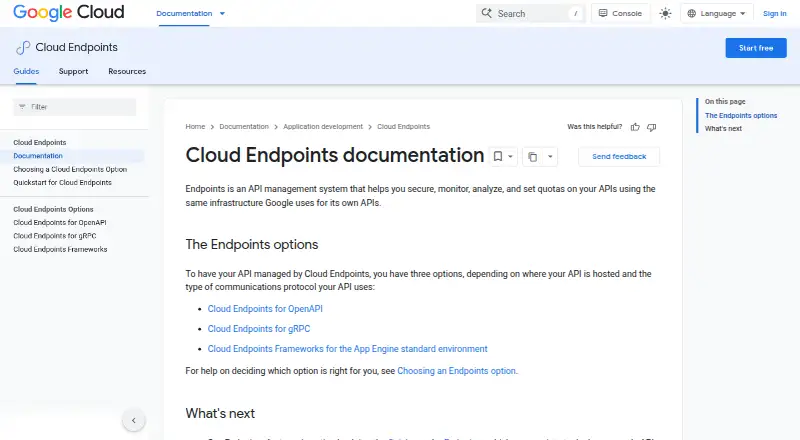
What Google Cloud Endpoints is
Google Cloud Endpoints is an API management system for securing, monitoring, analyzing, and setting quotas on APIs. It accepts API descriptions in OpenAPI 2.0 and 3.x formats, as well as gRPC, and manages them through the Extensible Service Proxy (ESP) or ESPv2. Documented deployment targets include Google Kubernetes Engine, Compute Engine, Kubernetes, App Engine, Cloud Run, Cloud Run functions, and Knative serving; proxy availability differs by backend. It is optimized for Docker and can host an API wherever Docker runs with internet access to Google Cloud.
Endpoints can require and validate API keys, which identify the Google Cloud project used for quota, billing, and monitoring. User authentication options include Firebase Authentication and Auth0, with JWT validation by ESP. Service Infrastructure manages APIs and reports logs and metrics in the Google Cloud console. Quotas can limit request rates, though that feature is Beta and may have limited support; requests need an API key for caller identification. Pricing depends on API calls to Service Control, with a free plan and listed usage tiers. Deployment is hybrid, with lifecycle management, access policies, and API analytics.
Good
- Supports OpenAPI 2.0, OpenAPI 3.x, and gRPC APIs.
- Offers ESP and ESPv2 proxy management.
- Can target several Google Cloud and Kubernetes backends.
- Provides logs and metrics in the Google Cloud console.
- Includes lifecycle management, access policies, and API analytics.
Watch out
- Quota functionality is Beta and may have limited support.
- API requests need keys for quota caller identification.
- Higher call volumes fall under paid usage tiers.
Who it suits
Endpoints suits teams that need API security, usage monitoring, and management across supported backends. It is especially relevant when API keys, project-based quota identification, or Firebase Authentication and Auth0 JWT validation fit the deployment.
Verdict
Choose Google Cloud Endpoints when API management across Docker-capable hosting or its documented backends, with project-identified keys and monitoring, matches your setup. Look elsewhere if you need quotas without the stated Beta limitation or do not want call-based pricing.
Plans and prices
From Google Cloud Endpoints's own pricing page, checked 21 Sep 2026.
| Plan | Price | What it gives you |
|---|---|---|
| Free usage tier | Free | 1,999,999 API calls · Price per million API calls (USD) |
| Standard usage tier | $3 a month | 2,000,000 to 1,000,000,000 API calls · Price per million API calls (USD) |
| High-volume usage tier | $1.50 a month | 1,000,000,000 API calls and above · Price per million API calls (USD) |
| Usage-based | Free | 1,000,000,000 API calls and above: $1.50 per million |
The facts
Each one read from Google Cloud Endpoints's own pages, with the date it was checked.
What it does
- API access
- Endpoints can require and validate API keys, and API keys identify a Google Cloud project for quota, billing, and monitoring.checked 9 Oct 2026
- API formats
- Endpoints supports APIs described with OpenAPI 2.0 and OpenAPI 3.x, as well as a gRPC option.checked 9 Oct 2026
- Authentication
- Documented user authentication options include Firebase Authentication and Auth0, which use JWT validation by ESP.checked 9 Oct 2026
- Deployment options
- Documented backends include Google Kubernetes Engine, Compute Engine, Kubernetes, App Engine, Cloud Run, Cloud Run functions, and Knative serving, with proxy availability varying by backend.checked 9 Oct 2026
- Hosting
- Endpoints is optimized for Docker and can host an API anywhere Docker is supported if it has internet access to Google Cloud.checked 9 Oct 2026
- Logs and metrics
- Endpoints uses Service Infrastructure to manage APIs and report logs and metrics viewable in the Google Cloud console.checked 9 Oct 2026
- Pricing basis
- Endpoints pricing depends on the number of API calls, and Endpoints charges by calls to Service Control.checked 9 Oct 2026
- Proxy
- Endpoints provides API management through the Extensible Service Proxy (ESP) or ESPv2.checked 9 Oct 2026
- Purpose
- Cloud Endpoints is an API management system for securing, monitoring, analyzing, and setting quotas on APIs.checked 9 Oct 2026
- Quota identification
- To use features such as quotas, each request must pass an API key so Endpoints can identify the caller's Google Cloud project.checked 9 Oct 2026
- Quotas
- Quotas control the rate of application calls and help protect APIs from excessive requests, but the documented quota feature is Beta and may have limited support.checked 9 Oct 2026
The company
- Maker founding
- Google Inc. was officially born in August 1998.checked 9 Oct 2026
- Maker headquarters
- Google's company story identifies its current headquarters, the Googleplex, as being in Mountain View, California.checked 9 Oct 2026
The full review of Google Cloud Endpoints
Google Cloud Endpoints is a managed layer for securing, observing, and governing APIs. It fits teams that want Google Cloud operational visibility while retaining Docker-based deployment flexibility. Its strongest case is a hybrid API estate using documented Google backends; the main trade-offs are call-based billing and quota controls still marked Beta.
Overview
Endpoints manages API access and lifecycle through Google Cloud Service Infrastructure. Logs and metrics appear in the Google Cloud console, giving teams a central place to follow API behavior and usage. API definitions can use OpenAPI 2.0, OpenAPI 3.x, or gRPC, so it accommodates both established REST contracts and gRPC services.
The Extensible Service Proxy (ESP) and ESPv2 provide the management layer. Documented deployment targets include Google Kubernetes Engine, Compute Engine, Kubernetes, App Engine, Cloud Run, Cloud Run functions, and Knative serving, although proxy support differs by backend. Because the service is optimized for Docker, an API can also run wherever Docker is supported, provided it can reach Google Cloud over the internet. That makes the hybrid model useful for organizations avoiding a single hosting runtime, but deployment planning must account for backend-specific proxy availability.
Key features
- Project-aware API keys: Endpoints can require and validate keys, with each key identifying a Google Cloud project for quota accounting, billing, and monitoring. This ties caller attribution to project identity and is important when usage must be separated by application or customer.
- JWT-based user authentication: Firebase Authentication and Auth0 are documented choices, with ESP validating their JWTs. Teams already using either identity service can keep authentication in that ecosystem while placing API policy at the proxy.
- Logs, metrics, and analytics: Service Infrastructure reports logs and metrics to the Google Cloud console, supporting operational monitoring and API analytics without adding a separate reporting layer.
- Quota controls: Quotas regulate application-call rates and help shield an API from excessive requests. The documented quota capability is Beta and may have limited support, so it is better treated as a useful control with qualification than as the sole protection for a critical service.
- Lifecycle and access policy: Lifecycle management and access policies are part of the platform, giving teams governance tools alongside the proxy, authentication, and observability functions.
Pricing
Billing is based on API calls to Service Control. The free allowance covers the first 1,999,999 calls, which suits prototypes, internal services, and low-volume APIs. After that, the standard tier is $3.00 per month per million calls for 2,000,000 through 1,000,000,000 calls. At 1,000,000,000 calls and above, the high-volume tier drops to $1.50 per million, making the model more attractive for very busy APIs than a flat per-seat charge.
| Plan | Price | Allowance or range |
|---|---|---|
| Free usage tier | free | 1,999,999 API calls |
| Standard usage tier | $3 a month | 2,000,000 to 1,000,000,000 API calls |
| High-volume usage tier | $1.50 a month | 1,000,000,000 API calls and above |
| Usage-based | free | From 1,000,000,000 calls: $1.50 per million |
The cheaper tiers provide the same core management approach but are limited by call volume rather than seats. Organizations should forecast Service Control calls carefully, particularly where quota enforcement requires API keys on every request.
Platforms
Endpoints supports api, Linux, macOS, self-hosted, and web environments. Its Docker orientation and hybrid deployment model favor teams operating across cloud and self-managed infrastructure rather than buyers seeking a single turnkey gateway appliance.
Who it's for
Choose it for API teams already invested in Google Cloud Service Infrastructure, Firebase Authentication, Auth0, or Google Cloud monitoring, especially when services span Kubernetes, serverless runtimes, and Docker hosts. It is less suitable when quota functionality must be fully mature or when a deployment cannot consistently provide Google Cloud internet access.
Pros and cons
Pros
- Supports OpenAPI 2.0, OpenAPI 3.x, and gRPC, covering varied API contracts.
- Works across numerous Google Cloud backends and Docker-capable hosts.
- Combines API keys, JWT validation, logs, metrics, lifecycle management, and access policies.
- Offers a large free call allowance and a lower per-million rate at very high volume.
Cons
- Quota support is Beta and may have limited support.
- Quota, billing, and monitoring attribution depends on API keys identifying a Google Cloud project.
- Proxy availability varies across documented backends, complicating otherwise flexible deployments.
- Call-based charges require ongoing volume tracking rather than a simple fixed subscription.
Alternatives
Browse the API Management Software list for broader management platforms, or compare the API Gateway Software category when gateway routing is the priority.
- Gravitee API Gateway suits buyers wanting a free Apache 2.0 community edition with self-hosted and Windows coverage, plus a $2,500-per-month Planet plan.
- Kong Gateway is a better fit when a 30-day, no-credit-card trial with no gateway limits and 30 days of analytics retention is the deciding factor.
- Algolia is for search and recommendations rather than general API management, with a free tier capped at 10K search requests per month and 50K records.
- Amazon API Gateway is the alternative for teams standardizing on Amazon Web Services.
- Jitterbit App Builder suits application-building requirements with published Standard and Professional packages rather than a gateway-first deployment.
- Apiman is a fully free, Apache-2.0 self-hosted community option with no features hidden behind paywalls.
- DreamFactory is aimed at connector-led API generation, including an open-source PostgreSQL connector option.
- Fusio is a free, Apache 2.0 open-source API management platform for self-hosted deployments.
Verdict
Google Cloud Endpoints is a strong choice for teams managing APIs across Google Cloud and Docker-capable infrastructure that value project-level attribution, Google Cloud monitoring, and support for both REST descriptions and gRPC. Its free allowance and high-volume rate can be compelling, but buyers who need dependable non-Beta quotas or dislike usage-metered billing should choose another gateway.
Getting started
- Visit https://cloud.google.com/endpoints.
- Choose a documented deployment backend and account for proxy availability on that backend.
- Describe the API with OpenAPI 2.0, OpenAPI 3.x, or gRPC.
- Configure ESP or ESPv2 for API management.
- Set API key validation when project-based quota, billing, and monitoring identification is needed.
- Choose a usage tier based on API-call volume.
Limits worth knowing
The free usage tier covers 1,999,999 API calls. The Standard usage tier is $3 a month for 2,000,000 to 1,000,000,000 API calls, while the High-volume usage tier is $1.50 a month for 1,000,000,000 API calls and above; prices are presented per million API calls. Quotas are Beta and may have limited support.
Questions
Is Google Cloud Endpoints free?
It has a free usage tier at no cost for 1,999,999 API calls. Paid tiers are listed at $3 a month and $1.50 a month for higher call-volume ranges.
How is pricing calculated?
Pricing depends on API calls to Service Control. Listed prices are per million API calls, with tiers defining call-volume ranges.
Which API formats does it support?
It supports APIs described with OpenAPI 2.0, OpenAPI 3.x, and a gRPC option.
Where can APIs be deployed?
Documented backends include Google Kubernetes Engine, Compute Engine, Kubernetes, App Engine, Cloud Run, Cloud Run functions, and Knative serving. Proxy availability varies by backend.
What authentication options are documented?
Firebase Authentication and Auth0 are documented user authentication options; ESP validates their JWTs.
Who makes Google Cloud Endpoints?
It is a Google product. Google's company story identifies its headquarters, the Googleplex, as being in Mountain View, California.
Alternatives to Google Cloud Endpoints
- 1

Algolia
Free planAndroidiOSWebAPI8.2From $0.50 a month - 2

Amazon API Gateway
Free planAndroidiOSWebAPI8.2From $1 a month - 3

Boomi
WebAPILinuxSelf-hosted7.6$99 usage-based - 4

DigitalAPI
WebAPISelf-hosted7.1From $2,500 a month - 5

SnapLogic
WebAPILinuxmacOS7.1 - 6
Square Online
Free planWeb7.1From $49 a month