Konsolidat
Konsolidat is an MIT-licensed, open-source enterprise performance management product for finance teams working with SAP or Microsoft Dynamics.
What Konsolidat is
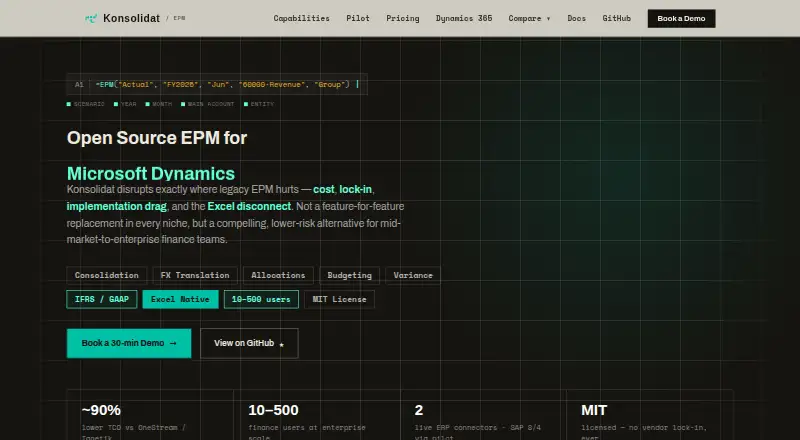
Konsolidat is an MIT-licensed, open-source enterprise performance management product for finance teams working with SAP or Microsoft Dynamics. It uses an Excel-native interface: worksheet formulas retrieve results from the backend into existing workbooks. Its consolidation supports multiple entities and currencies, elimination logic, non-controlling-interest attribution, and ownership-tree grouping. The allocation engine handles driver-based, cascading, and reciprocal allocations, with iterative solving and traceability to source pools. The product describes driver-based budgets, scenarios, and variance analysis; rolling forecasts are also listed as a roadmap item. Dynamics 365 F&O and ERPNext connectors are available today, while SAP S/4HANA is offered through a paid pilot. SAP ECC, Business Central, and SAP Business One are roadmap items. Teams can self-host on their own cloud or on-premises infrastructure, or use a managed hosted plan. Self-hosting costs nothing, but entails operating the software and cloud infrastructure. Automated cash-flow statements and multi-GAAP parallel reporting are roadmap items.
Good
- Self-hosted plan costs nothing.
- Consolidates multiple entities and currencies.
- Excel formulas bring backend results into workbooks.
- Includes role-based access control and audit logging.
- Available Dynamics 365 F&O and ERPNext connectors.
Watch out
- Self-hosting requires operations effort and cloud infrastructure.
- SAP S/4HANA is available through a paid pilot.
- Cash-flow statements and multi-GAAP reporting are roadmap items.
Who it suits
Konsolidat is aimed at finance teams using SAP or Microsoft Dynamics that need entity consolidation and allocations. Self-hosting may suit teams wanting infrastructure control; hosted service is an alternative for managed operations.
Verdict
Konsolidat offers an Excel-centered approach to consolidation and allocation, with both self-hosted and managed deployment options. Verify connector availability and roadmap gaps against the finance team's requirements.
Plans and prices
From Konsolidat's own pricing page, checked 15 Oct 2026.
| Plan | Price | What it gives you |
|---|---|---|
| Self-hosted | Free | MIT software; self-operated; ~0.3–1 FTE plus cloud infrastructure; community support · $0 |
| Hosted | $3,500 a month | Managed platform; $500–$1,500/month per ERP connector; $300–$800/month per legal entity · From $3,500/month |
| 4-Week Pilot | $25,000, paid once | 4 weeks; hosted tenant; one consolidation scenario; excludes unlimited entities, full statutory pack and multi-year support · From $25K one-time |
The facts
Each one read from Konsolidat's own pages, with the date it was checked.
What it does
- Allocations
- Allocation models support driver-based, cascading and reciprocal pools with iterative solving and traceability to source pools.checked 15 Oct 2026
- API
- The documentation describes REST endpoints exposed through Frappe whitelisted methods and registry-validated fact tables and measures.checked 15 Oct 2026
- Architecture in README
- The documented data flow is ERP to Airbyte to ClickHouse to dbt to Cube.js to Frappe API and authentication to Excel.checked 15 Oct 2026
- Automated testing
- The project README describes 44 dbt models and 26 automated tests.checked 15 Oct 2026
- Backend stack
- The architecture combines Airbyte, dbt, ClickHouse and Frappe before serving results to Excel.checked 15 Oct 2026
- Budgeting
- Budgeting includes driver-based models, seasonal spread profiles, rolling forecasts and scenario management.checked 15 Oct 2026
- Consolidation
- Its consolidation engine supports multiple entities, currencies, ownership trees, intercompany eliminations and non-controlling interest.checked 15 Oct 2026
- Data control
- The maker says customers can run the application on their own infrastructure, including cloud or on-premises, to keep financial data under their control.checked 29 Sep 2026
- Data stack
- The product describes an Airbyte, dbt, and ClickHouse pipeline that pulls ERP data and runs the consolidation model.checked 29 Sep 2026
- Deployment method
- A Docker-based deployment is documented, with services including Frappe, Cube.js, ClickHouse and Caddy.checked 15 Oct 2026
- Deployment requirements
- The deployment guide specifies a fresh Ubuntu 22.04 host with at least 4 vCPUs, 8 GB RAM and 80 GB SSD.checked 15 Oct 2026
- Documentation depth
- Documentation includes a roughly 15-minute quickstart, setup and architecture guides, user guides, REST API reference, data dictionary, dbt extension guidance and troubleshooting help.checked 15 Oct 2026
- ERP connectors
- Dynamics 365 Finance and Operations and ERPNext connectors are available, while SAP S/4HANA is handled through a paid pilot.checked 15 Oct 2026
- ERP integrations
- Dynamics 365 F&O and ERPNext connectors are available today; SAP S/4HANA is offered through a paid pilot, while SAP ECC, Business Central, and SAP Business One are on the roadmap.checked 29 Sep 2026
- ERP roadmap
- SAP ECC, Dynamics 365 Business Central and SAP Business One are listed as roadmap items rather than self-service connectors.checked 15 Oct 2026
- Excel interface
- The product delivers live figures into Excel through =EPM() formulas.checked 15 Oct 2026
- Extensibility
- Developers can add dbt gold models, seeds and tests, then register fact tables so the models become queryable through the API and Excel.checked 15 Oct 2026
- Financial reporting
- Report templates cover profit and loss, balance sheet and cash flow statements, with custom definitions queried through Excel.checked 15 Oct 2026
- FX and CTA
- The system translates functional currencies and calculates cumulative translation adjustments.checked 15 Oct 2026
- Identity integrations
- Single sign-on is supported through OIDC or SAML including Microsoft Entra ID, with LDAP and Active Directory options.checked 15 Oct 2026
- Known roadmap gaps
- Automated cash-flow statements and multi-GAAP parallel reporting are listed as roadmap items; rolling forecasts are also listed as a roadmap item.checked 29 Sep 2026
- Licence
- The repository contains an MIT licence permitting use, modification, redistribution and sublicensing, subject to its notice and warranty terms.checked 15 Oct 2026
The company
- Founded
- Grynn's site displays an establishment year of 2016.checked 15 Oct 2026
- Headquarters
- Grynn lists Zürich, Switzerland as its location and gives Neuweg 24, 8222 Beringen, Switzerland as its legal address.checked 15 Oct 2026
The full review of Konsolidat
Overview
Konsolidat is an open-source EPM system for finance teams working with SAP or Microsoft Dynamics. It is best suited to teams that want consolidation and allocation results inside existing Excel workbooks and can either operate the software themselves or fund a managed service. Its breadth is promising, but connector coverage and several reporting capabilities are still works in progress.
Key features
Consolidation and allocations
Konsolidat handles multi-entity, multi-currency consolidation, with intercompany eliminations, non-controlling-interest attribution and ownership-tree-based grouping. Full-method consolidation and audit trails make it relevant to statutory close and group reporting workflows.
Its allocation engine supports driver-based, cascading and reciprocal allocations, including iterative solving. Traceability back to source pools is useful when finance teams need to explain how an allocation was produced rather than accept a result as a black box.
Planning and data flow
Driver-based budgets, scenario management and variance analysis are among its planning and analysis capabilities. Rolling forecasts are also described, but remain a roadmap item, so teams that need this as a dependable current workflow should confirm it before choosing Konsolidat.
The data pipeline combines Airbyte, dbt and ClickHouse to bring in ERP data and run the consolidation model. The product describes 44 dbt models, 26 automated data-quality assertions and transformation lineage, giving finance and data teams ways to check and trace figures. Excel's =EPM() worksheet formulas retrieve backend results into existing workbooks, a practical fit for teams that want to retain spreadsheet-based reporting.
Connectors and controls
Dynamics 365 F&O and ERPNext connectors are available today. SAP S/4HANA is offered through a paid pilot; SAP ECC, Business Central and SAP Business One remain on the roadmap. That makes current connector fit a key selection test, especially for organizations with a broader or different ERP estate.
Controls include 2FA, role-based access, session management, audit logging, OIDC/SAML single sign-on including Microsoft Entra ID, and LDAP/Active Directory. Customers can run the application on their own cloud or on-premises infrastructure to keep financial data under their control.
Pricing
Self-hosted
The self-hosted plan is free (free) and MIT open source, with no per-user fees. It includes Dynamics 365 F&O and ERPNext connectors, while SAP S/4HANA is available through a pilot. Community support and a public roadmap suit technically capable teams that value control over the environment and licensing costs. The trade-off is operational responsibility: the plan calls for about 0.3–1 FTE of operations capacity, plus cloud infrastructure.
Hosted
The fully managed plan starts at $3,500 USD per month. It includes managed infrastructure, upgrades and monitoring, an enterprise SLA, and priority support from the core team. ERP connectors add $500–$1,500 per month each, and each additional legal entity adds $300–$800 per month. This is the more suitable route for teams that want service support and less infrastructure work, but connector and entity charges can materially increase the starting price.
4-Week Pilot
The fixed-scope pilot costs $25K USD one-time for four weeks. It includes a hosted pilot tenant, loading of the general ledger and entities, Excel =EPM(), and one consolidation scenario. Unlimited entities, a full statutory pack and multi-year support are out of scope, so this is a bounded evaluation rather than a substitute for a full deployment.
Platforms
Konsolidat supports API, self-hosted and web deployments. The self-hosted option accommodates customer cloud or on-premises infrastructure; the hosted plan is fully managed. Excel integration is through worksheet formulas that pull results from the backend.
Who it's for
Konsolidat is a strong candidate for finance teams using Dynamics 365 F&O or ERPNext that want multi-entity consolidation, traceable allocations and Excel-centered reporting. Self-hosting makes it more attractive to organizations that prioritize infrastructure and data control and have capacity to run the system. Teams without that capacity can consider hosted deployment, provided the monthly base price and per-connector and per-entity charges fit their budget.
It is a weaker fit for teams that require an unlisted ERP connector today, fully mature rolling forecasts, automated cash-flow statements or multi-GAAP parallel reporting: the latter capabilities are roadmap items, while SAP S/4HANA is pilot-based rather than a generally available connector.
Pros and cons
- Pros: Full-method, multi-currency consolidation with eliminations, non-controlling-interest attribution and audit trails supports demanding group reporting needs.
- Pros: Driver-based, cascading and reciprocal allocations with iterative solving and source-pool traceability help teams inspect complex allocation results.
- Pros: Free MIT-licensed self-hosting and Excel worksheet formulas offer a low-license-cost route for teams prepared to operate the platform.
- Cons: Self-hosting requires about 0.3–1 FTE of operations effort and separate infrastructure, which can outweigh the zero license price for lean teams.
- Cons: Hosted costs start at $3,500 USD per month, with additional monthly charges for connectors and legal entities.
- Cons: Connector availability is uneven, and rolling forecasts, automated cash-flow statements and multi-GAAP reporting are roadmap items.
Alternatives
For a broader comparison set, see Financial Consolidation Software.
- AARO CPM is worth considering if a paid product with macOS, Windows, web and self-hosted platform support better matches the organization's deployment needs; its Base Package is priced on request and offers a demo.
- EMAsphere is another freemium web option with a free plan for readers who want to compare a browser-based alternative.
- IDL Konsis may suit buyers seeking a paid web and Windows option; pricing is by request and a demo is offered.
- OneStream is a paid platform spanning mobile, web, Windows, API and self-hosted access; prospective buyers can request a demo to discuss pricing.
- Arvexi is a paid API and web alternative.
- NDC Financial Consolidation offers a paid standalone product or SAP Analytics Cloud extension, with cloud or on-premises installation.
- Profitbase Consolidation is a paid web option with tailored pricing available by request and no free plan.
- Vena is a paid web and Windows alternative; its Professional and Complete plans are listed without prices.
Verdict
Choose Konsolidat if your finance team needs serious consolidation and allocation workflows, already uses a supported connector, and values Excel access alongside the option to control its own infrastructure. Its free self-hosted license is appealing only when your team can absorb the operating work; hosted service reduces that burden but starts at $3,500 USD per month before connector and entity charges. Look elsewhere if your ERP is not supported today or your close depends on roadmap capabilities such as rolling forecasts, automated cash-flow statements or multi-GAAP reporting.
Getting started
- Visit the Konsolidat website.
- Choose the free self-hosted plan or hosted service starting at $3,500 per month.
- For self-hosting, prepare customer cloud or on-premises infrastructure.
- Connect Dynamics 365 F&O or ERPNext; SAP S/4HANA is available through a paid pilot.
- Use Excel =EPM() worksheet formulas to retrieve backend results.
Limits worth knowing
The free self-hosted plan is self-operated and calls for about 0.3–1 FTE of operations plus cloud infrastructure. The hosted plan starts at $3,500 per month, with additional monthly charges for ERP connectors and legal entities. The $25,000 one-time four-week pilot excludes unlimited entities, a full statutory pack, and multi-year support.
Questions
Is Konsolidat free?
Its self-hosted plan is free and has no per-user fees.
Which ERP connectors are available?
Dynamics 365 F&O and ERPNext connectors are available today. SAP S/4HANA is offered through a paid pilot.
Is Konsolidat open source?
Yes. It is MIT-licensed and open source.
Can Konsolidat be self-hosted?
Yes. Customers can run it on their own cloud or on-premises infrastructure.
What does the hosted plan cost?
ERP connectors cost an additional $500–$1,500 per month each, and legal entities cost an additional $300–$800 per month each.
What does the four-week pilot cost?
It has a fixed scope; unlimited entities, a full statutory pack, and multi-year support are out of scope.