
KitchenOwl
KitchenOwl is a free, open-source grocery list and recipe manager for households, with meal planning and expense tracking.
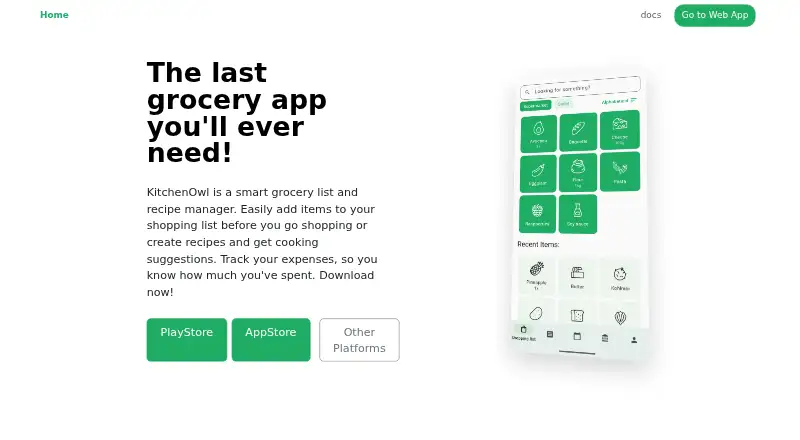
What KitchenOwl is
KitchenOwl is a free, open-source grocery list and recipe manager for households, with meal planning and expense tracking. Members can work together on shopping lists, recipes, meal plans, and shared expenses. Lists support descriptions, categories, sorting by store, and live syncing across users and devices. Users can create recipes or import them from popular websites, then add recipe ingredients to lists. Meal plans can draw on household preferences and pantry inventory, and connect with shopping lists. Expense tools let members split bills and review monthly reports and charts. The apps provide partial offline support for keeping track of grocery lists. KitchenOwl also lists a Home Assistant integration for automations and smart-home connectivity. It is available on Android, iOS, Linux, macOS, Windows, and the web, with self-hosting supported. The official server installation uses Docker or Docker Compose, and the documentation recommends HTTPS behind a reverse proxy. KitchenOwl is licensed under AGPL-3.0.
Good
- Lists sync in real time across users and devices.
- Recipes can be imported from popular websites.
- Supports shared expense tracking and monthly reports.
- Free Software under the AGPL-3.0 license.
Watch out
- Offline support is partial.
- Self-hosted installation uses Docker or Docker Compose.
- Cloud server owners can see uploaded content and account and device information.
Who it suits
KitchenOwl suits households that want shared grocery lists, recipes, meal planning, and expense tracking. It also fits users who want to self-host or connect it with Home Assistant.
Verdict
KitchenOwl brings household shopping, recipe, meal-planning, and expense tools into one free application. Choose between its default cloud syncing and self-hosting, keeping the documented cloud visibility and setup requirements in mind.
Plans and prices
From KitchenOwl's own pricing page, checked 30 Sep 2026.
| Plan | Price | What it gives you |
|---|---|---|
| KitchenOwl | Free | Free, open-source application; self-hosting supported |
The facts
Each one read from KitchenOwl's own pages, with the date it was checked.
What it does
- Cloud data
- The default cloud stores and syncs app content, encrypts data in transit, and server owners can see uploaded content and account and device information.checked 30 Sep 2026
- Expense tracking
- Household members can track expenses, split bills, and review monthly reports and charts.checked 30 Sep 2026
- Households
- Household members can collaborate on recipes, expenses, shopping lists, and meal plans.checked 30 Sep 2026
- Integration
- KitchenOwl lists Home Assistant integration for automations and smart home connectivity.checked 30 Sep 2026
- License
- KitchenOwl is Free Software available under the AGPL-3.0 license.checked 30 Sep 2026
- Offline use
- The apps provide partial offline support for keeping track of grocery lists without an internet connection.checked 30 Sep 2026
- Privacy
- The apps do not send data to services without authorization, and the policy says app data is not sent to tracking APIs.checked 30 Sep 2026
- Purpose
- KitchenOwl is a grocery list and recipe manager that also supports meal planning and household expense tracking.checked 30 Sep 2026
- Recipes
- Users can create recipes, scrape them from popular websites, organize them, and add their ingredients to shopping lists.checked 30 Sep 2026
- Self-hosting
- The official server installation uses Docker or Docker Compose, and the documentation recommends HTTPS behind a reverse proxy.checked 30 Sep 2026
- Shopping lists
- Shopping lists support item descriptions, categories, store-based sorting, sharing, and real-time syncing across users and devices.checked 30 Sep 2026
- Support
- The documentation directs users to GitHub issues for bug reports and feature requests and lists [email protected] for privacy questions.checked 30 Sep 2026
Money
- Meal planning
- Meal plans can use suggestions based on preferences and pantry inventory and sync with shopping lists.checked 30 Sep 2026
Where it runs
- Platforms
- The privacy policy names Android, iOS, Web, Windows, macOS, and Linux applications.checked 30 Sep 2026
The full review of KitchenOwl
Overview
KitchenOwl is a free, open-source household organizer for people who want grocery shopping, cooking plans, and shared spending in one place. It suits households coordinating those chores across devices, especially people comfortable choosing between a hosted account and running their own server. Its breadth is a strong point, but the cloud option requires accepting that server owners can see uploaded content and account and device information.
Key features
Shopping lists and recipes
Household members can share lists with item descriptions and categories, sort items by store, and see changes sync in real time across users and devices. That makes KitchenOwl useful for households dividing shopping rather than maintaining separate lists. Recipe creation and imports scraped from popular websites can feed ingredients into those lists, connecting meal ideas to the next shop.
Meal planning and expenses
Meal plans can draw on preferences and pantry inventory, then sync with shopping lists. This can reduce the work of translating a weekly plan into a grocery run, though the suggestions are not a substitute for deciding what the household wants to eat. Expense tracking adds bill splitting and monthly reports and charts, making the app broader than a dedicated list tool.
Offline, smart home, and privacy
The apps offer partial offline support for keeping track of grocery lists, a useful fallback when a connection drops but not a promise that every feature works offline. KitchenOwl also lists Home Assistant integration for automations and smart-home connectivity.
The apps do not send data to services without authorization, and the privacy policy says app data is not sent to tracking APIs. The default cloud stores and syncs app content and encrypts it in transit, but server owners can see uploaded content plus account and device information. Households that want control over hosting can self-host under the AGPL-3.0 Free Software license. The official server setup uses Docker or Docker Compose, and the documentation recommends HTTPS behind a reverse proxy; that is a meaningful technical commitment, not a one-click privacy setting.
Pricing
KitchenOwl is free: its KitchenOwl plan costs nothing and is an open-source application with self-hosting supported. Shared lists, real-time syncing, and recipe import are included. There is no paid tier to budget for, but the choice is between using the default cloud and taking on the server setup and maintenance associated with self-hosting. The free offering is a strong fit for households seeking these tools without subscription costs; those unwilling to accept cloud visibility or manage a server may prefer a different approach.
Platforms
KitchenOwl supports Android, iOS, Linux, macOS, Windows, and the web, as well as self-hosting. That range gives mixed-device households options beyond mobile apps. Offline support is partial and focused on keeping grocery lists accessible.
Who it's for
KitchenOwl is best for households that want shared shopping, recipe management, meal planning, and expense tracking together, particularly those who value open-source software or are prepared to self-host. It is less suitable for someone seeking only a simple list app, or for a household that wants cloud syncing but is uncomfortable with server owners being able to see uploaded content.
Pros and cons
- Pro: Shared lists, recipe imports, meal planning, and expense tools serve several household routines in one free application.
- Pro: Real-time syncing, store-based sorting, and list sharing support coordinated shopping across devices.
- Pro: AGPL-3.0 licensing and self-hosting give technically capable households an alternative to the default cloud.
- Con: Self-hosting calls for Docker or Docker Compose, with HTTPS behind a reverse proxy recommended, so privacy-minded users need server skills.
- Con: The cloud syncs content but its server owners can see uploaded content and account and device information.
- Con: Offline support is partial and limited to keeping track of grocery lists.
Alternatives
For a wider comparison, see Shopping List Apps. Choose Buy Me a Pie! if you want a free plan capped at three shopping lists, sharing with two other accounts, and eight color groups. OurGroceries is an option for free list sharing and all features with ads on a few screens, with a $1 a month ad-removal subscription. Pick AnyList if core list creation and sharing plus up to five imported web recipes meet your needs on its free plan. BuyBye offers a free plan capped at five shopping lists, two people per list, a five-recipe box, and current-week meal planning. Bring! keeps its core functions, including shared shopping lists, recipes, and special offers, free. GroceryShare has a free Simple plan covering grocery lists, smart categories, shopping mode, and basic recipes. Groly may suit users seeking a free self-hosted option with Docker and admin-invited users rather than open registration. Listonic is another shopping-list alternative.
Verdict
KitchenOwl is a compelling choice for households that want shopping, recipes, meal plans, and shared expenses without a subscription, and it stands out for offering self-hosting under an open-source license. Choose it if that combination matters more than a narrower list app. Look elsewhere if cloud server visibility is unacceptable and you cannot manage the recommended self-hosting setup, or if partial grocery-list offline access is not enough.
Getting started
- Visit kitchenowl.org.
- Choose the free app on Android, iOS, Linux, macOS, Windows, or the web.
- Create or join a household to collaborate on lists, recipes, plans, and expenses.
- For self-hosting, install the server with Docker or Docker Compose.
- For a self-hosted server, follow the recommendation to use HTTPS behind a reverse proxy.
Questions
Is KitchenOwl free?
Yes. KitchenOwl is free software available under the AGPL-3.0 license.
Which platforms does KitchenOwl support?
It is available on Android, iOS, Linux, macOS, Windows, and the web. Self-hosting is also supported.
Can household members share lists and recipes?
Yes. Household members can collaborate on shopping lists, recipes, meal plans, and expenses. Lists sync in real time across users and devices.
Can recipes be imported?
Yes. Users can create recipes or scrape them from popular websites, organize them, and add their ingredients to shopping lists.
Does KitchenOwl work offline?
The apps provide partial offline support for keeping track of grocery lists.
Does KitchenOwl have Home Assistant integration?
Yes. KitchenOwl lists Home Assistant integration for automations and smart-home connectivity.